Chapter 13 · 1920–1930
The Electric Loom
Freeing the Mill from the River
Electrification revolutionized mill architecture and geography. No longer tied to waterfalls or steam boilers, the industry could modernize—and, just as importantly, keep moving away from the unionized North.
Jump to classroom kit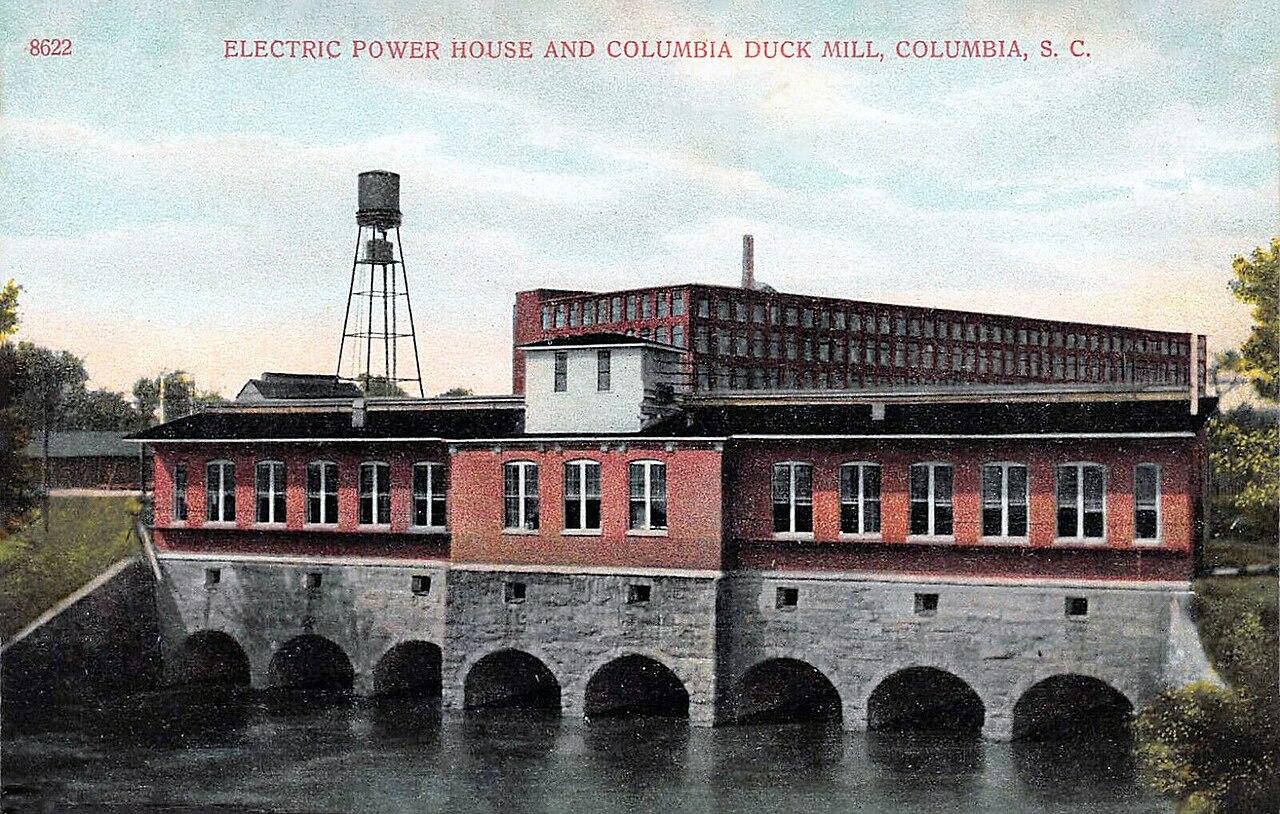
Electric motors mounted on individual machines eliminated the line shafting and belts that had driven mills for a century and often caused accidents and shutdowns. Buildings could be brighter and more flexible, machines could be added or rearranged without re-engineering a central drive, and a mill no longer needed to sit on a river. In North Carolina, Duke Power and the Duke family financed new mills to create customers for their electricity. The technological liberation became a labor strategy: capital flowed to Piedmont towns where land was cheap, taxes were low, and unions were weak. By 1929 Southern mills had surpassed New England in active spindles and in cotton consumed. The same decade saw rayon—a regenerated cellulose fiber—become a mass-market material, the beginning of a chemical revolution that would, after nylon, transform the industry entirely.
Inside this chapter
- Innovation
The Death of the Shaft
How the electric motor ended a century of belts and line shafts.
- Innovation
Rayon: The First Manufactured Fiber
Trees, chemistry, and the beginning of the artificial-fiber age.
- Impact
The Great Piedmont Migration
How electricity and cheap labor moved an industry south.
- Biography
Ella May Wiggins: The Singer of Gastonia
A mill mother shot dead on the road to a union rally in 1929.
- Tragedy
The Marion Massacre
Six strikers killed at the Marion Manufacturing Company gate, less than three weeks after Ella May Wiggins.
Classroom Kit
Did new technology in 1920s Southern mills make work better, or only faster?
The Mill Mother's Lament
Ella May Wiggins, 1929
We leave our homes in the morning, / We kiss our children good-bye, / While we slave for the bosses, / Our children scream and cry. ... But understand, all workers, / Our union they do fear. / Let's stand together, workers, / And have a union here.
Context: Wiggins, who was raising five surviving children and worked a night shift at a Gastonia-area mill, wrote ballads for the National Textile Workers Union during the 1929 Loray Mill strike. She was shot and killed by anti-union vigilantes in September 1929, and her songs became labor anthems.
Source: Ella May Wiggins. The Mill Mother's Lament. ANCHOR, State Library of North Carolina. 1929
Interview with Robert Ragan, Uprising of '34 Collection
Robert Ragan, interviewed by Judith Helfand and George Stoney, Early 1990s
they were trying to make up the difference by pushing the workers harder there to produce more, and uh ... to have fewer people tending more machines, and this may have been—it was a management efficiency technique is basically what it was, it was called the Bedaux, Bedaux system in France. But to everyone in this part of the country it was the stretch-out.
Context: Ragan, a Gastonia, North Carolina, resident whose father was interviewed by historians about the 1929 strike, recorded this for the documentary The Uprising of '34. He explains how the Loray Mill's owners, Manville-Jenckes of Pawtucket, used efficiency methods to cut labor costs.
Discussion questions
- According to Robert Ragan, what was the "stretch-out," and why did the Loray Mill's Rhode Island owners impose it?
- Wiggins wrote her ballad during the 1929 Gastonia strike, weeks before she was shot and killed; Ragan spoke about it more than sixty years later. How do their positions shape how each describes the same events?
- Using the chapter narrative, explain how electric power and new machinery made the stretch-out possible.
- Warehouse and call-center workers today report productivity quotas set and tracked by software. Is this a modern stretch-out? Argue with evidence from both eras.
Key terms
- Stretch-out
- Southern mill workers' name for management's practice of assigning each worker more machines without more pay.
- Scientific management
- Using time studies and measurement to make each worker's movements faster and more efficient; the Bedaux system was one version.
- Rayon
- A manufactured fiber made from wood pulp, first produced in large quantities in the 1920s.
- Absentee ownership
- When a business is owned by people or companies far away who do not see local working conditions.
- National Textile Workers Union
- A Communist-led union that organized the 1929 Loray Mill strike in Gastonia, North Carolina.
Sources
- ScholarshipManufacturing: Early History. NCpedia (State Library of North Carolina).
- ScholarshipCotton Mills. NCpedia (State Library of North Carolina).
- ScholarshipJacquelyn Dowd Hall, James Leloudis, Robert Korstad, et al. Like a Family: The Making of a Southern Cotton Mill World. University of North Carolina Press, 1987.