Chapter 08 · 1846–1860
The Sewing Revolution
Howe, Singer, and the Mechanization of the Stitch
The sewing machine was one of the most consequential technological leaps in the history of clothing. It moved the factory principle from the cloth to the garment—and helped build one of the first mass consumer-durables markets in American history.
Jump to classroom kit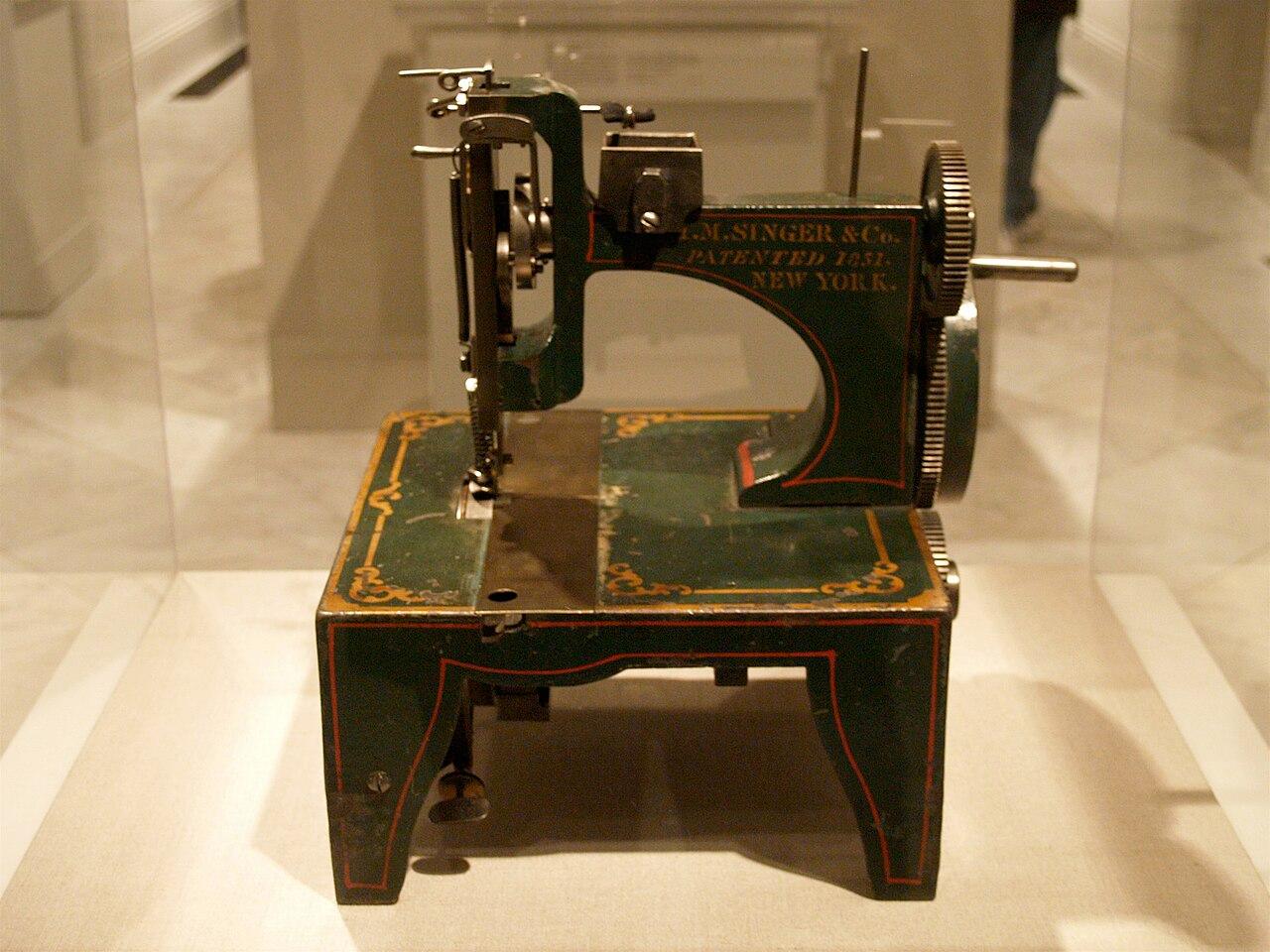
For centuries every stitch of clothing was made by hand. Elias Howe's 1846 lockstitch patent, Isaac Singer's practical refinements of 1851, and improvements by Wheeler & Wilson and Grover & Baker turned hours of hand-sewing into minutes. The machine did not stay in the shop: it migrated into the parlor of the middle-class home, sold by agents on installment plans. The sewing machine became one of the first mass-marketed consumer durables and a pioneer of installment credit, and it accelerated the ready-to-wear clothing industry. For the tens of thousands of women who earned their living by the needle, it raised output without raising pay: the National Museum of American History notes that the machines did not greatly increase seamstresses' earnings.
Inside this chapter
Classroom Kit
Did the sewing machine free needleworkers or simply speed up their exploitation?
The Song of the Shirt
Thomas Hood, December 1843
With fingers weary and worn, / With eyelids heavy and red, / A woman sat in unwomanly rags, / Plying her needle and thread— / Stitch! stitch! stitch! / In poverty, hunger, and dirt, / And still with a voice of dolorous pitch / She sang the "Song of the Shirt." ... "O, men, with sisters dear! / O, men, with mothers and wives! / It is not linen you're wearing out, / But human creatures' lives!"
Context: Hood wrote this poem after a London court case exposed a seamstress paid so little she pawned her employer's cloth to feed her children. Reprinted widely in Britain and the United States, it became the anthem of needlewomen's misery just as the sewing machine was being invented.
Source: Thomas Hood. The Song of the Shirt. Academy of American Poets (Poets.org). 1843
U.S. Patent No. 4,750: Sewing-Machine
Elias Howe Jr., September 10, 1846
In sewing a seam with my machine two threads are employed, one of which threads is carried through the cloth by means of a curved needle, the pointed end of which is to pass through said cloth. ... It will therefore be seen that a stitch is made at every back-and-forth movement of the shuttle.
Context: Howe's patent for a lockstitch machine combined an eye-pointed needle with a shuttle carrying a second thread. His lawsuits against Isaac Singer and others led to the 1856 "Sewing Machine Combination," a patent pool that let machines be mass-produced.
Source: Elias Howe Jr. United States Patent 4750. United States Patent Office (via Wikisource). 1846
Discussion questions
- In your own words, explain how Howe's machine forms a stitch using two threads.
- Hood's poem appeared in the British humor magazine Punch at Christmas 1843, three years before Howe's patent. Why would a poet and an inventor describe sewing in such different language?
- Machines made a shirt faster to sew. Using the chapter narrative, explain who captured the time and money that the machine saved: workers, manufacturers, or buyers?
- Hood's lines "It is not linen you're wearing out, / But human creatures' lives!" could describe fast-fashion supply chains today. Is that comparison fair? Use evidence to support your answer.
Key terms
- Lockstitch
- A stitch made by two threads, one from a needle and one from a shuttle or bobbin, that interlock inside the fabric.
- Shuttle
- A small boat-shaped holder that carries the lower thread back and forth beneath the cloth in a sewing machine.
- Patent pool
- An agreement among inventors or companies to share their patents and split the royalties instead of suing each other.
- Installment plan
- A way of buying an expensive item by paying a little at a time; Singer used it to sell sewing machines to households.
- Outwork
- A system in which manufacturers sent cut cloth to workers' homes to be sewn and paid them by the piece.
Sources
- Archive / museum1846—Elias Howe Jr.'s Sewing Machine Patent Model. Smithsonian National Museum of American History.
- ScholarshipHow Singer Won the Sewing Machine War. Smithsonian Magazine, 2015.
- ScholarshipHistory of Sweatshops: 1820–1880. Smithsonian National Museum of American History.