RI · Textile era 1790–1955
Rhode Island
Where the American Industrial Revolution Began
Rhode Island holds the founding moment of American industry: at Pawtucket in 1790, Samuel Slater and his partners got water-powered cotton spinning running on the Blackstone River. From that point, the state's mill villages spread along every fall line, producing yarn and cloth—and, in 1924 and 1934, some of the most significant labor confrontations in New England history.
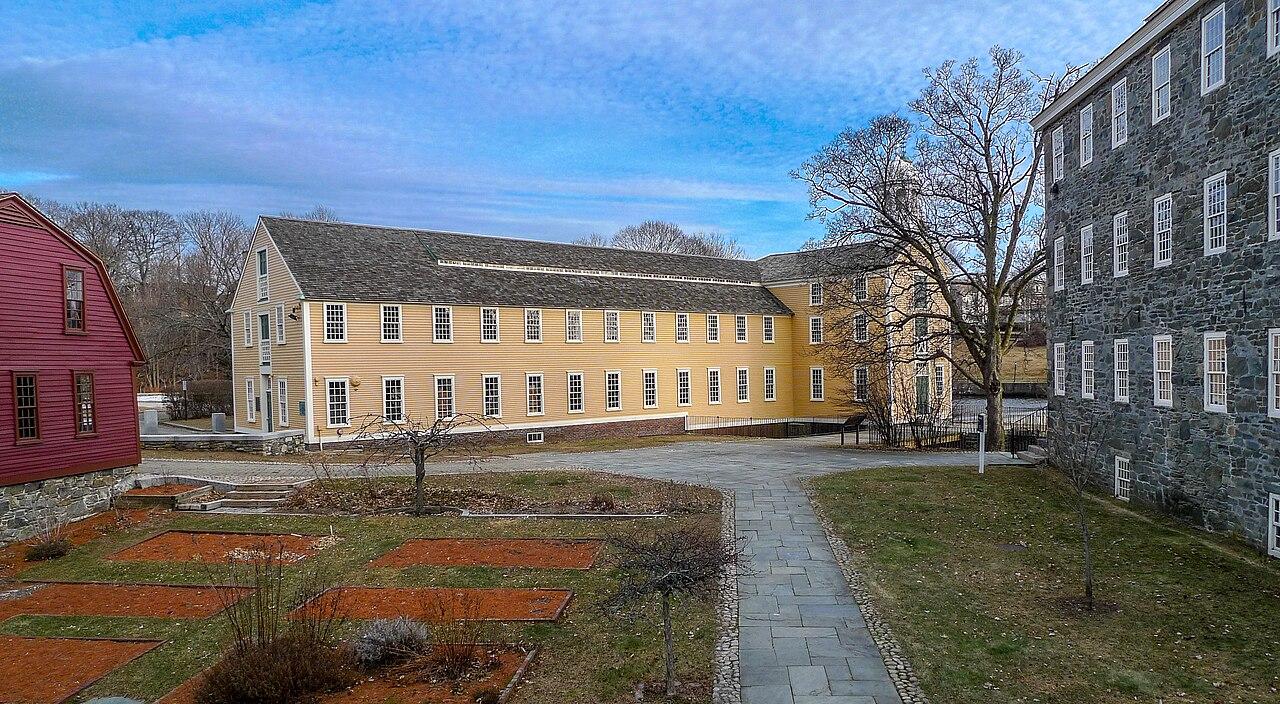
Samuel Slater's water-powered spinning at Pawtucket, running by December 1790 for the firm of Almy & Brown with the backing of the Quaker merchant Moses Brown, is the founding monument of American industrial textile manufacturing; the mill building that he and his partners raised in 1793 still stands. Within a generation, mill villages had risen along the Blackstone, the Pawtuxet, and the Woonasquatucket—each a self-contained company town running on the family-labor 'Rhode Island System.' In 1824, women weavers in Pawtucket led a walkout against a wage cut and longer hours that is often called the first factory strike in the United States. By the early twentieth century, Rhode Island held one of the densest concentrations of textile capital in the country. In 1922 tens of thousands of workers struck against wage cuts and longer hours, and in September 1934 the National Guard fired on strikers at Saylesville and Woonsocket, killing four. Most of the mills had closed within two decades. Many of the brick complexes that remain have been reborn as apartments, studios, and museums.
In memoriam: industrial tragedies
1934Saylesville Shootings
2
National Guardsmen fire into Moshassuck Cemetery on September 12; Charles Gorcynski and William Blackwood are killed and others wounded.
1934Woonsocket Shootings
2
Guard fire kills nineteen-year-old Jude Courtemanche on September 12; Leon Rouette, eighteen, dies of his wounds ten days later.
What remains
Slater Mill is now part of Blackstone River Valley National Historical Park, established in 2014 and managed by the National Park Service. Pawtucket, Providence, and Woonsocket retain Franco-American and Portuguese communities whose ancestors were drawn to the mills in the late nineteenth and early twentieth centuries.
Stories set here
Sources
- Government recordSamuel Slater. National Park Service, Blackstone River Valley National Historical Park.
- Government recordThe 1824 Strike. National Park Service, Blackstone River Valley National Historical Park.
- Government recordThe Saylesville Massacre and American Tradition. National Park Service.
- Government record200 Labor Events in the Blackstone Valley. National Park Service, Blackstone River Valley National Historical Park.