Chapter 03 · 1760–1789
The Revolutionary Loom
Homespun as Political Defiance
As tensions with Britain rose, the spinning wheel became a symbol of liberty. To flaunt British finery was to invite suspicion; to wear homespun was to declare allegiance. The quarrel with the empire was argued, in part, in clothes of American making.
Jump to classroom kit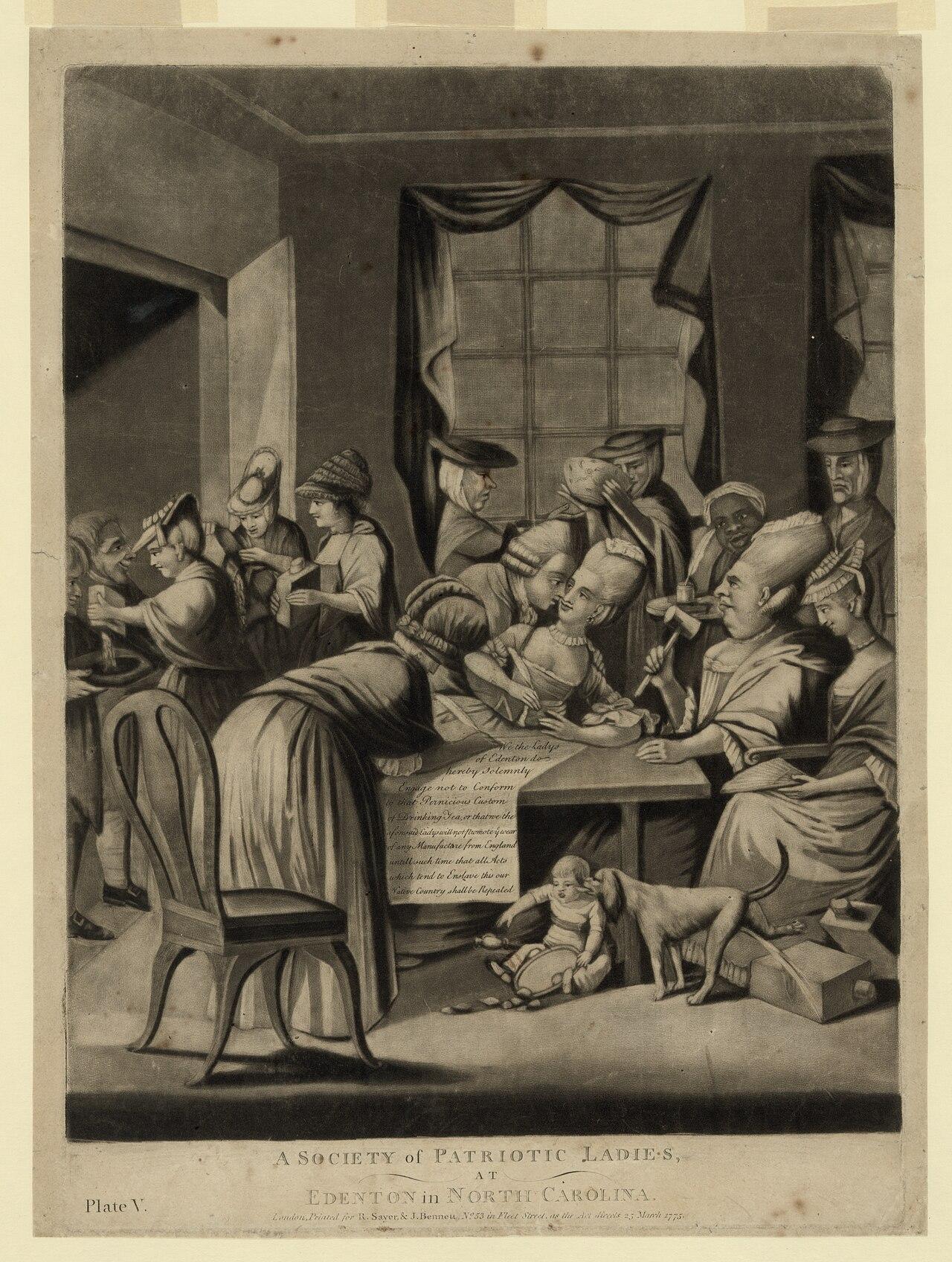
Following the Stamp Act and the Townshend duties, colonial non-importation agreements pushed Americans to expand their own production. Between 1768 and 1770, women gathered by the dozens for spinning meetings—usually at a minister's house—that newspapers reported as patriotic demonstrations, turning a domestic chore into a public political act. In 1768 the Connecticut Courant reported that Harvard's graduating class had resolved to take their degrees in homespun. Towns competed in print over how many skeins their women had spun. In April 1789, George Washington took the oath of office in a suit of brown broadcloth from the Hartford Woolen Manufactory, a deliberate sartorial declaration that the new republic could clothe itself.
Inside this chapter
Classroom Kit
Did homespun cloth help win American independence, or did it mainly make patriotism visible?
The Articles of Association (Continental Association)
First Continental Congress, October 20, 1774
That from and after the first day of December next, we will not import, into British America, from Great-Britain or Ireland, any goods, wares, or merchandise whatsoever ... 7. We will use our utmost endeavours to improve the breed of sheep, and increase their number to the greatest extent; and to that end, we will kill them as seldom as may be, especially those of the most profitable kind; nor will we export any to the West-Indies or elsewhere ... 8. We will, in our several stations, encourage frugality, economy, and industry, and promote agriculture, arts and the manufactures of this country, especially that of wool; and will discountenance and discourage every species of extravagance and dissipation ...
Context: Delegates from twelve colonies agreed to a coordinated boycott of British goods in response to the Coercive Acts, enforced by local committees. Producing wool and cloth at home was written directly into this founding act of colonial resistance.
Source: The Articles of Association; October 20, 1774. The Avalon Project, Yale Law School. 1774
Letter to the Marquis de Lafayette
George Washington, January 29, 1789
Though I would not force the introduction of manufactures, by extravagant encouragements, and to the prejudice of agriculture; yet, I conceive, much might be done in that way by woman, children & others; without taking one really necessary hand from tilling the earth. ... I have been writing to our friend Genl Knox this day, to procure me homespun broad cloth, of the Hartford fabric, to make a suit of cloaths for myself. I hope it will not be a great while, before it will be unfashionable for a gentleman to appear in any other dress. Indeed we have already been to long subject to British prejudices.
Context: Writing months before he took office, Washington explains why he intends to wear American-made wool from the Hartford Woolen Manufactory. He did wear a brown Hartford broadcloth suit at his April 1789 inauguration, turning clothing into a statement of economic independence.
Discussion questions
- List the specific actions the Continental Association asked colonists to take regarding imports, sheep, and wool.
- Washington wrote this letter privately to a French ally three months before his inauguration. Why might he describe his plan to wear Hartford broadcloth to Lafayette in particular?
- Both documents rely on someone's cloth-making labor. Using Washington's phrase "woman, children & others," explain whose work made the homespun movement possible and how much public credit they received.
- Consumers today boycott brands or "buy local" to make political statements. Compare these choices with the homespun movement: which is more effective at forcing change, and why?
Key terms
- Non-importation
- An agreement to stop buying goods from a particular country as a form of political protest.
- Boycott
- Refusing to buy, sell, or use something in order to pressure a government or company to change.
- Broadcloth
- A dense, smooth woolen cloth used for high-quality coats and suits.
- Committee of inspection
- A local group elected under the Continental Association to watch merchants and publicly name anyone who broke the boycott.
- Manufactures
- In the 1700s, goods made by hand or machine, as opposed to farm products or raw materials.
Sources
- ScholarshipLaurel Thatcher Ulrich. The Age of Homespun: Objects and Stories in the Creation of an American Myth. Alfred A. Knopf, 2001.
- ScholarshipT. H. Breen. The Marketplace of Revolution: How Consumer Politics Shaped American Independence. Oxford University Press, 2004.
- Primary sourceCourse documents: Connecticut Courant, 11 January 1768. Harvard University (HSB 41 course resources).
- ScholarshipWashington's Inauguration in New York. George Washington's Mount Vernon.