Chapter 09 · 1861–1865
Uniforms of Conflict
The Civil War and Standardized Sizing
The Civil War demanded the first true mass production of apparel in American history. To clothe more than two million Union soldiers, the industry adopted a new language of fit—and gave a new word to the language of fraud.
Jump to classroom kit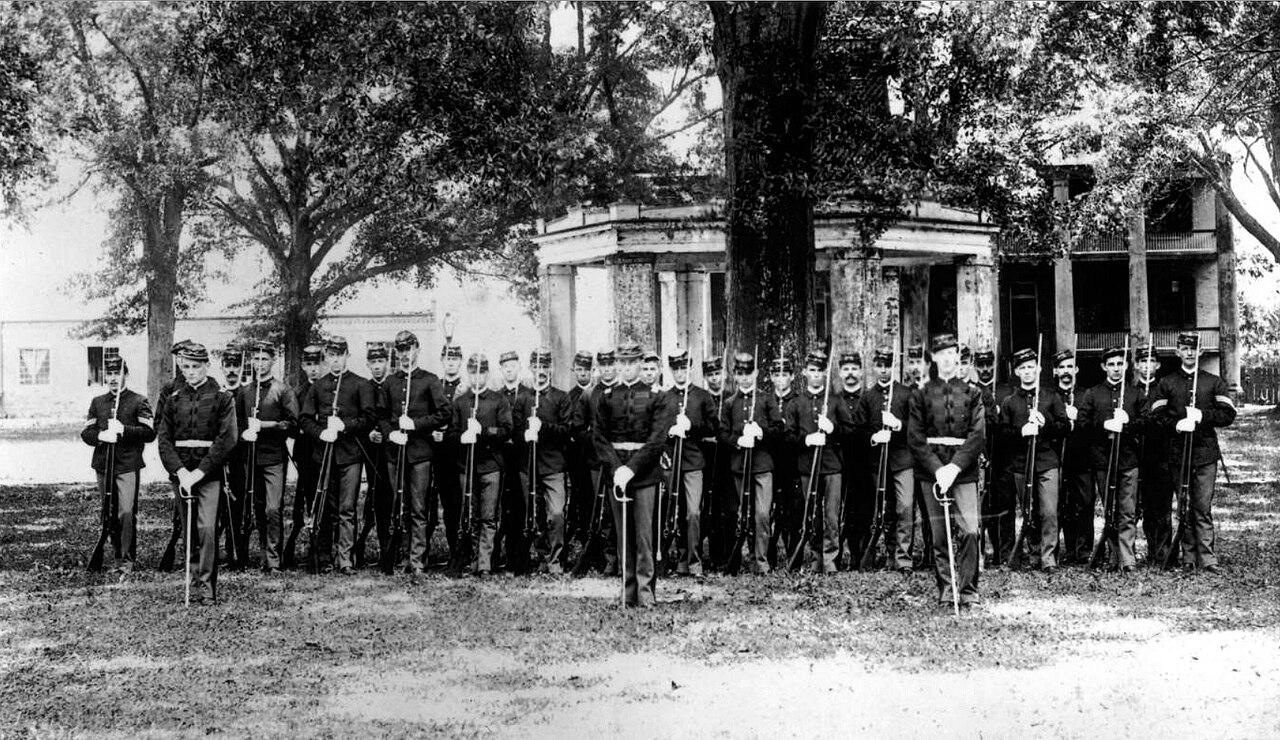
The Union's need for uniforms created a sudden, colossal demand for ready-made clothing. To make garments in volume, the Quartermaster's Department specified uniforms in a small set of numbered sizes, graded by breast and waist measurements, so that contractors could cut thousands of identical pieces; historians of government contracting credit the war with spreading standard men's sizes into postwar civilian clothing. The U.S. Sanitary Commission, meanwhile, measured thousands of soldiers in detail and compiled the heights and ages of more than a million volunteers. The same urgency that encouraged standardized fit also invited fraud: contractors sold the government cloth made of reworked rags, and 'shoddy'—an old woolen-trade term—became a national byword for cheap goods and profiteers.
Inside this chapter
- Tragedy
The Spread of 'Shoddy'
War profiteering, recycled rags, and a word that entered everyday speech.
- Innovation
Measuring the Union Army
How wartime measurement shaped ready-made sizing—and what the myth of 'S, M, L' gets wrong.
- Impact
Uniforms and the Black Soldier
When the right to wear blue was an argument for citizenship.
Classroom Kit
Did the Civil War's demand for uniforms modernize American industry, or did it mainly reward profiteers?
Annual Report of the Quartermaster General for the Fiscal Year Ending June 30, 1865
Montgomery C. Meigs, 1865
At the commencement of the war the department had but one depot for the supply of clothing and equipage, the Schuylkill arsenal, at Philadelphia. This was organized for the equipment of an army of 13,000 men. ... Eight or ten thousand work-people were employed in Philadelphia in the manufacture of clothing and equipage. ... Contracts were made for the supply of clothing ready-made. The manufacturers of the loyal States were urged to turn their machinery upon army goods. The clothing merchants who had, before the war, supplied the southern markets, made contracts with the department for the supply of army clothing, and in a few months the industry and manufacturing power of the country were turned into the new channel ...
Context: Meigs ran the Union army's supply system throughout the war. His report shows how a department built for a 13,000-man army mobilized private factories and thousands of seamstresses to clothe more than two million soldiers.
Investigations in the Military and Anthropological Statistics of American Soldiers
Benjamin Apthorp Gould, for the U.S. Sanitary Commission, 1869
The andrometer is said to have been originally devised by a tailor in Edinburgh, named McDonald, who used it to determine the proper size for soldiers' clothing, for which he had undertaken a considerable contract with the military authorities. ... It enables the total height, breadth of neck, of shoulders, and of pelvis, the length of legs and height to the knee to be measured with greater accuracy and rapidity than otherwise would be possible ... Instruments of this kind were constructed for the Sanitary Commission in 1863, at the office of the U. S. Coast Survey ...
Context: Gould, an astronomer, led the Sanitary Commission's effort to measure Union soldiers' bodies. His survey studied soldiers' health and physique. The Army's uniforms were already cut in four numbered sizes, and historians credit that contracting practice, rather than the survey, with spreading standard men's sizes into the postwar ready-to-wear trade.
Discussion questions
- According to Meigs, how did the Quartermaster's Department solve the army's clothing shortage after 1861?
- Meigs wrote this as an official report at the war's end. What problems, such as the early "shoddy" uniform scandals, might a quartermaster general have reason to downplay?
- Gould describes an instrument first designed to size soldiers' clothing. The Sanitary Commission measured 23,785 men, while the Army already issued uniforms in four numbered sizes. What could a survey like Gould's reveal about soldiers' bodies, and what can it not prove about where ready-made clothing sizes came from?
- Clothing sizes today vary widely from brand to brand. Should there be a national standard for clothing sizes, like the numbered sizes the Army used for uniforms in the 1860s? Argue your position.
Key terms
- Shoddy
- Cheap cloth made from shredded, reused wool that fell apart quickly; the word came to mean any poor-quality goods sold for profit.
- Quartermaster
- The military officer or department responsible for supplying troops with clothing, food, shelter, and equipment.
- Ready-made clothing
- Garments produced in standard sizes ahead of time rather than sewn to fit an individual customer.
- Anthropometry
- The scientific measurement of the human body, such as height, chest, and limb length.
- Depot
- A military storehouse where supplies are collected, made, or distributed.
Sources
- ScholarshipThe Civil War to 1880 (A History of Government Contracting). George Washington University Law School.
- Primary sourceBenjamin Apthorp Gould. Investigations in the Military and Anthropological Statistics of American Soldiers. U.S. Sanitary Commission / Hurd and Houghton, 1869.
- Government recordCommunication from the Governor transmitting the report of the Board of State Officers named in the act of April 16, 1861. State of New York (via HathiTrust), 1862.