Chapter 07 · 1840–1920
The Silk City
Paterson and the Rise of American Silk
While cotton was king, silk was luxury. Paterson, New Jersey, became 'Silk City'—the center of a specialized, high-skill industry that drew immigrant weavers from Lyon, Macclesfield, and northern Italy to the falls of the Passaic.
Jump to classroom kit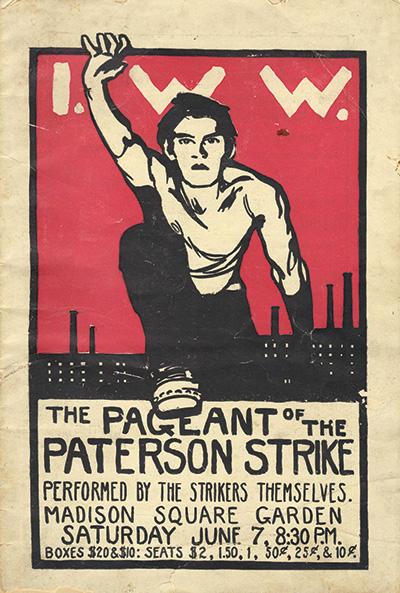
Silk demanded more skill than cotton. The fiber was costly, the looms intricate, the patterns commercially sensitive. Paterson's Great Falls of the Passaic, about seventy-seven feet high, provided power, and Alexander Hamilton's Society for Establishing Useful Manufactures, chartered by New Jersey in 1791, had laid the legal and hydraulic scaffolding of an industrial town. Silk manufacturing took root around 1840 and grew explosively after the Civil War, supplying everything from ribbons and thread to broad dress silks. With that skilled workforce came radical politics: Paterson became one of the most militant labor cities in America, culminating in the 1913 silk strike led by the Industrial Workers of the World.
Inside this chapter
Classroom Kit
Did Paterson's founding plan to rely on cheap machine labor make conflict like the 1913 silk strike inevitable?
Prospectus of the Society for Establishing Useful Manufactures
Alexander Hamilton (attributed), August 1791
The dearness of labour and the want of Capital are the two great objections to the success of manufactures in the United States. The first objection ceases to be formidable when it is recollected how prodigiously the proportion of manual labour in a variety of manufactures has been decreased by the late improvements in the construction and application of Machines—and when it is also considered to what an extent women and even children in the populous parts of the Country may be rendered auxiliary to undertakings of this nature. It is also to be taken into calculation that emigrants may be engaged on reasonable terms in countries where labour is cheap, and brought over to the United States.
Context: This prospectus launched the Society for Establishing Useful Manufactures, which founded Paterson, New Jersey, at the Great Falls of the Passaic River in 1792. Its plan to rely on machines, women, children, and imported workers foreshadowed the labor system of the later Silk City.
War in Paterson
John Reed, June 1913
There's war in Paterson. But it's a curious kind of war. All the violence is the work of one side—the Mill Owners. Their servants, the Police, club unresisting men and women and ride down law-abiding crowds on horseback. Their paid mercenaries, the armed Detectives, shoot and kill innocent people. ... They control absolutely the Police, the Press, the Courts. Opposing them are about twenty-five thousand striking silk-workers, of whom perhaps ten thousand are active, and their weapon is the picket-line.
Context: Reed wrote this for the socialist magazine The Masses after being jailed while observing a picket line during the 1913 Paterson silk strike. The strike, led by the IWW against the multi-loom system, lasted about five months and ended in defeat for the workers.
Source: John Reed. War in Paterson. The Masses (via Marxists Internet Archive). 1913
Discussion questions
- What two "objections" to American manufacturing does the 1791 prospectus identify, and what solutions does it propose?
- John Reed was a radical journalist who openly supported the strikers and the IWW. Which words reveal his point of view, and what would a mill owner's account of the same events likely emphasize?
- The prospectus planned to recruit "emigrants ... in countries where labour is cheap." How did that plan play out a century later, when Paterson's skilled weavers arrived from Europe with their own traditions of labor activism?
- Companies today debate automation and staffing levels much as Paterson's weavers fought the four-loom system. Is requiring one worker to tend more machines a fair productivity gain or an unfair "speed-up"? Defend your answer.
Key terms
- Four-loom system
- A management plan requiring each silk weaver to run four looms instead of two, which workers saw as a speed-up that would cut jobs and pay.
- Picket line
- A line of striking workers outside a workplace who try to persuade others not to enter.
- Industrial Workers of the World (IWW)
- A radical labor union founded in 1905 that aimed to organize all workers, skilled and unskilled, into "one big union."
- Society for Establishing Useful Manufactures
- A private corporation chartered by New Jersey in 1791 to build an industrial city; it founded Paterson.
- Broad silk
- Wide silk cloth woven for dresses and linings, Paterson's most important product in the early 1900s.
Sources
- ScholarshipThe 1913 Paterson Silk Strike. PBS American Experience.
- ScholarshipSteve Golin. The Fragile Bridge: Paterson Silk Strike, 1913. Temple University Press, 1988.
- ScholarshipPhilip B. Scranton (editor). Silk City: Studies on the Paterson Silk Industry, 1860–1940. New Jersey Historical Society, 1985.