Chapter 05 · 1793–1850
The Cotton Kingdom
The Gin, the Lash, and the Loom
The 'efficiency' of the Northern mills was fed by the brutality of the Southern cotton field. The rise of the American textile industry was inextricable from the expansion of slavery, and the spindles of Massachusetts spun fiber picked under the lash in Mississippi.
Jump to classroom kit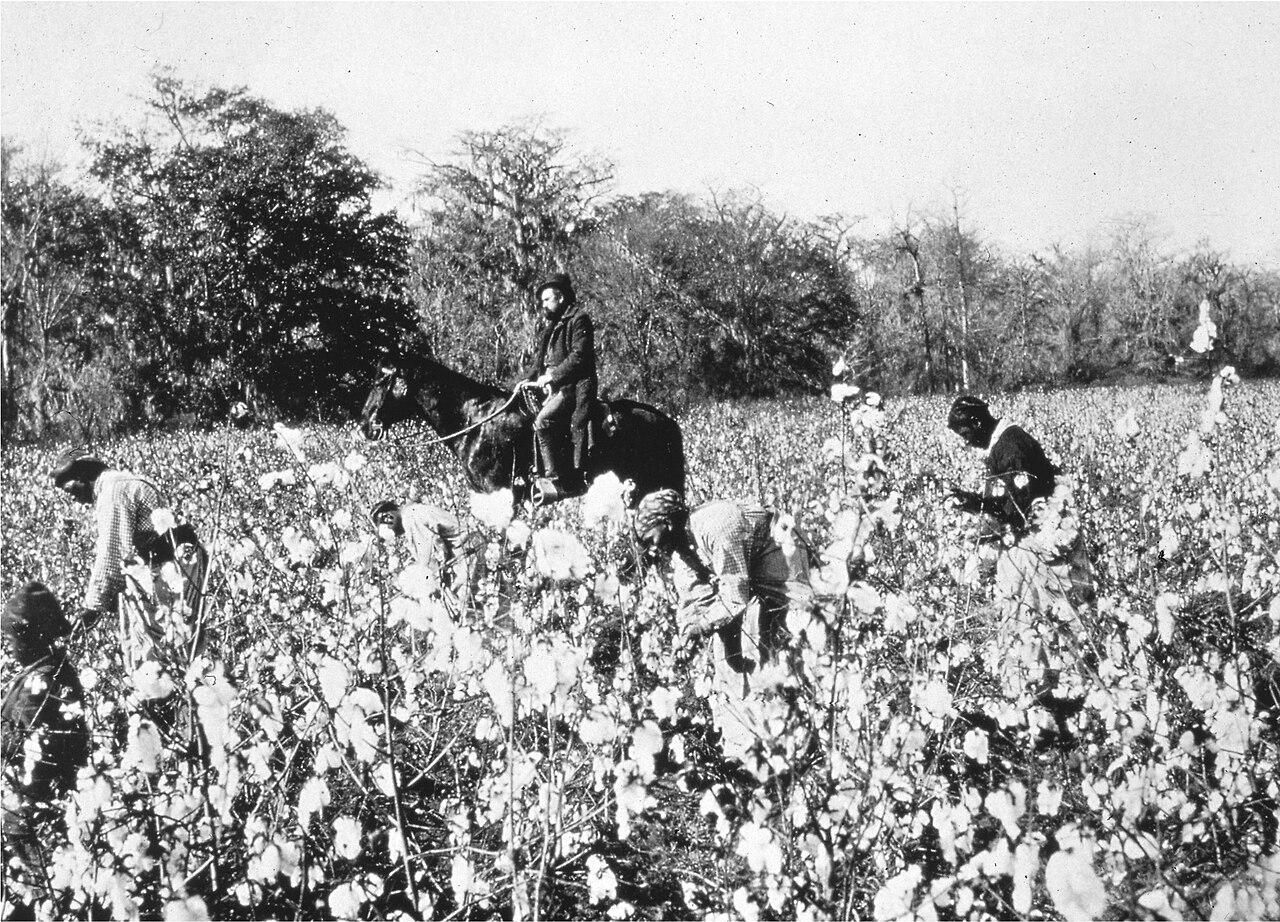
Eli Whitney's cotton gin (1793) made short-staple upland cotton commercially viable. Within a generation it helped transform the American South into the leading supplier of the raw material of the world's first industrial economy. The 'Cotton Kingdom' expanded westward through Georgia, Alabama, Mississippi, Louisiana, and beyond, fueling the 'Second Middle Passage'—the forced removal of roughly a million enslaved people from the Upper South to the Deep South between 1790 and 1860. Cotton was the nation's leading export from about 1803, and by 1840 it accounted for more than half the value of all American exports. Northern mills did not merely buy this cotton: Northern merchants, shippers, insurers, and banks financed, carried, and insured the crop, and Northern politicians tied to the trade resisted measures that threatened it.
Inside this chapter
- Tragedy
The Second Middle Passage
The forced migration that built the Cotton Kingdom.
- Impact
Lords of the Loom, Lords of the Lash
The political alliance between Boston mill owners and Southern planters.
- Biography
Eli Whitney's Patent Trap
The inventor of the gin made little from it.
- Tragedy
The Hands That Picked
The enslaved people who grew the cotton, as named individuals and as the largest financial asset in the American economy.
Classroom Kit
How responsible were Northern mills and consumers for the expansion of slavery in the Cotton South?
Twelve Years a Slave
Solomon Northup, 1853
When a new hand, one unaccustomed to the business, is sent for the first time into the field, he is whipped up smartly, and made for that day to pick as fast as he can possibly. At night it is weighed, so that his capability in cotton picking is known. He must bring in the same weight each night following. If it falls short, it is considered evidence that he has been laggard, and a greater or less number of lashes is the penalty. An ordinary day's work is two hundred pounds. ... a slave never approaches the gin-house with his basket of cotton but with fear.
Context: Northup, a free Black man from New York, was kidnapped in 1841 and enslaved on Louisiana cotton plantations for twelve years. His account describes the quota-and-whip system that drove the enormous rise in cotton output feeding Northern and British mills.
Interview with Sarah Ashley
Sarah Ashley, interviewed by the Federal Writers' Project, c. 1937
I used to have to pick cotton and sometime I pick 300 pound and tote it a mile to de cotton house. Some pick 300 to 800 pound cotton and have to tote de bag de whole mile to de gin. Iffen dey didn't do dey work dey git whip till dey have blister on 'em. Den iffen dey didn't do it, de man on a hoss goes down de rows and whip with a paddle make with holes in it and bus' de blisters. I never git whip, 'cause I allus git my 300 pound.
Context: Ashley, born in Mississippi and sold to a Texas planter as a child, was interviewed in her eighties by the New Deal's Federal Writers' Project. The dialect spellings were chosen by the mostly white interviewers and reflect their assumptions as well as her speech.
Discussion questions
- According to both narrators, how was the amount of cotton an enslaved person had to pick decided, and how was it enforced?
- Northup published his book with a white editor in 1853 to influence the national debate over slavery; Sarah Ashley was interviewed by a government writer in the 1930s. How might each setting shape what was said and how it was recorded?
- Using the chapter narrative, trace the path of a bale of cotton from a Louisiana gin-house to a New England loom. Who profited at each step?
- The United States now bans imports of cotton linked to forced labor in China's Xinjiang region. Should companies and consumers be held responsible for labor conditions far down their supply chains? Use the nineteenth-century evidence to support your argument.
Key terms
- Quota
- A required amount of work; on cotton plantations, the weight each enslaved person was forced to pick daily under threat of punishment.
- Gin-house
- The plantation building where the cotton gin separated seeds from fiber and where each day's picking was weighed.
- Second Middle Passage
- The forced movement of about one million enslaved people from the Upper South to new cotton lands in the Deep South between 1790 and 1860.
- Short-staple cotton
- Upland cotton with short fibers that grew across the interior South once the cotton gin made it profitable to clean.
- WPA slave narratives
- More than 2,300 interviews with formerly enslaved people recorded by the Works Progress Administration's Federal Writers' Project in 1936–1938.
Sources
- Government recordPatent for Cotton Gin (1794). U.S. National Archives.
- ScholarshipIra Berlin. Generations of Captivity: A History of African-American Slaves. Harvard University Press, 2003.
- ScholarshipGene Dattel. Cotton, the Oil of the Nineteenth Century. The International Economy.
- ScholarshipSven Beckert. Empire of Cotton: A Global History. Alfred A. Knopf, 2014.