Chapter 06 · 1820–1845
The Lowell Mill Girls
Vertical Integration and Social Experimentation
Francis Cabot Lowell and his partners built the first American mill to integrate power spinning and power weaving under one roof. They recruited young women from New England farms with the promise of cash wages and respectability—and built the country's first large industrial workforce.
Jump to classroom kit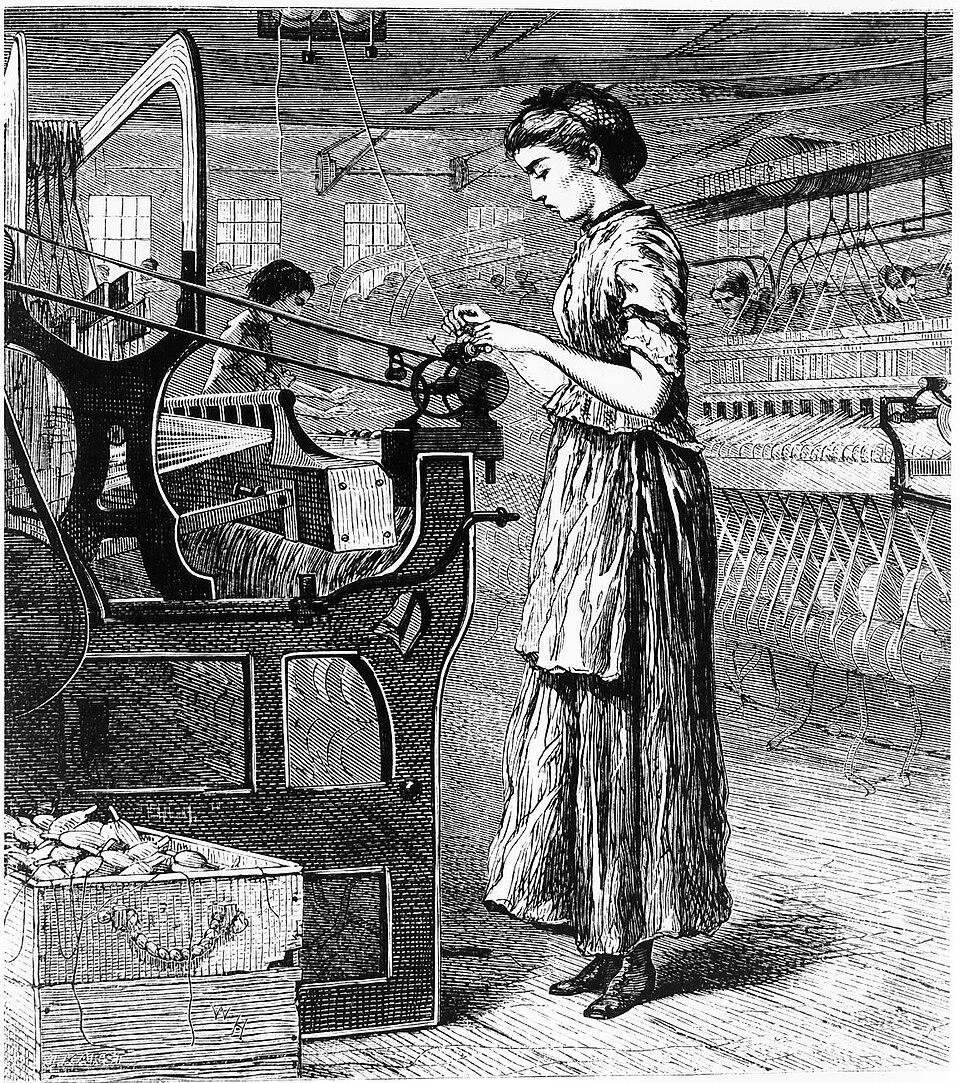
After studying British power looms on a visit in 1810–1812, Lowell returned to Massachusetts and, with the mechanic Paul Moody, reconstructed a working loom from what he had observed. He and the investors later called the Boston Associates incorporated the Boston Manufacturing Company in 1813; its Waltham mill, running by 1814, carried cotton from bale to finished cloth under one roof. After Lowell's death in 1817, his partners scaled the model dramatically: the Merrimack Manufacturing Company, incorporated in 1822, began building at East Chelmsford, which was incorporated as the town of Lowell in 1826. Young women, most between fifteen and twenty-five, were recruited from New England farms, housed in company boarding houses, and given access to lectures, libraries, and their own literary magazines. Most stayed only a few years. By the 1830s, as competition intensified, the bargain soured: wages were cut, machines were sped up, and the 'mill girls' turned out in some of the earliest strikes by women factory workers in the United States.
Inside this chapter
Classroom Kit
Was the Lowell mill system an opportunity for young women or a new form of exploitation?
Testimony of Sarah G. Bagley, Massachusetts House Document No. 50
Massachusetts House of Representatives, Special Committee on Hours of Labor, 1845
Miss Sarah G. Bagley said she had worked in the Lowell Mills eight years and a half, six years and a half on the Hamilton Corporation, and two years on the Middlesex. She is a weaver, and works by the piece. She worked in the mills three years before her health began to fail. ... The chief evil, so far as health is concerned, is the shortness of time allowed for meals. The next evil is the length of time employed—not giving them time to cultivate their minds. She spoke of the high moral and intellectual character of the girls.
Context: Bagley, founder of the Lowell Female Labor Reform Association, testified after workers petitioned the legislature for a ten-hour day. The committee heard the women but declined to recommend a law, saying the matter belonged to employers and workers.
Loom and Spindle; or, Life Among the Early Mill Girls
Harriet H. Robinson, 1898
When the day came on which the girls were to turn out, those in the upper rooms started first, and so many of them left that our mill was at once shut down. Then, when the girls in my room stood irresolute, uncertain what to do, asking each other, "Would you?" or "Shall we turn out?" and not one of them having the courage to lead off, I, who began to think they would not go out, after all their talk, became impatient, and started on ahead, saying, with childish bravado, "I don't care what you do, I am going to turn out, whether any one else does or not;" and I marched out, and was followed by the others.
Context: Robinson began work in Lowell as a ten-year-old bobbin doffer and here recalls the 1836 turn-out against higher boardinghouse charges. She wrote decades later as a women's suffrage activist, which shaped how she framed the mill girls' story.
Discussion questions
- What two "evils" did Sarah Bagley identify, and why did she rank them in that order?
- Bagley's words survive only as a legislative committee's summary, while Robinson wrote her memoir more than fifty years after the events. How does each format affect how far we can trust the details?
- Robinson remembered the 1836 walkout as a lesson in independence. Why might mill work have pushed women toward political activism in the 1830s and 1840s?
- Compare the Lowell workers' demands, more time for meals and time to "cultivate their minds," to debates today about the four-day week or "right to disconnect" laws. Has the core argument changed? Explain.
Key terms
- Operative
- A nineteenth-century word for a factory worker who ran machines.
- Turn-out
- The term mill workers in the 1830s used for a strike or walkout.
- Piece rate
- Pay based on how much a worker produces rather than how many hours she works.
- Boardinghouse
- Company-owned housing where Lowell's young women lived under rules and curfews set by the corporation.
- Ten-hour movement
- A campaign by workers in the 1840s and 1850s to limit the factory workday to ten hours by law.
Sources
- Government recordThe Mill Girls of Lowell. National Park Service, Lowell National Historical Park.
- Government recordEarly Strikes. National Park Service, Lowell National Historical Park.
- ScholarshipThomas Dublin. Women at Work: The Transformation of Work and Community in Lowell, Massachusetts, 1826–1860. Columbia University Press, 1979.