Chapter 15 · 1940–1950
Synthetic Warfare
Nylon and the WWII Pivot
World War II pushed the American textile industry from a natural-fiber economy toward a chemical one. Nylon went from stockings to parachutes; the American mill became a front in the war effort and emerged as a foundation of postwar consumer culture.
Jump to classroom kit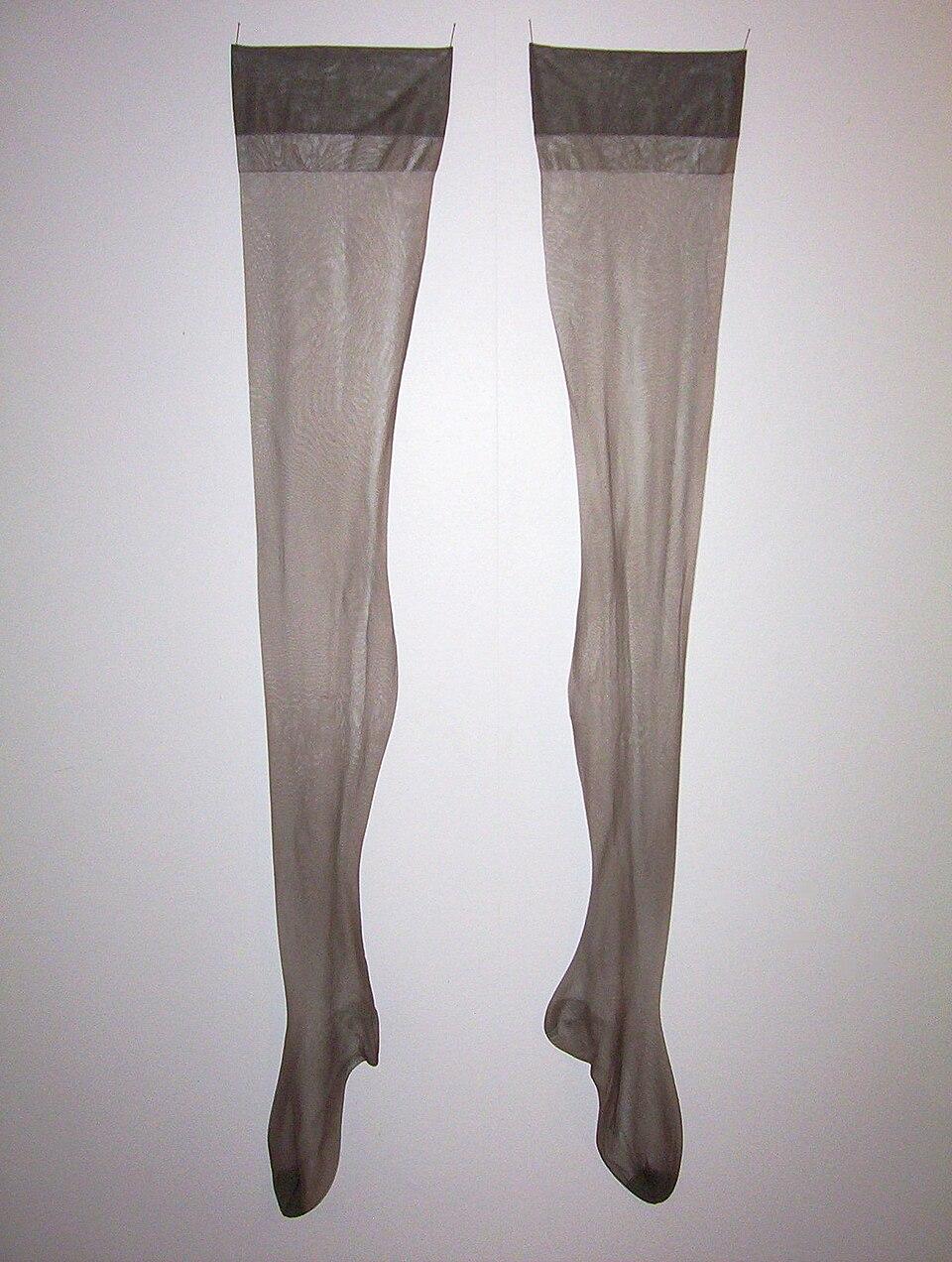
When the United States froze Japanese assets in the summer of 1941, imports of Japanese silk—the raw material of American hosiery and parachutes—stopped, making synthetic fibers a matter of national security. DuPont's nylon, introduced in women's stockings in 1939–40, was allocated to military use from 1942 and went into parachutes, ropes, tents, mosquito netting, and aircraft tire cord. Cotton mills produced vast quantities of duck, twill, and uniform cloth. The industry that emerged from the war was larger, more chemically sophisticated, and more politically connected than its predecessors—and within a few years it would redirect that wartime technology into the American closet.
Inside this chapter
- Material Culture
The Nylon Riots
When stockings were worth standing in line all day.
- Biography
Wallace Carothers, Inventor of Nylon
The brilliant chemist who did not live to see his invention reach the public.
- Material Culture
Rosie's Coveralls and the Cotton Duck Mills
American mills as a logistical front in the war.
Classroom Kit
When World War II turned nylon from a luxury into a strategic material, who gained and who paid?
U.S. Patent No. 2,130,948: Synthetic Fiber
Wallace H. Carothers, assignor to E. I. du Pont de Nemours & Company, September 20, 1938
This invention relates to new compositions of matter, and more particularly to synthetic linear condensation polyamides and to filaments, fibers, yarns, fabrics, and the like prepared therefrom. This invention has as an object the preparation of new and valuable compositions of matter, particularly synthetic fiber-forming materials. Another object is the preparation of filaments, fibers, and ribbons from these materials. A further object is the manufacture of yarns, fabrics, and the like from said filaments.
Context: Carothers led the DuPont research team that invented nylon; this patent, granted after his death in 1937, covered nylon fibers. Within four years nearly all nylon production was diverted from stockings to parachutes, tow ropes, and other military uses.
United States v. Schautz (quoting War Production Board Orders M-356 and L-274)
U.S. District Court for the District of New Jersey, 1946
General Conservation Order M-356, which provides in its pertinent part as follows: (b) (1) "No person shall sell or deliver nylon except as specifically authorized in writing by the War Production Board." (b) (2) "No person shall knowingly purchase, accept delivery or commercially use nylon contrary to any restriction of the War Production Board." and General Limitation Order L-274, which in part reads as follows: (c) (1) "On and after May 15, 1943, no person shall put into production women's full-fashioned plain-knit hosiery, women's seamless, circular-knit hosiery, men's hosiery, or misses', children's or infants' hosiery except in accordance with Schedules A, B, C, and D ..."
Context: This federal court decision involved charges of illegally diverting nylon yarn during the war. The wartime orders it quotes show how tightly the government controlled synthetic fiber and how valuable nylon became on the black market.
Source: United States v. Schautz. CourtListener, Free Law Project. 1946
Discussion questions
- What does Carothers's patent list as its "objects," and what properties of the new fiber does it highlight?
- A patent is written to secure a company's legal rights. What does this patent reveal, and what does it conceal, about DuPont's plans for nylon?
- The War Production Board banned selling nylon without written permission. Why would the government control a stocking fiber, and what does the Schautz case suggest about black markets during the war?
- During the COVID-19 pandemic, the federal government used the Defense Production Act to direct production of masks and protective gear. Should government have the power to take control of civilian materials in a crisis? Compare with 1942–1945.
Key terms
- Polymer
- A large molecule made of many small repeating units linked in a chain; nylon and polyester are polymers.
- Polyamide
- The chemical family of polymers that includes nylon, linked by amide bonds.
- War Production Board
- The federal agency that controlled raw materials and factory production in the United States during World War II.
- Rationing
- Government limits on how much of a scarce product people or businesses may buy or use.
- Black market
- Illegal buying and selling of goods, often scarce or rationed ones, outside official rules.
Sources
- ScholarshipWallace Hume Carothers. Science History Institute.
- ScholarshipEmily Spivack. Stocking Series, Part 1: Wartime Rationing and Nylon Riots. Smithsonian Magazine, 2012.
- ScholarshipSusannah Handley. Nylon: The Story of a Fashion Revolution. Johns Hopkins University Press, 1999.