Chapter 04 · 1790–1810
The Industrial Spy
Samuel Slater and the Transfer of Secrets
The American Industrial Revolution began with an act of industrial espionage. Samuel Slater carried the knowledge of British water-powered spinning across the Atlantic in his head, and—with American mechanics and Providence capital-rebuilt it on the banks of the Blackstone River.
Jump to classroom kit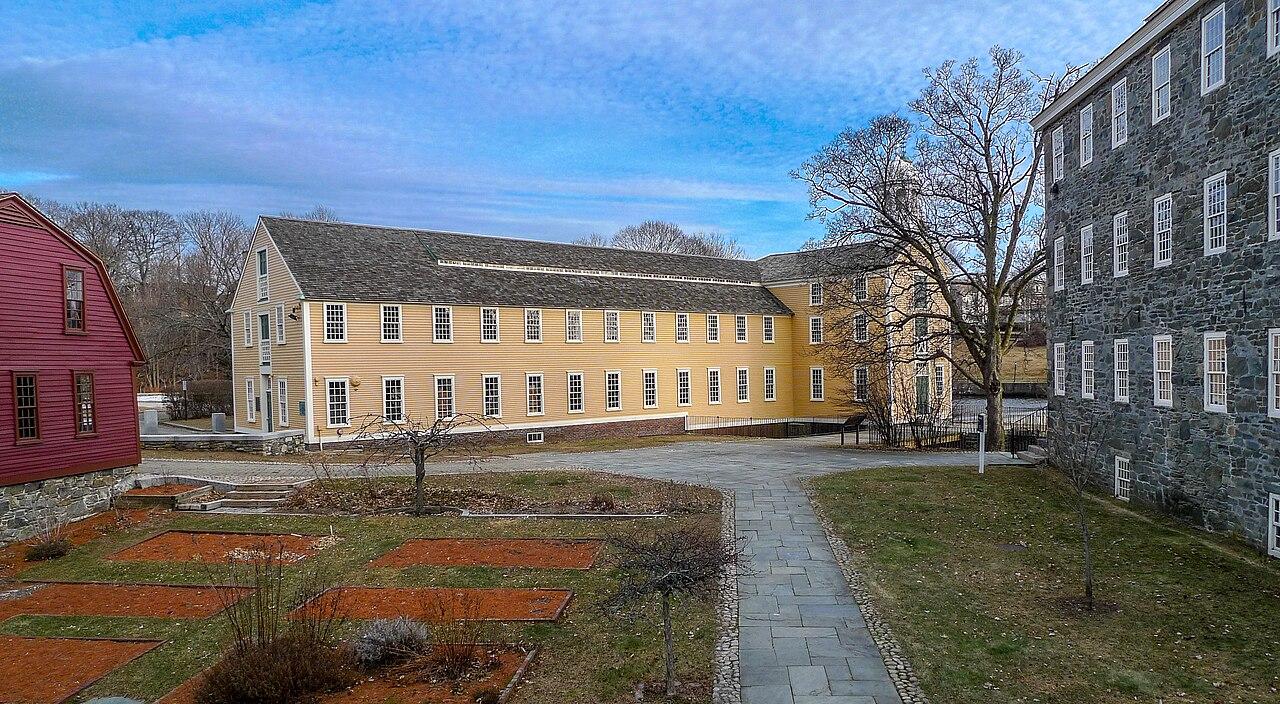
Britain protected its textile machinery with laws that barred the export of machines and drawings and discouraged skilled mechanics from emigrating. Slater, apprenticed in 1782 to Jedediah Strutt, Richard Arkwright's partner at Milford and Belper in Derbyshire, absorbed the workings of Arkwright's spinning system over seven years. In September 1789, aged twenty-one, he sailed from London; a long-repeated story says he passed himself off as a farm laborer. He reached New York after a sixty-six-day crossing and in January 1790 contracted with Almy & Brown of Providence—William Almy and Smith Brown, backed by the Quaker merchant Moses Brown. With local mechanics including the Wilkinson family and Sylvanus Brown, he got water-powered spinning running at Pawtucket on December 20, 1790. The 'Rhode Island System' he developed—hiring whole families, beginning with children aged seven to twelve—became the dominant labor model of the early southern New England mill.
Inside this chapter
- Biography
Slater the Memoryman
How an apprentice carried an empire's secret across an ocean in his head—and what he needed help to rebuild.
- Biography
Moses Brown: The Quaker Capitalist
The abolitionist financier whose family fortune was tangled with slavery.
- Labor
The Rhode Island System
America's first factory system built on the labor of children.
Classroom Kit
Was Samuel Slater a traitor, a thief, or the founder of American manufacturing?
Letter to Moses Brown
Samuel Slater, December 2, 1789
Sir, A few days ago I was informed that you wanted a manager of cotton spinning, &c. in which business I flatter myself that I can give the greatest satisfaction, in making machinery, making good yarn, either for Stockings or twist, as any that is made in England; as I have had opportunity, and an oversight, of Sir Richard Arkwright's works, and in Mr. Strutt's mill upwards of eight years. . . . My intention is to erect a perpetual card and spinning.
Context: Slater, a 21-year-old former apprentice to Jedediah Strutt, had left England, according to a long-repeated tradition in disguise, because British law banned skilled textile workers from emigrating. Writing from New York, he offered to build Arkwright-style machinery from memory.
Reply to Samuel Slater
Moses Brown, December 10, 1789
I, or rather Almy & Brown, who has the business in the cotton line, which I began, one being my son-in-law, and the other a kinsman, want the assistance of a person skilled in the frame or water spinning. An experiment has been made, which has failed, no person being acquainted with the business, and the frames imperfect. We are destitute of a person acquainted with water-frame spinning; thy being already engaged in a factory with many able proprietors, we can hardly suppose we can give the encouragement adequate to leaving thy present employ.
Context: Brown, a wealthy Providence Quaker merchant, had bought spinning machines that his workers could not make run. His reply shows that American investors had capital but lacked the technical knowledge that Slater carried in his head.
Report on the Subject of Manufactures
Alexander Hamilton, December 5, 1791
The Cotton Mill invented in England, within the last twenty years, is a signal illustration of the general proposition, which has been just advanced. In consequence of it, all the different processes for spining Cotton are performed by means of Machines, which are put in motion by water, and attended chiefly by women and Children ... It is worthy of particular remark, that, in general, women and Children are rendered more useful and the latter more early useful by manufacturing establishments, than they would otherwise be.
Context: Treasury Secretary Hamilton urged Congress to support American manufacturing, pointing to the Arkwright mill that Slater had just reproduced in Rhode Island. His report shows how early leaders saw the labor of women and children as a national resource.
Discussion questions
- What skills and experience does Slater claim in his letter, and what problem does Moses Brown say his business is facing?
- Both letters survive because they were printed in an 1836 memoir praising Slater. How might that publication shape which documents were preserved and how Slater is remembered?
- Hamilton praises machines "attended chiefly by women and Children." How does his report help explain why the first Pawtucket mill hired children?
- Governments today accuse rivals of stealing trade secrets and technology. Was Slater's decision to carry Arkwright's methods to America different from modern industrial espionage? Argue using the documents.
Key terms
- Water frame
- Richard Arkwright's spinning machine, powered by a water wheel, that made strong cotton thread continuously.
- Carding
- Brushing raw fiber so the strands line up and can be spun into thread.
- Trade secret
- Valuable business knowledge, such as a machine design, that a company keeps private to stay ahead of competitors.
- Rhode Island System
- Slater's method of hiring whole families, including children, to work in small rural mills and live in company housing.
- Emigration ban
- British laws that made it illegal for skilled textile workers to leave the country or for textile machinery to be exported.
Sources
- Government recordSamuel Slater. National Park Service, Blackstone River Valley National Historical Park.
- Government recordOld Slater Mill, National Register of Historic Places nomination. National Park Service.
- Government recordGoing in Circles: A Revolution Along the Blackstone. National Park Service.