Chapter 16 · 1950–1980
The Polyester Dream
Post-War Consumerism and 'Better Living Through Chemistry'
The post-war era was the age of 'Better Living Through Chemistry.' Synthetic fibers made clothing cheaper, more durable, and easier to care for—and seeded a global problem of plastic pollution that scientists would not measure for decades.
Jump to classroom kit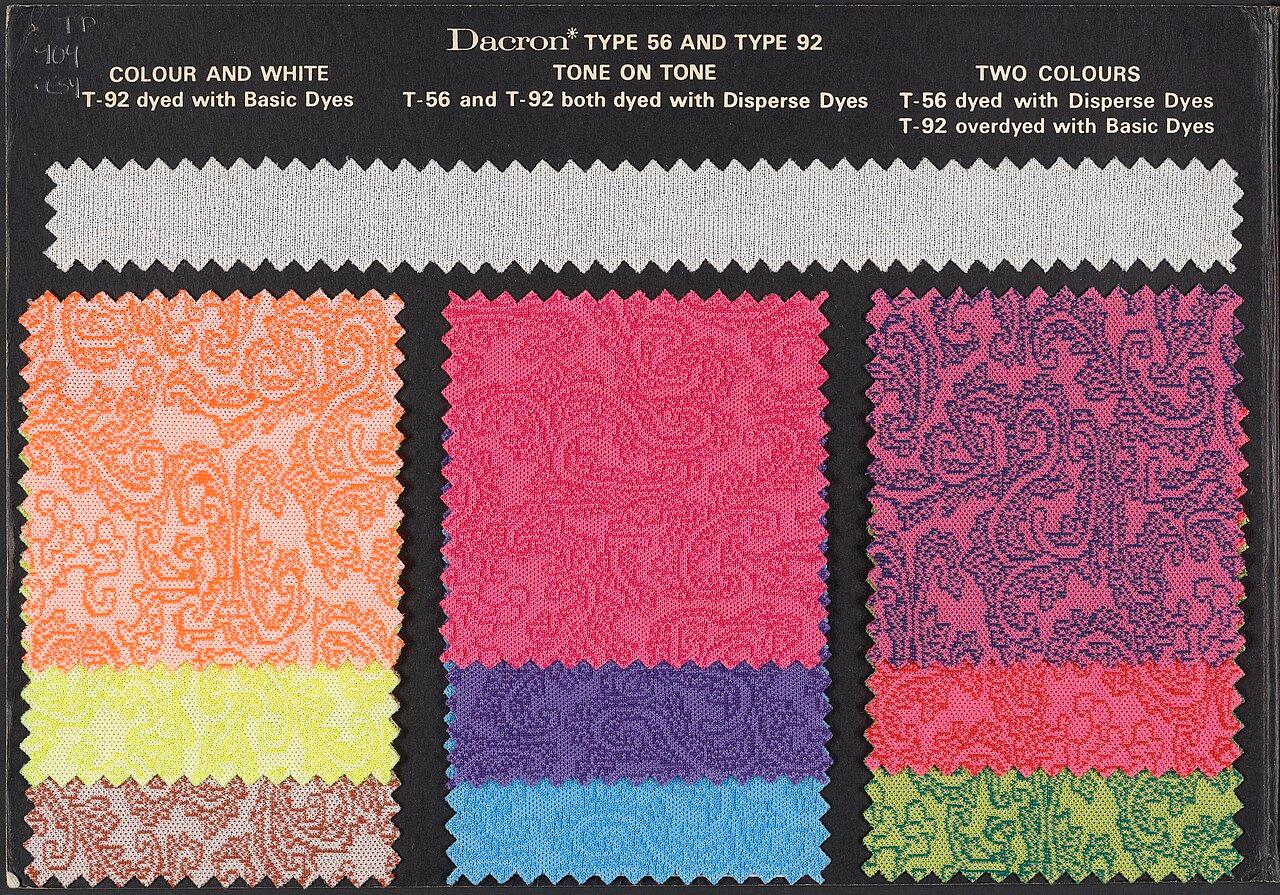
DuPont began commercial production of its polyester fiber, Dacron, in 1953. Within two decades, polyester double-knits filled American closets, and the leisure suit had become a symbol of 1970s fashion. Wash-and-wear blends, permanent-press finishes, and stretch fibers such as spandex, invented in 1958 and introduced the next year, reshaped not only clothes but the laundry room. Synthetic fibers made fashion more affordable and convenient and, unlike wool, cotton, or linen, did not biodegrade. Scientists reported plastic debris on the open ocean as early as 1972, but the shedding of microscopic fibers from synthetic clothing in the wash was not studied systematically until the 2010s.
Inside this chapter
Classroom Kit
Was the postwar promise of cheap, easy-care synthetic clothing a sign of progress or a problem passed to the future?
The Kitchen Debate (as reported in The New York Times)
The New York Times, reporting Richard Nixon and Nikita Khrushchev, July 24, 1959 (published July 25, 1959)
He said American houses were built to last only twenty years ... "We build firmly. We build for our children and grandchildren." Mr. Nixon said he thought American houses would last more than twenty years, but even so, after twenty years many Americans want a new home or a new kitchen, which would be obsolete then.
Context: Vice President Nixon and Soviet Premier Khrushchev argued about consumer goods at the American National Exhibition in Moscow. Nixon's defense of constant replacement captured the Cold War idea that abundant, ever-newer products proved capitalism's superiority.
Source: The Kitchen Debate. Teaching American History, Ashbrook Center. 1959
Plastics on the Sargasso Sea Surface
Edward J. Carpenter and Kenneth L. Smith Jr., March 17, 1972
Plastic particles, in concentrations averaging 3500 pieces and 290 grams per square kilometer, are widespread in the western Sargasso Sea. ... Increasing production of plastics, combined with present waste-disposal practices, will undoubtedly lead to increases in the concentration of these particles. Plastics could be a source of some of the polychlorinated biphenyls recently observed in oceanic organisms.
Context: Two Woods Hole oceanographers published one of the first scientific reports of plastic pollution in the open ocean. They found mostly plastic pellets rather than textile fibers, but their warning came at the height of the polyester boom.
Discussion questions
- According to Carpenter and Smith, how much plastic did they find in the Sargasso Sea, and what did they predict would happen?
- The Kitchen Debate excerpt is a reporter's summary in the New York Times, not a transcript. How does that affect how we use it as evidence of what Nixon and Khrushchev believed?
- Nixon defended a system in which products become "obsolete." How does the idea of planned obsolescence help explain the rise of polyester and disposable fashion?
- Scientists now find microplastic fibers from synthetic clothing in oceans, drinking water, and human tissue. Were the 1972 warnings ignored, and who should bear responsibility now: producers, consumers, or government? Argue.
Key terms
- Polyester
- A synthetic fiber made from petroleum-based chemicals, valued for being cheap, wrinkle-resistant, and quick-drying.
- Planned obsolescence
- Designing or marketing products so they go out of date or wear out quickly, encouraging people to buy replacements.
- Wash-and-wear
- 1950s advertising term for clothing that could be washed and worn without ironing.
- Petrochemical
- A chemical made from petroleum or natural gas, including the raw materials for synthetic fibers.
- Microplastics
- Plastic pieces smaller than five millimeters, including fibers shed from synthetic clothing during washing.
Sources
- Primary sourceEdward J. Carpenter and K. L. Smith Jr. Plastics on the Sargasso Sea Surface. Science, 1972.
- ScholarshipThe History of LYCRA Fiber. The LYCRA Company.
- Archive / museumDacron shirts (DuPont promotional photograph). Hagley Museum and Library, 1955.