Tragedy · Chapter 05, 1793–1850
The Second Middle Passage
The forced migration that built the Cotton Kingdom.
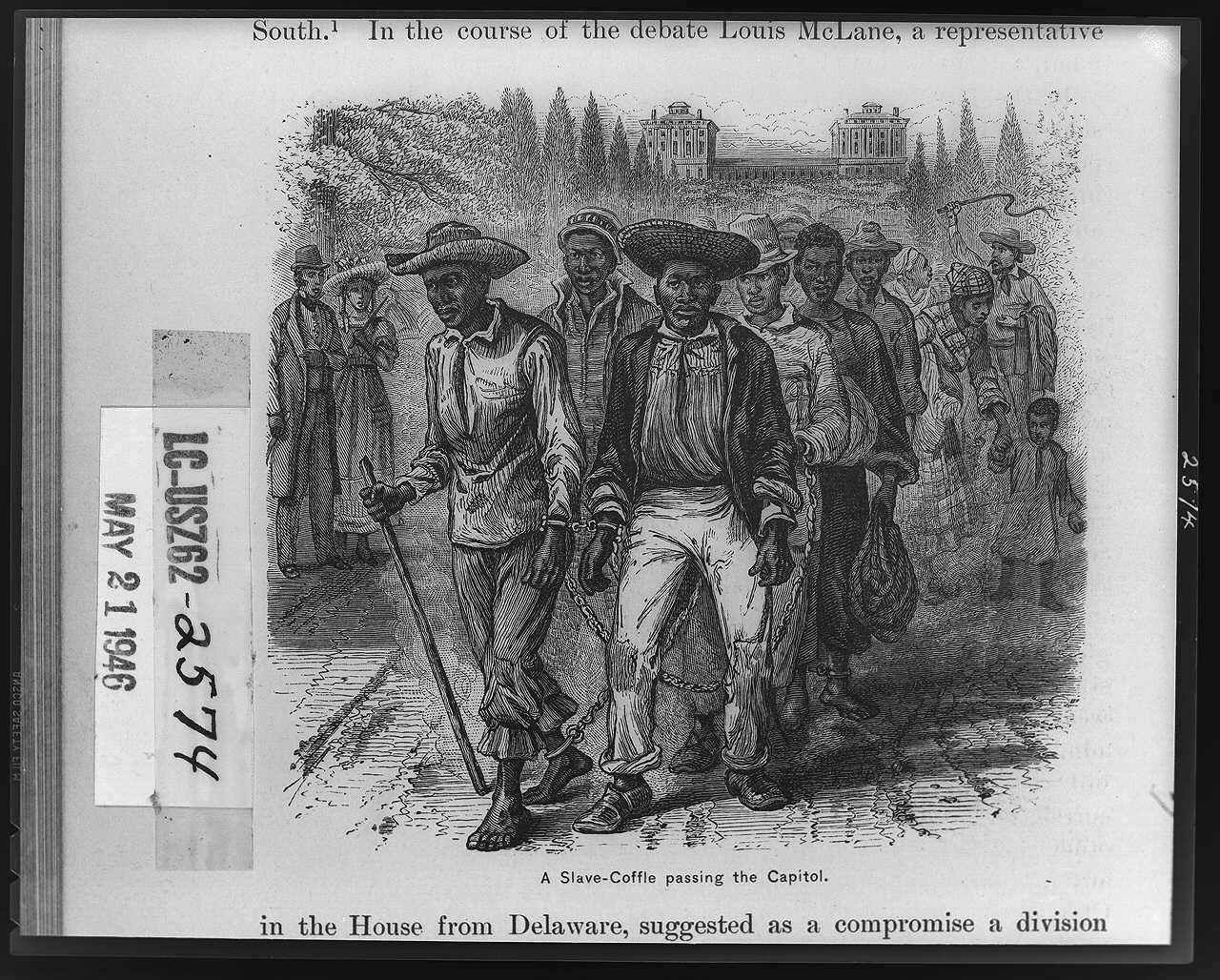
As demand for cotton from Lowell, Manchester, and Liverpool exploded, roughly a million enslaved men, women, and children were moved from the Upper South—Virginia, Maryland, Kentucky, the Carolinas—to the cotton frontier of Alabama, Mississippi, Louisiana, and Texas, some carried west by their enslavers and many more sold through the domestic slave trade. Many made the journey on foot, chained together in coffles, walking for weeks; others were shipped down the coast to New Orleans. Families were systematically broken apart at markets in Richmond, Charleston, Natchez, and New Orleans. This internal forced migration was more than twice the size of the entire transatlantic trade to mainland North America, which had carried fewer than half a million Africans. The mills of New England were built upon this human geography.
Sources
- ScholarshipIra Berlin. Generations of Captivity: A History of African-American Slaves. Harvard University Press, 2003.
- ScholarshipEdward E. Baptist. The Half Has Never Been Told: Slavery and the Making of American Capitalism. Basic Books, 2014.
- Government recordSouthern Ties, Northern Gospels. National Park Service, Lowell National Historical Park.