GA · Textile era 1793–2005
Georgia
Where the South's Cotton Was Spun
Georgia hosts a founding moment of American cotton: Eli Whitney's first gin, built in 1793 at the Mulberry Grove plantation near Savannah. Georgia became a pillar of the slave-based cotton economy and, from the 1840s, a leading Southern textile state. Augusta, Columbus, Macon, and Atlanta's 1881 International Cotton Exposition made it a showcase of the 'New South.' In 1934 Governor Eugene Talmadge declared martial law and held arrested strikers behind barbed wire at Fort McPherson, the site of a World War I internment camp.
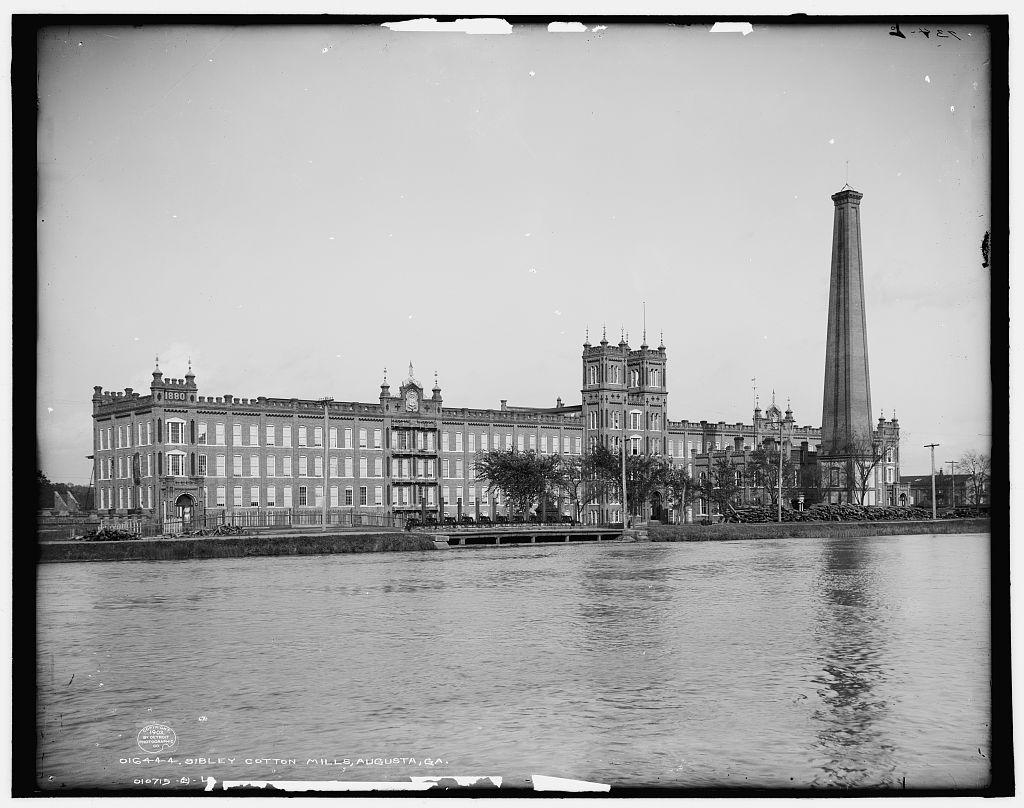
Georgia's textile history begins with the cotton gin. Eli Whitney built his first working gin in 1793 at Mulberry Grove, the plantation of Catharine Greene, widow of the Revolutionary general Nathanael Greene. Copies soon spread across the South, and Georgia became part of the expanding slaveholding cotton frontier. Industrial production followed: the Augusta Canal, built from 1845 to 1847, powered cotton mills and, during the Civil War, the Confederate Powder Works. Columbus on the Chattahoochee became a major industrial center supplying cloth to the Confederacy. After the war, Bibb Manufacturing in Macon (1876) grew into one of the South's largest textile firms. Atlanta's 1881 International Cotton Exposition—proposed by the New England textile insurer Edward Atkinson, run by H. I. Kimball, and championed by the Atlanta Constitution's Henry Grady—announced the 'New South' industrial program. In the 1934 strike, deputies and strikers died in clashes at Trion and elsewhere, and Governor Talmadge's National Guard arrested pickets at Newnan and held them at Fort McPherson without legal process. In 2005 WestPoint Stevens, the West Point-based heir to the Lanier family's textile empire, emerged from bankruptcy under the control of Carl Icahn.
In memoriam: industrial tragedies
1934Fort McPherson Detentions
More than 100 detained
On Governor Talmadge's orders, Guardsmen arrest more than a hundred pickets at Newnan and hold them for about a week behind barbed wire at Fort McPherson.
1934Trion and Other Killings
Several
At Trion on September 5, a deputy and a striker sympathizer are killed and about twenty wounded; further deaths follow at Augusta and Aragon.
What remains
The Augusta Canal National Heritage Area preserves the canal and its mills, including the Enterprise Mill, home to the Augusta Canal Discovery Center. The Atlanta History Center holds collections from the 1881 Cotton Exposition.
Sources
- ScholarshipHarvey K. Newman. Cotton Expositions in Atlanta. New Georgia Encyclopedia.
- ScholarshipForeign Prisoners of War. New Georgia Encyclopedia.
- ScholarshipThe 1934 general textile strike in Georgia. Southern Changes (Emory University).
- Primary sourceWestPoint Stevens sale to American Real Estate Partners completed. U.S. Securities and Exchange Commission, EDGAR, 2005.