Tragedy · Chapter 05, 1793–1850
The Hands That Picked
The enslaved people who grew the cotton, as named individuals and as the largest financial asset in the American economy.
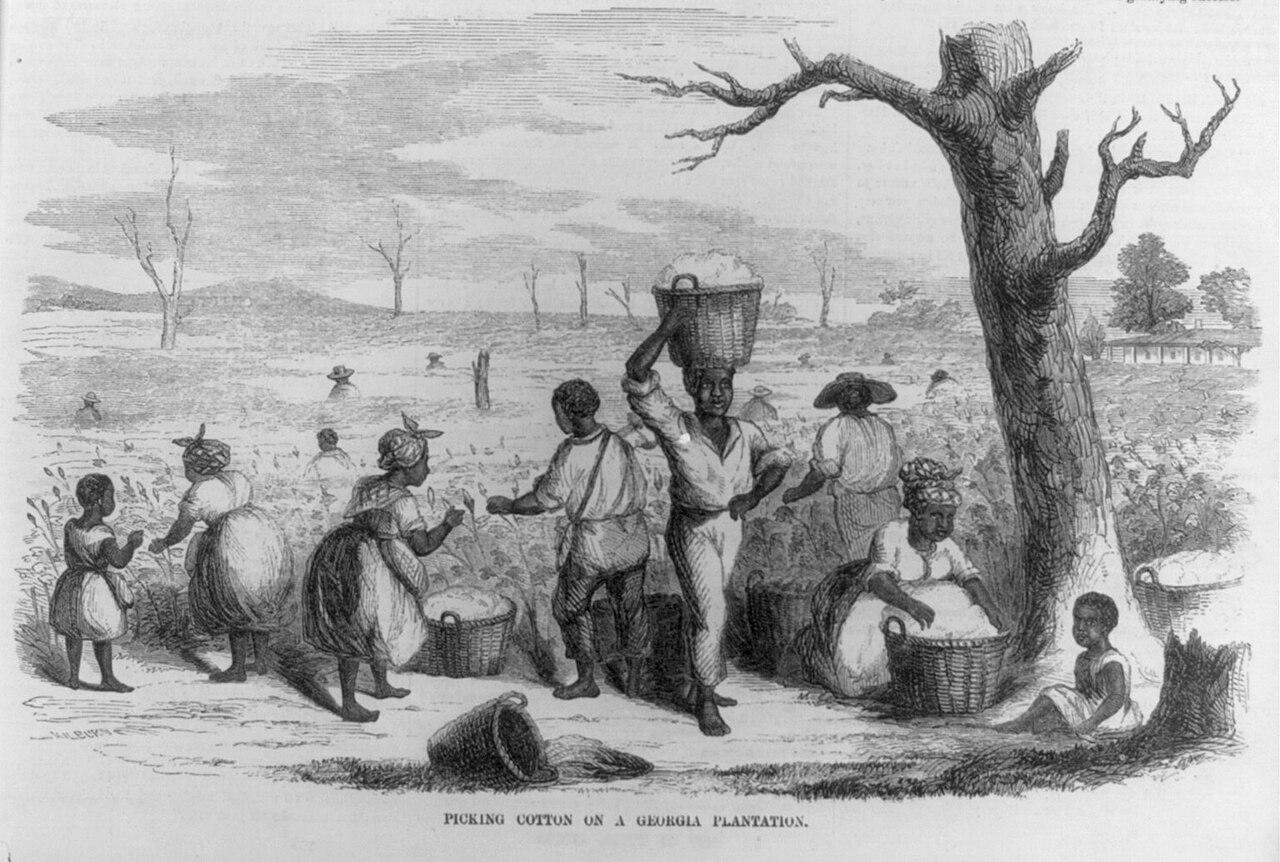
The cotton that fed Lowell's looms was picked by people with names. Charles Ball, born into slavery in Calvert County, Maryland, around 1781, was sold to a Georgia trader, chained by the neck with fifty-one others, and marched for more than a month to Columbia, South Carolina, where he was sold to a cotton planter. In the narrative he dictated, published in 1837, he described the work exactly: a bag hung from the neck, the rows walked side to side, each picker's cotton weighed at night under the overseer's eye, sixty pounds of seed cotton expected from a good field, the picking season running from August into January. He escaped twice. Ball's labor was also capital. By 1860 the nearly four million people enslaved in the United States were valued at roughly $3 billion to $3.5 billion, more, as historian David Blight has emphasized, than all of the nation's manufacturing and railroads combined. How enslavers extracted ever more cotton from them is debated. In The Half Has Never Been Told (2014), Edward Baptist argued that a 'pushing system' of individual quotas, raised whenever they were met and enforced by calibrated torture, his metaphorical 'whipping-machine,' drove the quadrupling of daily picking rates between 1800 and 1860. The economic historians Alan Olmstead and Paul Rhode, whose estimates Baptist used, countered in 2018 that improved cotton varieties explain much of that rise and that plantation records do not show ever-rising quotas. Neither side disputes the violence; the question is what it explains.
Sources
- Primary sourceCharles Ball. Slavery in the United States: A Narrative of the Life and Adventures of Charles Ball, a Black Man. John S. Taylor (via Documenting the American South, UNC-Chapel Hill), 1837.
- ScholarshipEdward E. Baptist. The Half Has Never Been Told: Slavery and the Making of American Capitalism. Basic Books, 2014.
- ScholarshipAlan L. Olmstead and Paul W. Rhode. Cotton, Slavery, and the New History of Capitalism. Explorations in Economic History, 2018.
- ScholarshipDavid W. Blight. The Civil War and Reconstruction Era, 1845–1877 (HIST 119), lecture on King Cotton. Open Yale Courses, 2008.