Innovation · Chapter 16, 1950–1980
The Wash-and-Wear Revolution
The shirt that promised to retire the iron.
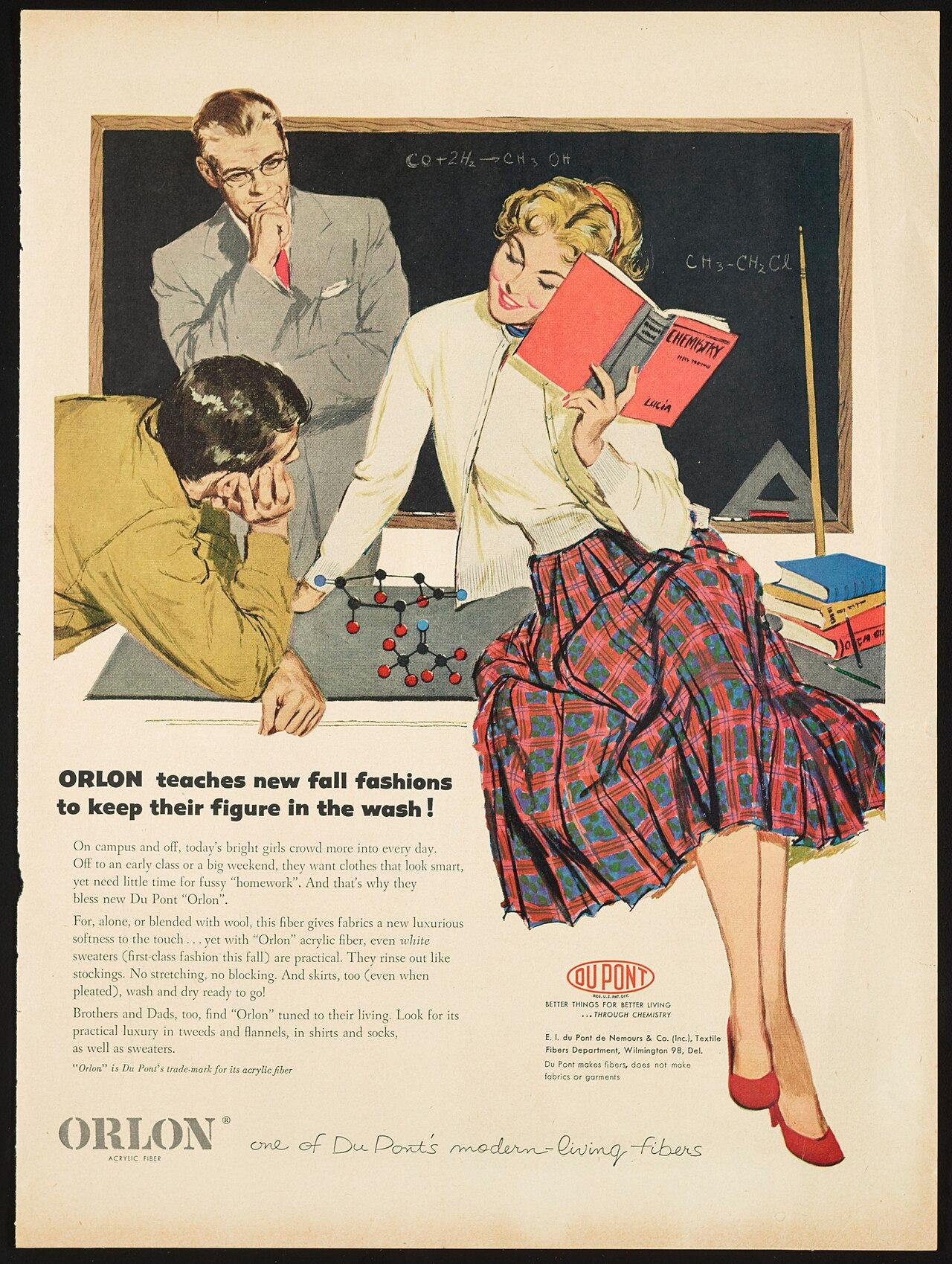
In 1953, Brooks Brothers, working with DuPont, introduced shirts in a Dacron-and-cotton blend—later woven by Cone Mills as 'Brooksweave,' sixty-five percent Dacron—that could be washed at night, hung up wet, and worn the next morning without ironing. Through the 1950s other makers followed, and cotton chemists, including Ruth Benerito at the U.S. Department of Agriculture, developed resin treatments that cross-linked cotton fibers to resist wrinkles. By the mid-1960s, 'permanent press' had spread from shirts to trousers, sheets, and uniforms. The technology delivered a real social shift: much of the weekly labor of ironing, which fell overwhelmingly on women, receded from American homes. It also had a cost: many durable-press resins release formaldehyde, and the federal formaldehyde standard adopted in 1987 applied to workers in garment and textile-finishing plants.
Sources
- Archive / museumDacron shirts (DuPont promotional photograph). Hagley Museum and Library, 1955.
- Primary sourceBrooks Brothers Heritage. Brooks Brothers.
- ScholarshipThe War Over Non-Iron Shirts. MR Magazine.
- Government recordOccupational Exposure to Formaldehyde (29 CFR 1910.1048). U.S. Occupational Safety and Health Administration, 1987.