PA · Textile era 1820–1980s
Pennsylvania
Hosiery, Wool, and the Philadelphia System
By the late nineteenth century, Philadelphia was one of the largest textile centers in the United States, running on a system of hundreds of small, specialized, family-owned mills that produced everything from carpets to hosiery to fine worsteds. Reading and Berks County became a national center of full-fashioned hosiery. Mother Jones's 1903 'March of the Mill Children' from Philadelphia toward New York remains one of the best-known early protests against industrial child labor.
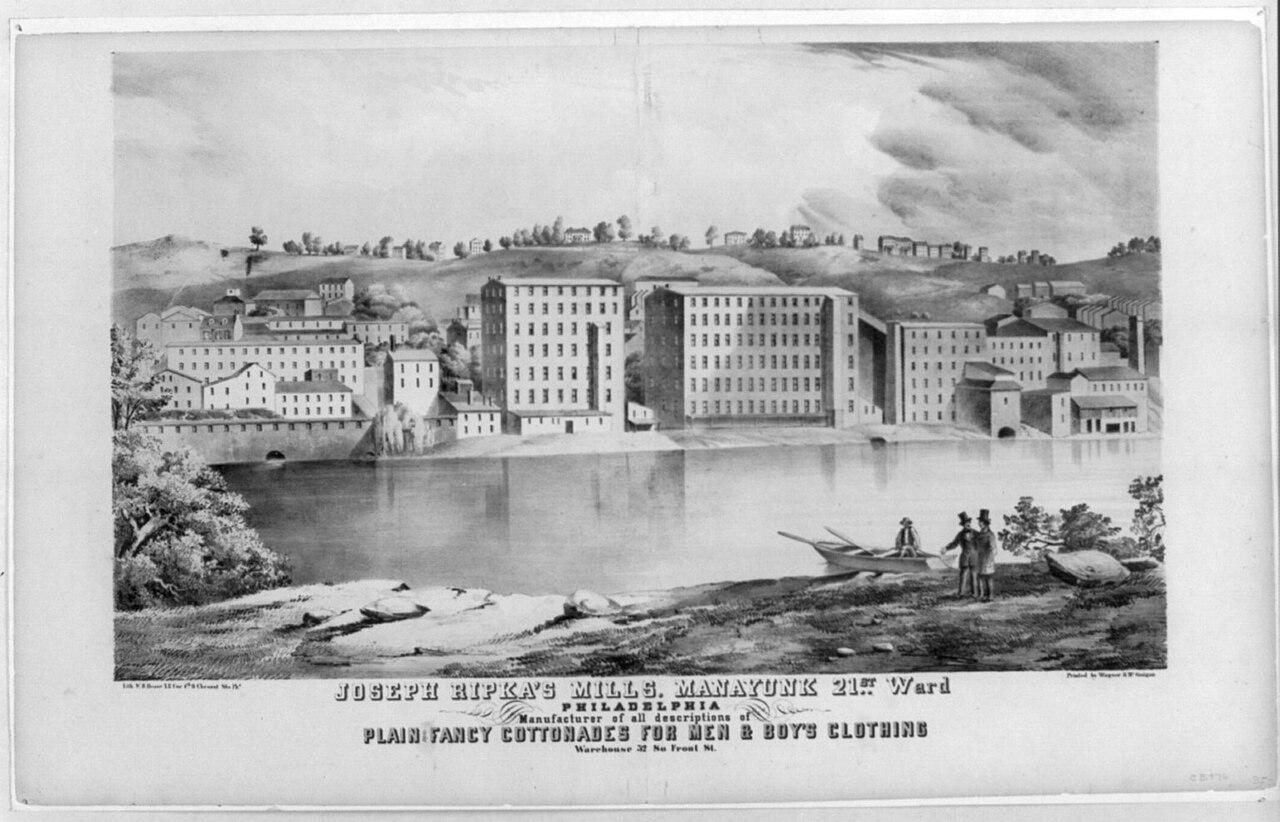
Where New England built massive integrated corporations, Philadelphia built a dense, flexible textile economy of hundreds of small, often family-owned firms—carpet weavers, hosiery knitters, worsted spinners, lace makers, and dyers-clustered in Kensington, Manayunk, and other mill neighborhoods. The historian Philip Scranton has called this pattern 'proprietary capitalism,' and by the 1880s it had made Philadelphia one of the leading textile-producing cities in the nation. Reading and the surrounding Berks County region became a center of full-fashioned hosiery, whose Berkshire Knitting Mills grew into one of the largest hosiery plants in the world, supplying the silk-stocking market that survived into the nylon era. In the summer of 1903, during a strike by tens of thousands of Philadelphia textile workers for shorter hours, Mother Jones led a band of striking children—some of them maimed by machinery—on a march toward President Theodore Roosevelt's summer home at Oyster Bay, Long Island. Roosevelt declined to meet them, but the march drew national attention to child labor in the mills and fed the campaign that eventually produced federal limits in 1938.
What remains
Kensington and Manayunk preserve dense neighborhoods of former textile mills and lofts, many now adapted as housing, studios, and small manufacturing space.
Sources
- ScholarshipPhilip Scranton. Proprietary Capitalism: The Textile Manufacture at Philadelphia, 1800–1885. Cambridge University Press, 1983.
- ScholarshipPhilip Scranton. Figured Tapestry: Production, Markets, and Power in Philadelphia Textiles, 1885–1941. Cambridge University Press, 1989.
- Primary sourceMary Harris Jones. The Autobiography of Mother Jones. Charles H. Kerr & Company, 1925.