Tragedy · Chapter 01, Before 1600
The Long Walk and the Trading Post
1863 to the 1930s: how conquest, confinement, and federal policy reshaped Diné weaving.
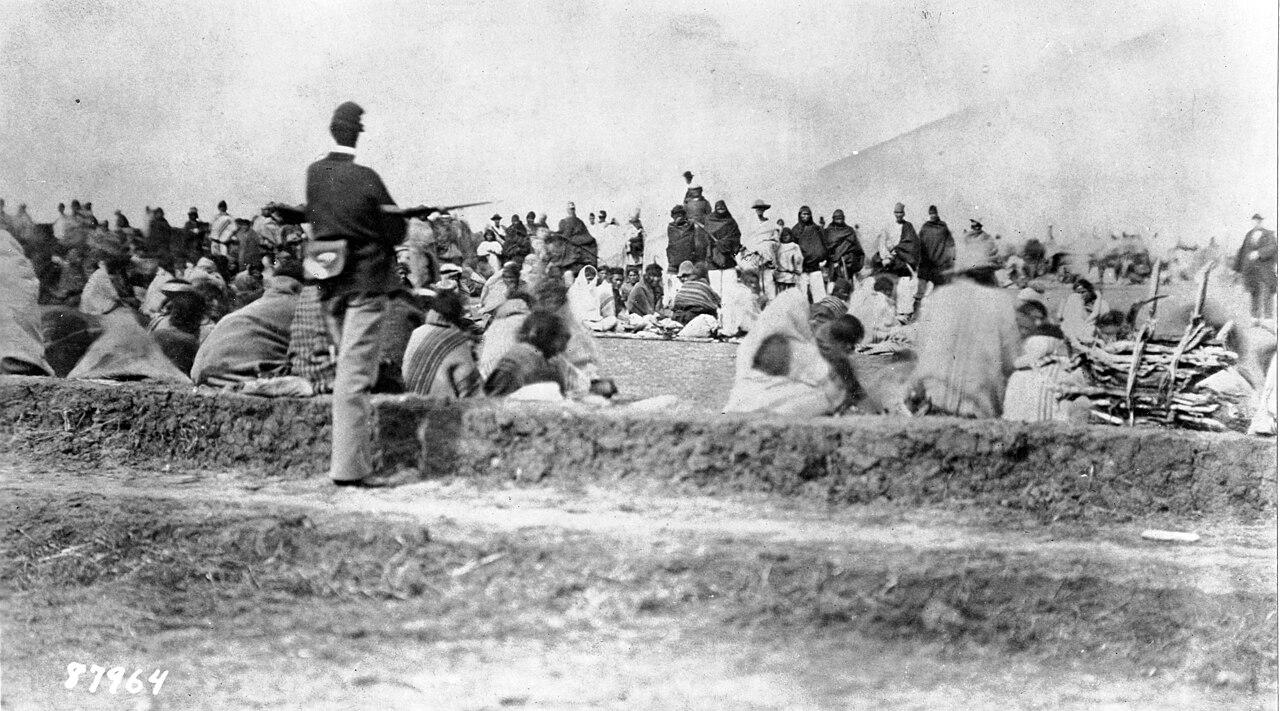
Colonization did not end Indigenous textile traditions, but it repeatedly attacked their foundations. The sharpest blow to Diné weaving came in 1863 and 1864, when General James H. Carleton ordered Colonel Christopher 'Kit' Carson to break Diné resistance with a scorched-earth campaign: troops burned villages and fields, destroyed water sources, and slaughtered the flocks on which Diné life and weaving depended. Between 1863 and 1866, more than ten thousand Diné were marched between 250 and 450 miles to Bosque Redondo at Fort Sumner, New Mexico, a reservation that functioned as an internment camp; hundreds died on the way. The treaty signed on June 1, 1868, let the survivors go home, and in November 1869 the government distributed fifteen thousand sheep and goats, about two animals per person. Recovery ran through the trading post. John Lorenzo Hubbell bought his post at Ganado in 1878; traders bought wool, pelts, and weavings and steered weavers from wearable blankets toward floor rugs for Anglo-American buyers, popularizing designs such as the Ganado Red. In 1883 alone, traders bought more than 1.3 million pounds of Diné wool. Then, beginning in 1934, the federal livestock reduction program killed or removed hundreds of thousands of sheep, goats, and horses in the name of soil conservation, falling hardest on Diné women, the principal owners of the flocks. Weaving survived all of it.
Sources
- ScholarshipThe Long Walk. National Museum of the American Indian, Native Knowledge 360°: The Navajo Treaty of 1868.
- ScholarshipRestocking the Navajo Reservation After the Bosque Redondo. New Mexico Historical Review 58, no. 4, 1983.
- Government recordHubbell Trading Post National Historic Site: History & Culture. National Park Service.
- ScholarshipMarsha Weisiger. Dreaming of Sheep in Navajo Country. University of Washington Press, 2009.