Innovation · Chapter 01, Before 1600
The Diné Loom
How the Diné made the Pueblo upright loom and Spanish sheep into one of the world's great weaving traditions.
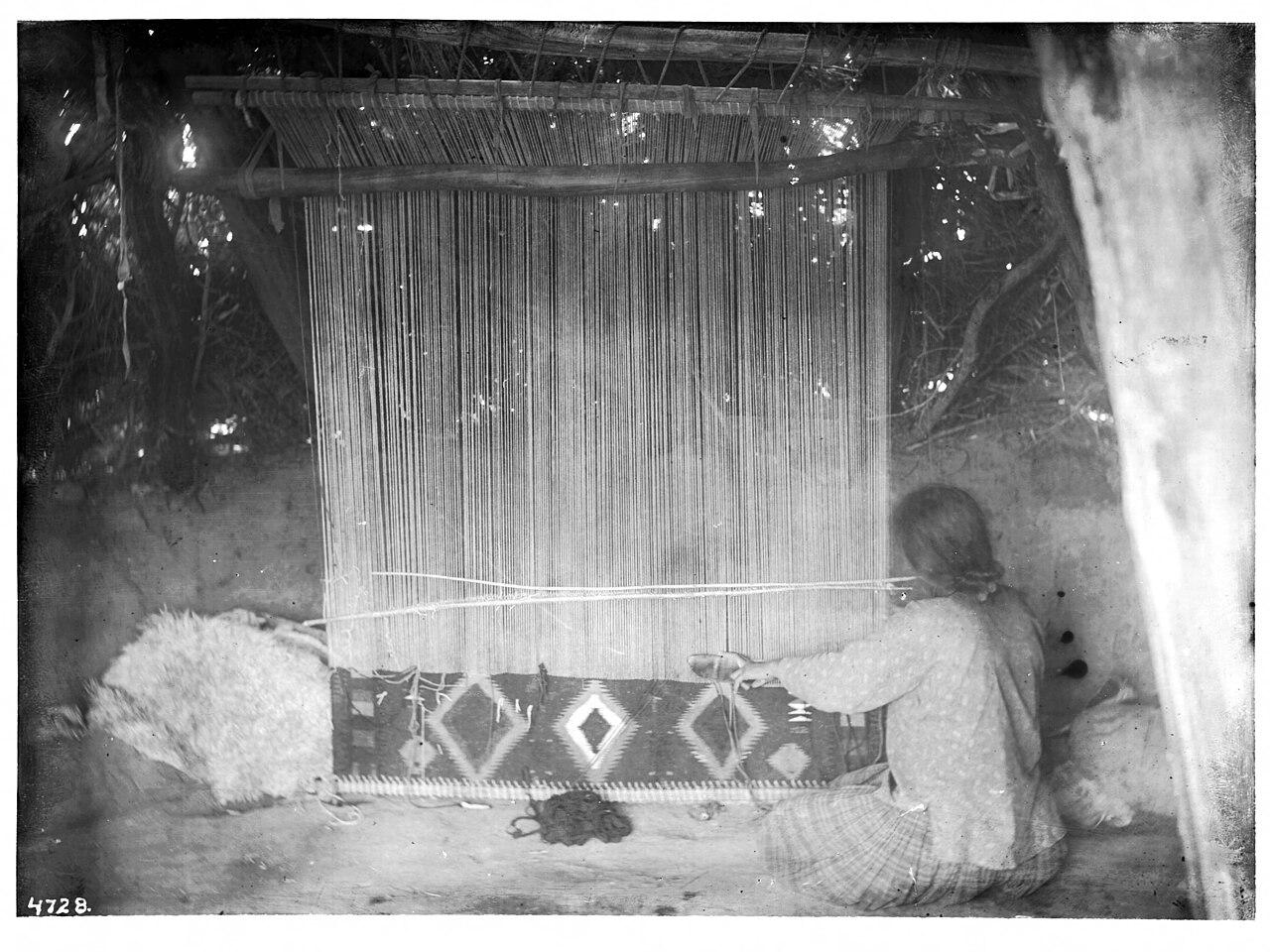
This story crosses the chapter's 1600 boundary on purpose, because it is a story of continuity rather than sudden invention. Athabaskan-speaking ancestors of the Diné (Navajo) were living in the Southwest by roughly 1400 CE. Pueblo peoples had been weaving cotton on upright looms for centuries, and in 1598 Juan de Oñate's colonizing expedition brought churra sheep up the Camino Real de Tierra Adentro. Over the seventeenth century, as Pueblo people fleeing Spanish repression found refuge among the Diné, Diné women adopted the Pueblo upright loom and the wool of the Spanish sheep. By about 1650 weaving had emerged as a distinctive Diné practice, and by the early 1700s Diné blankets were traded across the region and prized for their tight weave. Diné weavers transformed what they received: weaving became women's work rather than men's, and a tapestry technique, in which the weft hides the warp, opened the way to bold geometric design. Diné tradition gives a different and older account, crediting Spider Man with teaching the people to build a loom of sunshine, lightning, and rain, and Spider Woman with teaching them to weave. The sheep themselves became the Navajo-Churro breed, and the Diné saying dibé bé iiná, 'sheep is life,' names a bond among land, flock, and loom that the following centuries would test.
Sources
- ScholarshipTradition & Trade: 19th-Century Navajo Weaving. Arizona State Museum, University of Arizona.
- Government recordNew Mexico Fiber Arts Traditions. National Park Service.
- ScholarshipNavajo Textiles: 1840–1910 (gallery guide). Nerman Museum of Contemporary Art.