Innovation · Chapter 01, Before 1600
Cotton on the Mesa
Ancestral Pueblo and Hopi weavers, and a fiber grown in the desert for centuries before Europeans arrived.
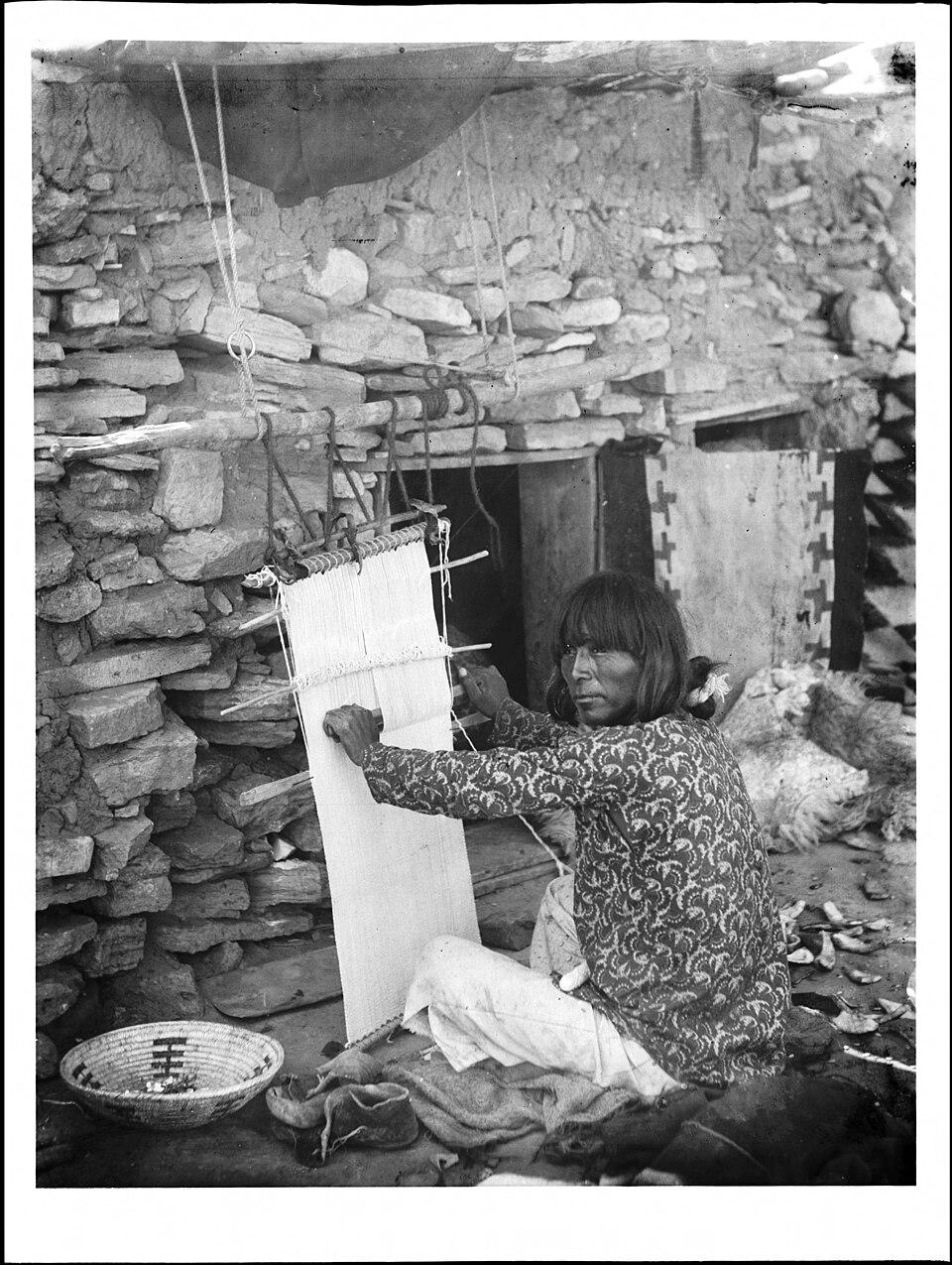
Cotton is not native to the Colorado Plateau; it had to be carried there, adapted, and coaxed to grow. Domesticated cotton remains from the Eagle Ridge site in southern Arizona date to the fourth century CE, and pollen from Arizona sites hints at cotton far earlier. A drought-hardy variety, Gossypium hopi, moved north of the Mogollon Rim around 700 CE. By about 900 CE, Ancestral Pueblo weavers were producing cotton cloth on backstrap looms, a technology whose lineage runs south to Mesoamerica. Between roughly 1150 and 1300, a cotton textile industry flourished across northeastern Arizona and southeastern Utah; at Cedar Mesa, archaeologists have recovered loom parts and weaving tools, and the geometry of woven cloth reappears on painted pottery and kiva murals. Later, in the northern Rio Grande, Pueblo farmers built gravel-mulched fields in which, pollen studies suggest, cotton was the principal crop. Among the Hopi, one of the Pueblo nations descended from these communities, weaving has traditionally been men's work, often done in the kiva. Cotton remained the prescribed fiber for ceremonial textiles such as the white wedding robe even after Spanish sheep made wool common by about 1650. The continuity is literal: the same plant, and much of the same knowledge, has passed through more than a thousand years of hands.
Sources
- ScholarshipA Remarkable Recovery: Cotton Pollen Identified from the Haynie Site. Crow Canyon Archaeological Center.
- ScholarshipBen Bellorado and Chuck LaRue. Cotton Weaving in Mesoamerica and the Northern US Southwest: A Study of Loom Parts and Weaving Tools Across 1,000 Years and Two Continents. Arizona Archaeological and Historical Society.
- ScholarshipUsing Cross-Media Approaches to Understand an Invisible Industry: How Cotton Production Influenced Pottery Designs and Kiva Murals in Cedar Mesa. Kiva, 2016.
- ScholarshipLiving Arts of the Hopi: Weaving. Timothy S. Y. Lam Museum of Anthropology, Wake Forest University.