Innovation · Chapter 09, 1861–1865
Measuring the Union Army
How wartime measurement shaped ready-made sizing—and what the myth of 'S, M, L' gets wrong.
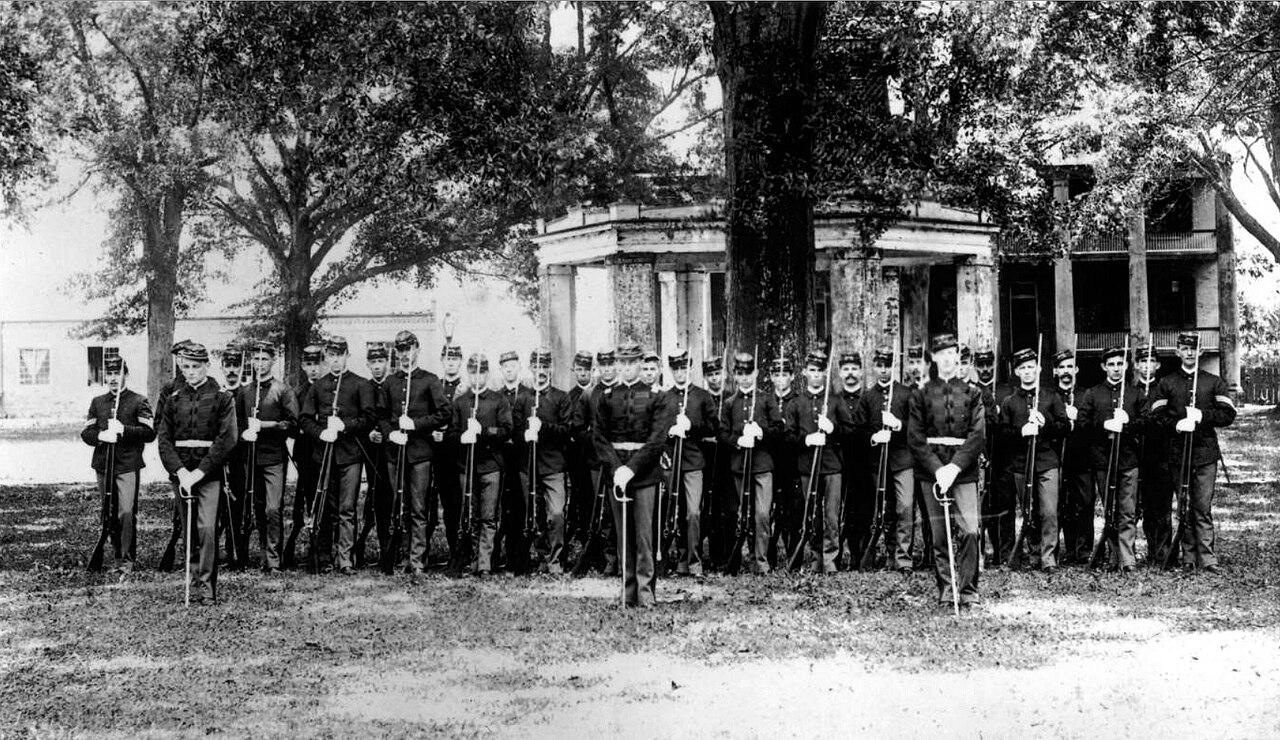
Two different wartime projects are often blurred together. The first was practical: the Quartermaster's Department issued uniforms in four numbered sizes, graded roughly from a 36- to a 42-inch breast, so that contractors could cut garments in bulk. The second was scientific: beginning in 1863, the U.S. Sanitary Commission sent trained examiners with calipers, tape, and spirometers to measure 23,785 men—white and Black Union soldiers, sailors, Confederate prisoners, and others—and its actuary, the astronomer Benjamin Apthorp Gould, also tabulated the ages and heights recorded for more than a million volunteers. Gould's 1869 report became a landmark of American anthropometry; it also ranked bodies by race in ways later used to support claims of innate racial difference. Popular accounts claim this survey invented small, medium, and large; no evidence supports that. What the war did do, historians of government contracting conclude, was spread the habit of standard men's sizes into the postwar ready-to-wear trade. Standard women's sizes came much later.
Sources
- Primary sourceBenjamin Apthorp Gould. Investigations in the Military and Anthropological Statistics of American Soldiers. U.S. Sanitary Commission / Hurd and Houghton, 1869.
- ScholarshipDora L. Costa. The Measure of Man and Older Age Mortality: Evidence from the Gould Sample (NBER Working Paper 8843). National Bureau of Economic Research, 2002.
- ScholarshipThe Civil War to 1880 (A History of Government Contracting). George Washington University Law School.
- ScholarshipRace, Lung Function, and the Historical Context of Prediction Equations. JAMA Network Open, 2023.