Impact · Chapter 11, 1880–1920
'The Chinese of the Eastern States'
French-Canadian migration to the New England mills, and the 1881 report that slandered it.
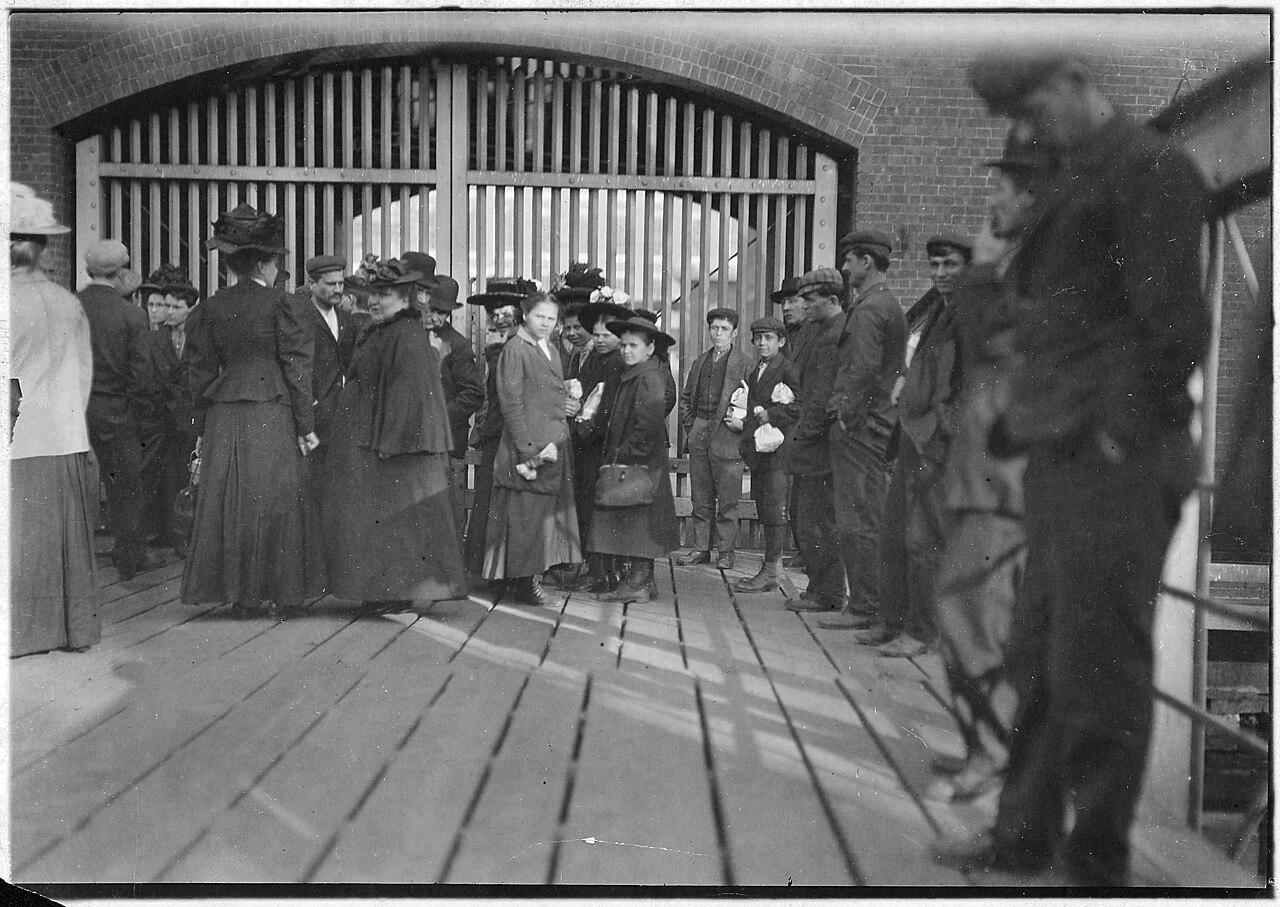
Between 1840 and 1930, roughly 900,000 French-speaking Quebecers left for the United States, and the textile cities of New England absorbed a large share of them. They came by rail, often as whole families, drawn by mill recruiters working the Québec countryside and by relatives already at work. New England's French-Canadian population grew from about 37,000 in 1860 to 573,000 in 1900. They built Petits Canadas, Little Canadas, around French-language parishes, schools, and newspapers in Fall River, Lowell, Lewiston, Woonsocket, and above all Manchester, New Hampshire, where in 1909, when Lewis Hine photographed workers leaving the mill yard, about 40 percent of the Amoskeag Manufacturing Company's roughly 15,000 employees were Franco-American. In 1908 Manchester's Franco-Americans founded La Caisse Populaire Sainte-Marie, the first credit union in the United States. Their reception was often hostile. In 1881 the Massachusetts Bureau of Statistics of Labor, under Carroll D. Wright, published a report calling French Canadians 'the Chinese of the Eastern States': transient, clannish, and an obstacle to the ten-hour day. It appeared the year before Congress passed the Chinese Exclusion Act. Franco-American leaders, among them the editor Ferdinand Gagnon and the lawyer Hugo Dubuque, demanded a hearing, and on October 25, 1881, they testified at the State House in Boston. Wright printed their rebuttal and conceded in his next report that the community meant to stay. The slur outlived the retraction, resurfacing in testimony before the U.S. Senate in 1883.
Sources
- ScholarshipFlashpoint: Fall River. Query the Past.
- ScholarshipFrench Canadian Immigration to Vermont and New England (1840–1930). Vermont History 86, no. 1.
- ScholarshipGary Samson. Le Patrimoine franco-américain: Franco-American Heritage in New Hampshire. Smithsonian Folklife Festival Program Book, 1999.
- Primary sourceCarroll D. Wright. The Canadian French in New England. Massachusetts Bureau of Statistics of Labor, Thirteenth Annual Report, 1882.