Threading America · Teacher edition · Chapter 8
The Sewing Revolution
Howe, Singer, and the Mechanization of the Stitch · 1846–1860
Guiding question
Did the sewing machine free needleworkers or simply speed up their exploitation?
Teacher notes
Objectives
Students will be able to:
- Place the chapter's key events, from 1846 to 1856, in order and explain why each mattered.
- Analyze 2 primary sources for context, audience, purpose, and point of view.
- Use the chapter's vocabulary accurately: Lockstitch, Shuttle, Patent pool, Installment plan, Outwork.
- Write an evidence-based argument that answers the guiding question.
AP U.S. History
Period 4 (1800–1848), Period 5 (1844–1877)
Standards
| Framework | Code | Students |
|---|---|---|
| C3 Framework | D2.His.1.9-12 | Explain how events were shaped by their time and place and by broader historical contexts. |
| C3 Framework | D2.His.4.9-12 | Analyze the factors that shaped people's perspectives in different eras. |
| C3 Framework | D2.His.10.9-12 | Identify the limitations of different kinds of historical evidence. |
| C3 Framework | D2.His.16.9-12 | Integrate evidence from multiple sources into a reasoned argument about the past. |
| Common Core | RH.9-10.1 / RH.11-12.1 | Cite specific textual evidence from primary and secondary sources. |
| Common Core | RH.9-10.4 / RH.11-12.4 | Determine the meaning of words and phrases as used in historical texts. |
| Common Core | RH.9-10.6 / RH.11-12.6 | Compare and evaluate authors' points of view on the same events. |
| Common Core | WHST.9-10.1 / WHST.11-12.1 | Write arguments focused on discipline-specific content. |
Pacing
Day 1 (50 minutes)
- 5 minBefore you read: guiding question and predictions
- 15 minReading and timeline
- 25 minPrimary source workshop (2 sources)
- 5 minExit ticket
Day 2 (50 minutes)
- 5 minKey terms matching
- 20 minCorroboration and discussion questions
- 25 minClaim, evidence, reasoning paragraph
Teaching hard history
- Never use role-play or simulations of slavery, violence, or other atrocities. Ask students to analyze the testimony and documented choices of real people instead.
- Pair the voices of the people who did the work (enslaved people, children, strikers, immigrants) with the voices of those who profited, and ask whose records survived and why.
- Primary sources are reproduced word for word, including period language and dialect transcribed by interviewers. Before reading, discuss who recorded each source and for whom. Do not ask students to perform dialect aloud.
- Tell students before they see images of injured, captive, or dead people, and give them a way to step back.
- Distinguish what the sources show from what they cannot prove. Several stories in this exhibit correct popular myths; name the myth, then the evidence.
Guidance follows Learning for Justice, "Teaching Hard History: American Slavery" (Southern Poverty Law Center, 2018).
Answer key: key terms
Lockstitch: B · Shuttle: A · Patent pool: E · Installment plan: D · Outwork: C
Part 1Before you read
- Read the guiding question. Write down what you already know, or think you know, about it.
- Predict one way your answer might change after reading the sources.
Part 2Read
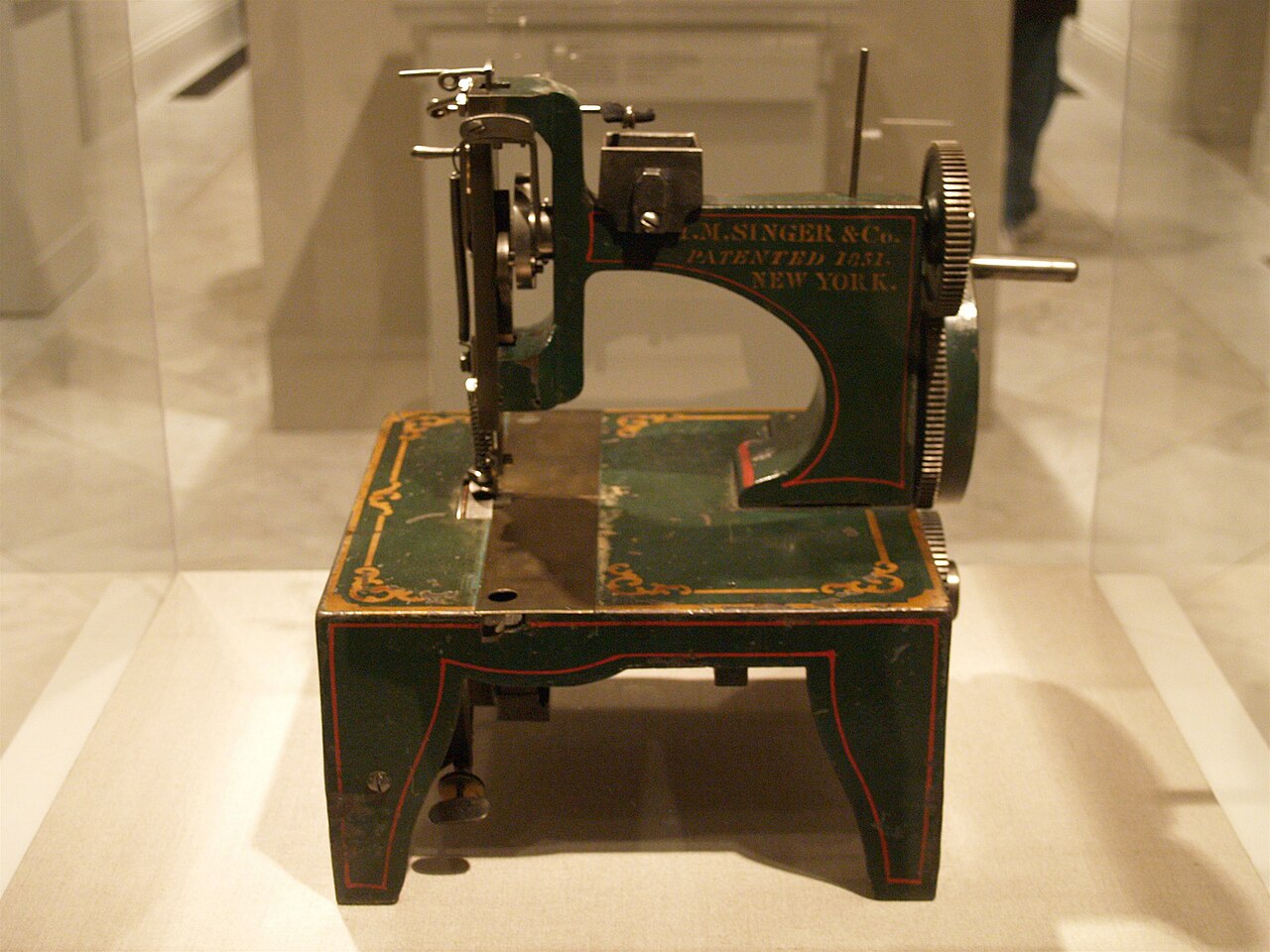
The sewing machine was one of the most consequential technological leaps in the history of clothing. It moved the factory principle from the cloth to the garment—and helped build one of the first mass consumer-durables markets in American history.
For centuries every stitch of clothing was made by hand. Elias Howe's 1846 lockstitch patent, Isaac Singer's practical refinements of 1851, and improvements by Wheeler & Wilson and Grover & Baker turned hours of hand-sewing into minutes. The machine did not stay in the shop: it migrated into the parlor of the middle-class home, sold by agents on installment plans. The sewing machine became one of the first mass-marketed consumer durables and a pioneer of installment credit, and it accelerated the ready-to-wear clothing industry. For the tens of thousands of women who earned their living by the needle, it raised output without raising pay: the National Museum of American History notes that the machines did not greatly increase seamstresses' earnings.
Part 3Timeline
Students write one sentence on why each event mattered.
- 1846
Howe's Lockstitch Patent
Elias Howe receives patent No. 4,750 for a lockstitch machine combining an eye-pointed needle with a shuttle; he struggles to find buyers.
- 1851
Singer's Machine
Isaac Singer patents his own machine; Howe sues, and in 1854 the courts uphold Howe's claims, forcing Singer to pay royalties.
- 1856
Singer's Installment Plan
Singer's partner Edward Clark introduces installment buying, among the first such plans offered by a nationally distributed manufacturer.
- 1856
The Sewing Machine Combination
On October 24, Howe and three manufacturers pool their patents in the 'Albany Agreement'—the first patent pool in American industry.
Part 4Key terms
- Lockstitch (answer B)
- A stitch made by two threads, one from a needle and one from a shuttle or bobbin, that interlock inside the fabric.
- Shuttle (answer A)
- A small boat-shaped holder that carries the lower thread back and forth beneath the cloth in a sewing machine.
- Patent pool (answer E)
- An agreement among inventors or companies to share their patents and split the royalties instead of suing each other.
- Installment plan (answer D)
- A way of buying an expensive item by paying a little at a time; Singer used it to sell sewing machines to households.
- Outwork (answer C)
- A system in which manufacturers sent cut cloth to workers' homes to be sewn and paid them by the piece.
Part 5Primary source workshop
These excerpts are quoted word for word, including the spelling and language of their time.
Document A
The Song of the Shirt
Thomas Hood, December 1843
With fingers weary and worn, / With eyelids heavy and red, / A woman sat in unwomanly rags, / Plying her needle and thread— / Stitch! stitch! stitch! / In poverty, hunger, and dirt, / And still with a voice of dolorous pitch / She sang the "Song of the Shirt." ... "O, men, with sisters dear! / O, men, with mothers and wives! / It is not linen you're wearing out, / But human creatures' lives!"
Context: Hood wrote this poem after a London court case exposed a seamstress paid so little she pawned her employer's cloth to feed her children. Reprinted widely in Britain and the United States, it became the anthem of needlewomen's misery just as the sewing machine was being invented.
Source: Thomas Hood. The Song of the Shirt. Academy of American Poets (Poets.org). 1843. https://poets.org/poem/song-shirt
- Historical context
- What was happening when and where this was created?
- Intended audience
- Who was meant to read, hear, or see it?
- Purpose
- Why was it created? What did its creator want to happen?
- Point of view
- Whose perspective does it show, and whose is missing?
Document B
U.S. Patent No. 4,750: Sewing-Machine
Elias Howe Jr., September 10, 1846
In sewing a seam with my machine two threads are employed, one of which threads is carried through the cloth by means of a curved needle, the pointed end of which is to pass through said cloth. ... It will therefore be seen that a stitch is made at every back-and-forth movement of the shuttle.
Context: Howe's patent for a lockstitch machine combined an eye-pointed needle with a shuttle carrying a second thread. His lawsuits against Isaac Singer and others led to the 1856 "Sewing Machine Combination," a patent pool that let machines be mass-produced.
Source: Elias Howe Jr. United States Patent 4750. United States Patent Office (via Wikisource). 1846. https://en.wikisource.org/wiki/United_States_patent_4750
- Historical context
- What was happening when and where this was created?
- Intended audience
- Who was meant to read, hear, or see it?
- Purpose
- Why was it created? What did its creator want to happen?
- Point of view
- Whose perspective does it show, and whose is missing?
Corroborate
Compare "The Song of the Shirt" (Thomas Hood, December 1843) with "U.S. Patent No. 4,750: Sewing-Machine" (Elias Howe Jr., September 10, 1846). Where do they agree, where do they differ, and what might explain the differences?
Part 6Discuss
- In your own words, explain how Howe's machine forms a stitch using two threads.
- Hood's poem appeared in the British humor magazine Punch at Christmas 1843, three years before Howe's patent. Why would a poet and an inventor describe sewing in such different language?
- Machines made a shirt faster to sew. Using the chapter narrative, explain who captured the time and money that the machine saved: workers, manufacturers, or buyers?
- Hood's lines "It is not linen you're wearing out, / But human creatures' lives!" could describe fast-fashion supply chains today. Is that comparison fair? Use evidence to support your answer.
Part 7Write: claim, evidence, reasoning
Answer the guiding question in one paragraph, using the documents and the reading.
| Claim | Answers the guiding question directly in one or two sentences. |
|---|---|
| Evidence | Cites at least two primary sources by name and at least one fact from the reading. |
| Reasoning | Explains how each piece of evidence supports the claim. |
| Sourcing | Notes at least one limitation of a source: who made it, when, and why. |
Part 8Exit ticket
- In one sentence, how would you answer the guiding question now?
- What piece of evidence would most change your mind?
Keep exploring
- Innovation
The Sewing Machine Combination
The first patent pool in U.S. history, born of years of lawsuits.
https://www.threadingamerica.com/topics/sewing-machine-combination
- Innovation
Singer's Installment Plan
A turning point in American consumer credit.
https://www.threadingamerica.com/topics/singer-installment-plan
- Impact
The Seamstress and the Machine
An economic cost rarely written into the history of the machine.
https://www.threadingamerica.com/topics/death-of-the-seamstress
Places: Massachusetts, New York, Connecticut