Threading America · Teacher edition · Chapter 14
The Great Textile Strike
Honea Path and the General Walkout of 1934 · 1934
Guiding question
Did the federal government protect or abandon Southern textile workers during the 1934 General Strike?
Teacher notes
Objectives
Students will be able to:
- Place the chapter's key events, from 1933 to 1934, in order and explain why each mattered.
- Analyze 2 primary sources for context, audience, purpose, and point of view.
- Use the chapter's vocabulary accurately: General strike, Flying squadron, Blacklist, NRA code, Board of inquiry.
- Write an evidence-based argument that answers the guiding question.
AP U.S. History
Period 7 (1890–1945)
Standards
| Framework | Code | Students |
|---|---|---|
| C3 Framework | D2.His.1.9-12 | Explain how events were shaped by their time and place and by broader historical contexts. |
| C3 Framework | D2.His.4.9-12 | Analyze the factors that shaped people's perspectives in different eras. |
| C3 Framework | D2.His.10.9-12 | Identify the limitations of different kinds of historical evidence. |
| C3 Framework | D2.His.16.9-12 | Integrate evidence from multiple sources into a reasoned argument about the past. |
| Common Core | RH.9-10.1 / RH.11-12.1 | Cite specific textual evidence from primary and secondary sources. |
| Common Core | RH.9-10.4 / RH.11-12.4 | Determine the meaning of words and phrases as used in historical texts. |
| Common Core | RH.9-10.6 / RH.11-12.6 | Compare and evaluate authors' points of view on the same events. |
| Common Core | WHST.9-10.1 / WHST.11-12.1 | Write arguments focused on discipline-specific content. |
Pacing
Day 1 (50 minutes)
- 5 minBefore you read: guiding question and predictions
- 15 minReading and timeline
- 25 minPrimary source workshop (2 sources)
- 5 minExit ticket
Day 2 (50 minutes)
- 5 minKey terms matching
- 20 minCorroboration and discussion questions
- 25 minClaim, evidence, reasoning paragraph
Teaching hard history
- Never use role-play or simulations of slavery, violence, or other atrocities. Ask students to analyze the testimony and documented choices of real people instead.
- Pair the voices of the people who did the work (enslaved people, children, strikers, immigrants) with the voices of those who profited, and ask whose records survived and why.
- Primary sources are reproduced word for word, including period language and dialect transcribed by interviewers. Before reading, discuss who recorded each source and for whom. Do not ask students to perform dialect aloud.
- Tell students before they see images of injured, captive, or dead people, and give them a way to step back.
- Distinguish what the sources show from what they cannot prove. Several stories in this exhibit correct popular myths; name the myth, then the evidence.
Guidance follows Learning for Justice, "Teaching Hard History: American Slavery" (Southern Poverty Law Center, 2018).
Answer key: key terms
General strike: D · Flying squadron: C · Blacklist: A · NRA code: B · Board of inquiry: E
Part 1Before you read
- Read the guiding question. Write down what you already know, or think you know, about it.
- Predict one way your answer might change after reading the sources.
Part 2Read
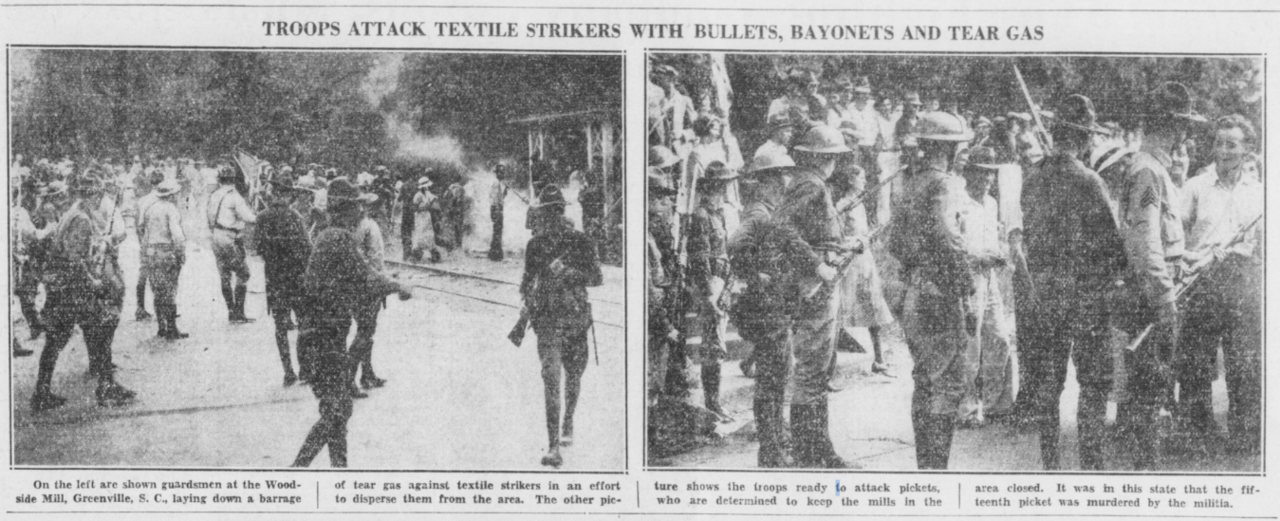
In the depths of the Great Depression, some four hundred thousand textile workers walked off the job in one of the largest strikes in American history—the largest the South had ever seen. It was called off after about three weeks, and Southern textile organizing was set back for decades.
The strike of 1934 was a response to the 'stretch-out'—the management practice of assigning workers more machines for the same pay—and to the failure of the New Deal's cotton textile code to deliver on the promise of Section 7(a) of the National Industrial Recovery Act, which guaranteed the right to organize. The United Textile Workers called the strike for Labor Day weekend, and from Maine to Alabama workers walked out. In the South it was met with state-sanctioned force: governors mobilized the National Guard, sheriffs deputized mill loyalists as special officers, and Georgia's governor declared martial law and detained strikers behind barbed wire. At Honea Path, South Carolina, six strikers were shot dead at the Chiquola Mill on September 6, and a seventh died later. The union called off the strike on September 22, accepting a federal mediation report that won almost nothing, and thousands of strikers were blacklisted.
Part 3Timeline
Students write one sentence on why each event mattered.
- 1933
The NIRA Promise
Section 7(a) of the National Industrial Recovery Act guarantees workers the right to organize; the textile code limits hours, but mill owners widely evade enforcement.
- 1934
The National Walkout
Beginning around September 1, some four hundred thousand textile workers strike from New England to the Deep South.
- 1934
The Honea Path Massacre
On September 6, deputized mill men open fire on pickets at the Chiquola Mill in Honea Path, South Carolina; six die that day and a seventh later.
- 1934
The Strike Called Off and the Blacklist
The union ends the strike on September 22; across the South, mill owners blacklist strikers, and many families lose company-owned homes.
Part 4Key terms
- General strike (answer D)
- A strike in which workers across a whole industry stop work at once; in 1934, textile workers from Maine to Alabama walked out.
- Flying squadron (answer C)
- Groups of strikers who traveled by car and truck from mill to mill to shut down production.
- Blacklist (answer A)
- A list, shared among employers, of workers who should not be hired, often because of union activity.
- NRA code (answer B)
- Rules for wages, hours, and production that industries wrote under the 1933 National Industrial Recovery Act.
- Board of inquiry (answer E)
- A group appointed by the government to investigate a dispute and recommend a settlement.
Part 5Primary source workshop
These excerpts are quoted word for word, including the spelling and language of their time.
Document A
Statement on the Receipt of a Report on the Cotton Textile Strike
Franklin D. Roosevelt, September 20, 1934
The excellent report of the board of inquiry for the Cotton Textile Industry presents findings and recommendations which cover the basic sources of difficulties, and does this in a way which shows the wholly fair and reasonable approach with which the board undertook its task. It is, I think, a good example of the practical way in which industrial problems can be calmly discussed and solved under a republican form of government. It is, of course, greatly to be hoped that a fair solution can be had because of the good-will and intelligence which undoubtedly exist in the industry as a whole including both workers and plant owners.
Context: Roosevelt endorsed the report of the Winant Board, which he had appointed during the strike of roughly 400,000 textile workers. The union called off the strike two days later, but the board's recommendations did little to stop the stretch-out or protect returning strikers.
Source: Franklin D. Roosevelt. Statement on the Receipt of a Report on the Cotton Textile Strike. The American Presidency Project, UC Santa Barbara. 1934. https://www.presidency.ucsb.edu/documents/statement-the-receipt-report-the-cotton-textile-strike
- Historical context
- What was happening when and where this was created?
- Intended audience
- Who was meant to read, hear, or see it?
- Purpose
- Why was it created? What did its creator want to happen?
- Point of view
- Whose perspective does it show, and whose is missing?
Document B
Interview with Sue Hill, Uprising of '34 Collection
Sue Hill, Early 1990s
My daddy was not on the mill ground, he was across the street when they shot him. ... But when they started shooting, people just started running. They were running away from the mill, they shot them in the back, most of 'em, and my daddy was across the street, they shot him five times.
Context: Hill's father was one of the strikers killed on September 6, 1934, when deputies and armed men fired on pickets at the Chiquola Mill in Honea Path, South Carolina. Her account was recorded for the documentary The Uprising of '34.
Source: Sue Hill Interview, Uprising of '34 Collection (L1995-13). Georgia State University Library, Southern Labor Archives. https://webapps.library.gsu.edu/ohms-viewer/viewer.php?cachefile=L1995-13_AV0371.xml
- Historical context
- What was happening when and where this was created?
- Intended audience
- Who was meant to read, hear, or see it?
- Purpose
- Why was it created? What did its creator want to happen?
- Point of view
- Whose perspective does it show, and whose is missing?
Corroborate
Compare "Statement on the Receipt of a Report on the Cotton Textile Strike" (Franklin D. Roosevelt, September 20, 1934) with "Interview with Sue Hill, Uprising of '34 Collection" (Sue Hill, Early 1990s). Where do they agree, where do they differ, and what might explain the differences?
Part 6Discuss
- What did President Roosevelt praise about the board of inquiry's report, and what did he say would make a "fair solution" possible?
- Roosevelt issued his statement two weeks after the Honea Path shootings. What does he leave unsaid, and why might a president who needed both Southern political support and labor votes choose those words?
- Sue Hill's testimony was recorded for a 1990s documentary that broke decades of community silence about 1934. How do memory and silence affect historians' use of oral history?
- The strike ended when the union accepted the board's report, but many strikers were blacklisted and promised protections were not enforced. Do workers today have stronger or weaker protections when they strike? Argue.
Part 7Write: claim, evidence, reasoning
Answer the guiding question in one paragraph, using the documents and the reading.
| Claim | Answers the guiding question directly in one or two sentences. |
|---|---|
| Evidence | Cites at least two primary sources by name and at least one fact from the reading. |
| Reasoning | Explains how each piece of evidence supports the claim. |
| Sourcing | Notes at least one limitation of a source: who made it, when, and why. |
Part 8Exit ticket
- In one sentence, how would you answer the guiding question now?
- What piece of evidence would most change your mind?
Keep exploring
- Labor
The Flying Squadrons
Mobile labor organizing in the Piedmont South.
https://www.threadingamerica.com/topics/flying-squadrons
- Tragedy
The Honea Path Massacre
Six dead at the Chiquola Mill gate in about three minutes; a seventh died later.
https://www.threadingamerica.com/topics/honea-path-massacre
- Impact
The Stretch-Out
The speed-up that detonated the 1934 strike.
https://www.threadingamerica.com/topics/the-stretch-out
- Tragedy
Saylesville and Woonsocket
The National Guard fires on strikers in two Rhode Island mill towns.
https://www.threadingamerica.com/topics/saylesville-massacre
Places: Massachusetts, Rhode Island, North Carolina, South Carolina, Georgia, Virginia, Alabama, Tennessee