Threading America · Teacher edition · Chapter 11
The Gilded Age of Wool
Massive Mills and Southern Migration · 1880–1920
Guiding question
Were child workers in Gilded Age mills the victims of greedy employers, desperate families, or weak laws?
Teacher notes
Objectives
Students will be able to:
- Place the chapter's key events, from 1880s to 1919, in order and explain why each mattered.
- Analyze 2 primary sources for context, audience, purpose, and point of view.
- Use the chapter's vocabulary accurately: Spinner, Doffer, Mill village, National Child Labor Committee, Bread and Roses strike.
- Write an evidence-based argument that answers the guiding question.
AP U.S. History
Period 6 (1865–1898), Period 7 (1890–1945)
Standards
| Framework | Code | Students |
|---|---|---|
| C3 Framework | D2.His.1.9-12 | Explain how events were shaped by their time and place and by broader historical contexts. |
| C3 Framework | D2.His.4.9-12 | Analyze the factors that shaped people's perspectives in different eras. |
| C3 Framework | D2.His.10.9-12 | Identify the limitations of different kinds of historical evidence. |
| C3 Framework | D2.His.16.9-12 | Integrate evidence from multiple sources into a reasoned argument about the past. |
| Common Core | RH.9-10.1 / RH.11-12.1 | Cite specific textual evidence from primary and secondary sources. |
| Common Core | RH.9-10.4 / RH.11-12.4 | Determine the meaning of words and phrases as used in historical texts. |
| Common Core | RH.9-10.6 / RH.11-12.6 | Compare and evaluate authors' points of view on the same events. |
| Common Core | WHST.9-10.1 / WHST.11-12.1 | Write arguments focused on discipline-specific content. |
Pacing
Day 1 (50 minutes)
- 5 minBefore you read: guiding question and predictions
- 15 minReading and timeline
- 25 minPrimary source workshop (2 sources)
- 5 minExit ticket
Day 2 (50 minutes)
- 5 minKey terms matching
- 20 minCorroboration and discussion questions
- 25 minClaim, evidence, reasoning paragraph
Teaching hard history
- Never use role-play or simulations of slavery, violence, or other atrocities. Ask students to analyze the testimony and documented choices of real people instead.
- Pair the voices of the people who did the work (enslaved people, children, strikers, immigrants) with the voices of those who profited, and ask whose records survived and why.
- Primary sources are reproduced word for word, including period language and dialect transcribed by interviewers. Before reading, discuss who recorded each source and for whom. Do not ask students to perform dialect aloud.
- Tell students before they see images of injured, captive, or dead people, and give them a way to step back.
- Distinguish what the sources show from what they cannot prove. Several stories in this exhibit correct popular myths; name the myth, then the evidence.
Guidance follows Learning for Justice, "Teaching Hard History: American Slavery" (Southern Poverty Law Center, 2018).
Answer key: key terms
Spinner: C · Doffer: D · Mill village: A · National Child Labor Committee: B · Bread and Roses strike: E
Part 1Before you read
- Read the guiding question. Write down what you already know, or think you know, about it.
- Predict one way your answer might change after reading the sources.
Part 2Read
The New England woolen and worsted mills reached their zenith of size and power even as the cotton industry began its long migration south. The Gilded Age mill was among the largest industrial structures on earth—and among the most contested.
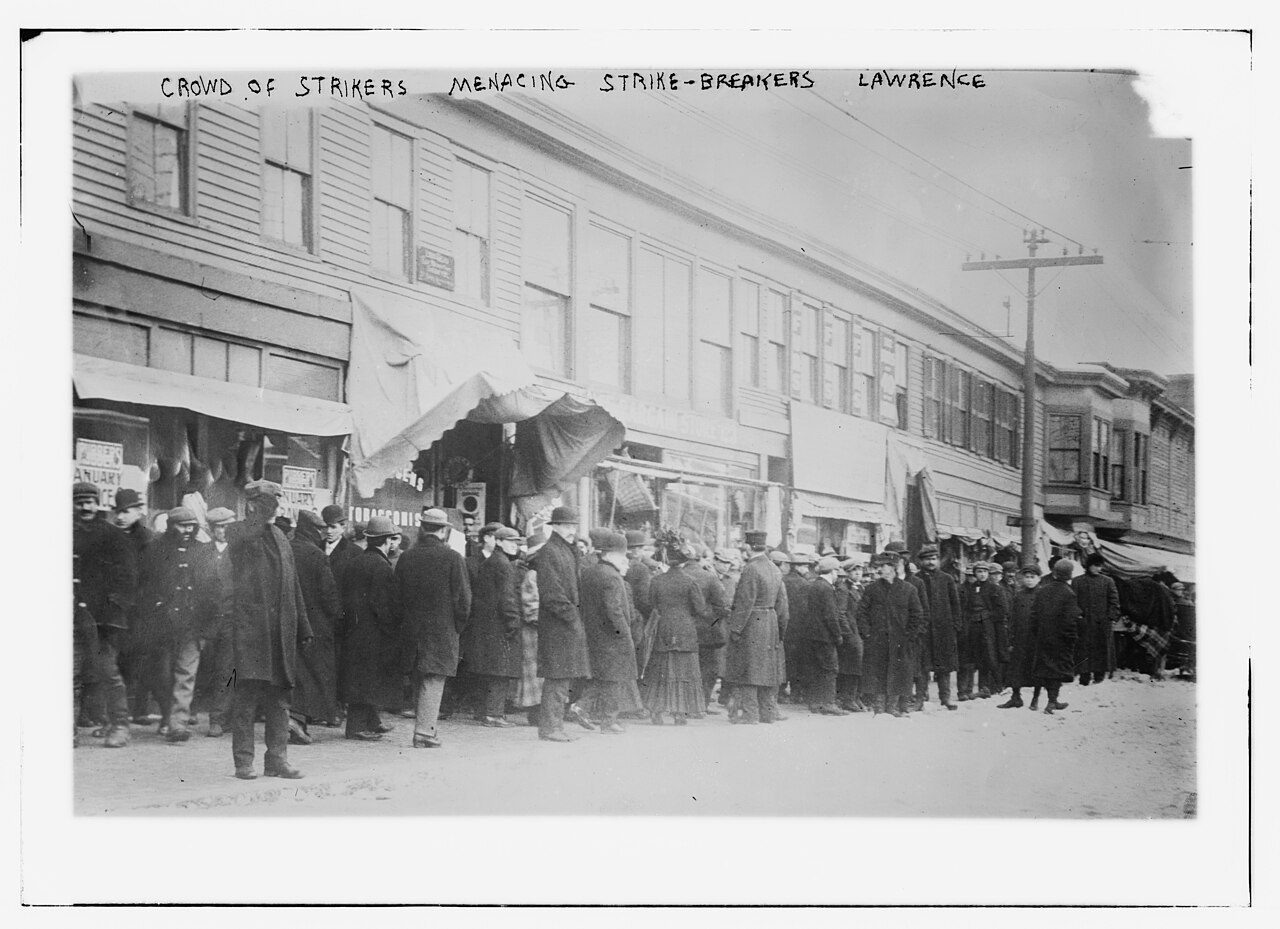
Massive structures like the American Woolen Company's Wood Worsted Mill in Lawrence, Massachusetts, billed by its owners as the largest worsted mill in the world, embodied New England's industrial confidence. Meanwhile, Southern boosters built cotton mills across the Piedmont of North Carolina, South Carolina, and Georgia to employ cheap, rural, non-union white labor. The transition from water to steam to electric power restructured both regions. New England became a polyglot immigrant industrial society; the Piedmont became a network of segregated, company-owned mill villages. The two regions' labor histories would intersect violently in the strikes of 1912, 1929, and 1934.
Part 3Timeline
Students write one sentence on why each event mattered.
- 1880s
The Piedmont Mill Campaign
Southern boosters launch a mill-building drive; North Carolina alone goes from about 75 cotton mills in 1884 to more than 200 additional mills over the next two decades.
- 1906
The Wood Worsted Mill
The American Woolen Company's Wood Mill begins operating in Lawrence—six stories, some thirty acres of floor space, and nicknamed locally 'the eighth wonder of the world.'
- 1912
The Lawrence Strike
More than twenty thousand workers of many nationalities strike at Lawrence and, after nine weeks, win raises of five to twenty-five percent.
- 1919
The Postwar Strike Wave
Textile strikes, including a sixteen-week walkout at Lawrence led by the minister A. J. Muste, win a forty-eight-hour week; the Red Scare and the slump of 1920–21 soon erode the gains.
Part 4Key terms
- Spinner (answer C)
- A mill worker, often a child, who walked along rows of spinning frames repairing broken threads.
- Doffer (answer D)
- A worker, usually a boy, who removed full bobbins of thread from spinning machines and replaced them with empty ones.
- Mill village (answer A)
- A company-owned town where the mill controlled housing, stores, churches, and schools.
- National Child Labor Committee (answer B)
- A reform group founded in 1904 to investigate child labor and push for laws to end it.
- Bread and Roses strike (answer E)
- The 1912 Lawrence, Massachusetts, textile strike, led largely by immigrant women and the IWW, against a pay cut.
Part 5Primary source workshop
These excerpts are quoted word for word, including the spelling and language of their time.
Document A
Testimony of Camella Teoli, House Hearings on the Strike at Lawrence
Camella Teoli, before the House Committee on Rules, March 1912
Miss TEOLI. Well, I used to go to school, and then a man came up to my house and asked my father why I didn't go to work, so my father says I don't know whether she is 13 or 14 years old. So, the man say you give me $4 and I will make the papers come from the old country saying you are 14. So, my father gave him the $4, and in one month came the papers that I was 14. I went to work, and about two weeks got hurt in my head. ... CHAIRMAN. Well, how were you hurt? Miss TEOLI. The machine pulled the scalp off.
Context: Teoli, a teenage worker from Lawrence, Massachusetts, testified to Congress during the 1912 "Bread and Roses" strike. Her testimony, given with First Lady Helen Taft in the audience, drew national attention to child labor and conditions in the woolen mills.
Source: Camella Teoli Testifies About the 1912 Lawrence Textile Strike (House Document 671, 62nd Congress). American Social History Project, Who Built America?. 1912. https://www.whobuiltamerica.org/item/camella-teoli-testifies-about-the-1912-lawrence-textile-strike
- Historical context
- What was happening when and where this was created?
- Intended audience
- Who was meant to read, hear, or see it?
- Purpose
- Why was it created? What did its creator want to happen?
- Point of view
- Whose perspective does it show, and whose is missing?
Document B
A Little Spinner in the Mollohan Mills, Newberry, S.C. (photograph caption)
Lewis Wickes Hine, National Child Labor Committee, December 3, 1908
A little spinner in the Mollohan Mills, Newberry, S.C. She was tending her "sides" like a veteran, but after I took the photo, the overseer came up and said in an apologetic tone that was pathetic, "She just happened in." Then a moment later he repeated the information. The mills appear to be full of youngsters that "just happened in," or "are helping sister." Dec. 3, 08. Witness Sara R. Hine.
Context: Hine photographed child workers across the country for the National Child Labor Committee, often posing as a salesman to get into mills. His captions recorded names, ages, and managers' excuses as evidence for reform campaigns.
Source: Lewis Wickes Hine. A little spinner in the Mollohan Mills, Newberry, S.C. Library of Congress, National Child Labor Committee Collection. 1908. http://www.loc.gov/item/2018674890/
- Historical context
- What was happening when and where this was created?
- Intended audience
- Who was meant to read, hear, or see it?
- Purpose
- Why was it created? What did its creator want to happen?
- Point of view
- Whose perspective does it show, and whose is missing?
Corroborate
Compare "Testimony of Camella Teoli, House Hearings on the Strike at Lawrence" (Camella Teoli, before the House Committee on Rules, March 1912) with "A Little Spinner in the Mollohan Mills, Newberry, S.C. (photograph caption)" (Lewis Wickes Hine, National Child Labor Committee, December 3, 1908). Where do they agree, where do they differ, and what might explain the differences?
Part 6Discuss
- How did Camella Teoli end up working at age thirteen, and what happened to her?
- Hine wrote his captions as an investigator for the National Child Labor Committee, which was campaigning for new laws. How does knowing his purpose affect how you read the overseer's words?
- Teoli's family arranged false papers; Hine's caption suggests mill managers hid child workers. Using both sources, explain why child labor laws were so hard to enforce in both New England and the South.
- Several states have recently loosened limits on teenagers' work hours, and federal investigators have found migrant children working in meatpacking plants. Do the arguments of 1912 still apply? Take a position.
Part 7Write: claim, evidence, reasoning
Answer the guiding question in one paragraph, using the documents and the reading.
| Claim | Answers the guiding question directly in one or two sentences. |
|---|---|
| Evidence | Cites at least two primary sources by name and at least one fact from the reading. |
| Reasoning | Explains how each piece of evidence supports the claim. |
| Sourcing | Notes at least one limitation of a source: who made it, when, and why. |
Part 8Exit ticket
- In one sentence, how would you answer the guiding question now?
- What piece of evidence would most change your mind?
Keep exploring
- Labor
Bread and Roses
The 1912 Lawrence strike that united dozens of nationalities.
https://www.threadingamerica.com/topics/bread-and-roses
- Innovation
The Wood Worsted Behemoth
The 'eighth wonder of the world' on the Merrimack.
https://www.threadingamerica.com/topics/wood-worsted-mill
- Impact
The Piedmont Mill Village
A new social order built around the Southern cotton mill.
https://www.threadingamerica.com/topics/mill-village-piedmont
- Tragedy
The Pemberton Mill Collapse
Lawrence's first industrial catastrophe—the disaster that haunted the city for a century.
https://www.threadingamerica.com/topics/pemberton-mill-collapse
- Impact
'The Chinese of the Eastern States'
French-Canadian migration to the New England mills, and the 1881 report that slandered it.
https://www.threadingamerica.com/topics/chinese-of-the-eastern-states
- Impact
The Dagenhart Boys and the Law
How a Charlotte cotton mill family carried child labor to the Supreme Court, and why it took twenty-five years to end it.
https://www.threadingamerica.com/topics/hammer-v-dagenhart
Places: Massachusetts, New Hampshire, Pennsylvania, North Carolina, South Carolina, Georgia, Virginia, Maine, Alabama