Threading America · Study guide · Chapter 10
The Garment District
New York City as the Fashion Capital · 1870–1910
Name
Class
Date
Guiding question
Who should have been held responsible for sweatshop conditions: the contractor, the manufacturer, the government, or the consumer?
Part 1Before you read
- Read the guiding question. Write down what you already know, or think you know, about it.
- Predict one way your answer might change after reading the sources.
Part 2Read
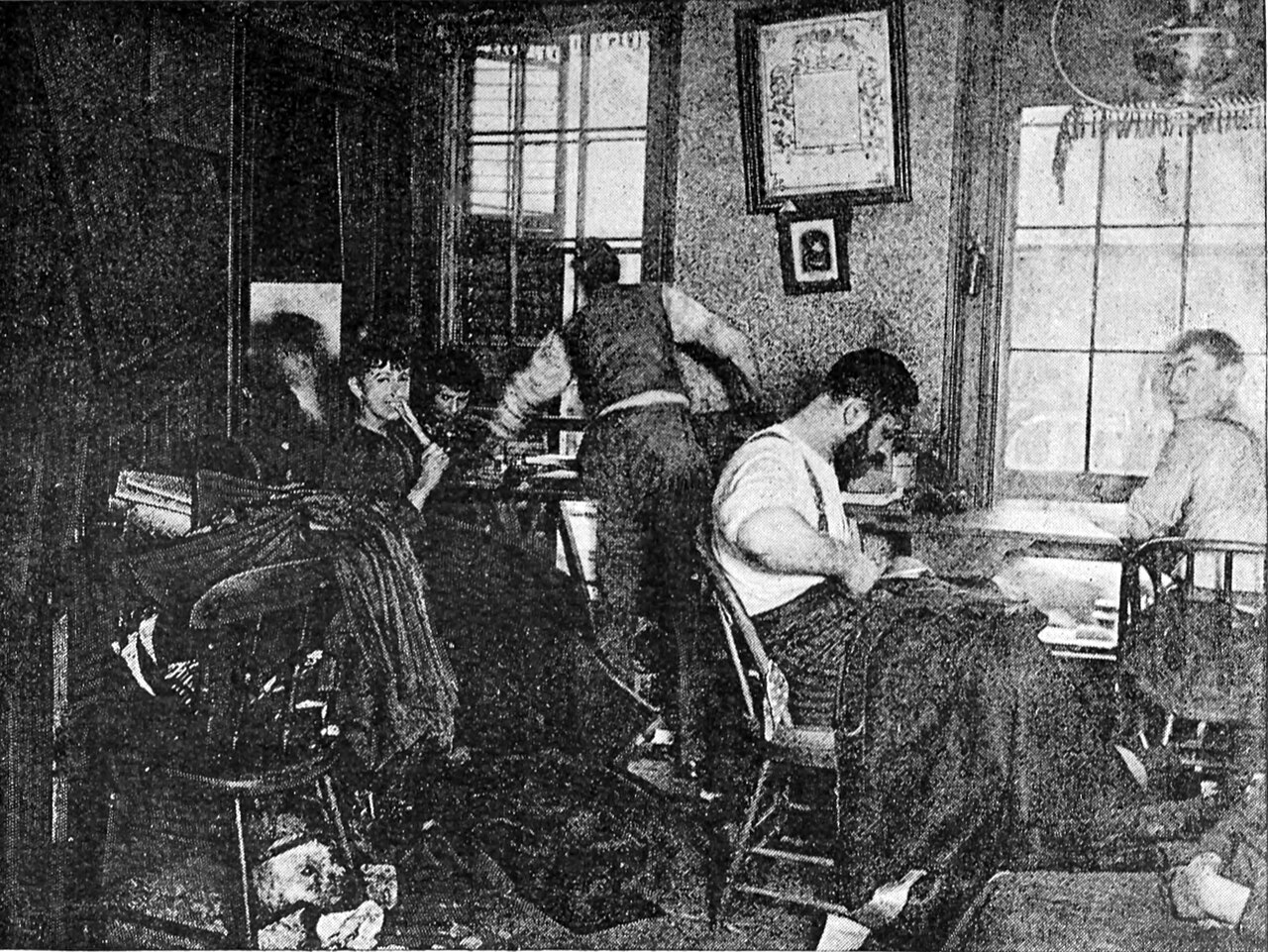
After the Civil War, the American apparel industry centered itself in New York City. The streets of Lower Manhattan became a hive of tenement sweatshops where Jewish and Italian immigrant labor fueled a booming fashion economy.
Jewish tailors from the Russian Pale and Italian seamstresses from southern Italy and Sicily brought needle skills to the Lower East Side. The industry organized around sub-contracting: a manufacturer bought and cut the fabric and handed bundles to a 'contractor,' who set up a shop in a crowded tenement apartment and paid piece rates to workers—often including members of his own family. As fashion magazines, department stores, and standardized sizes converged, New York emerged as the apparel capital of the Western Hemisphere, and the tenement sweatshop became its defining workplace.
Part 3Timeline
For each event, write one sentence on why it mattered.
- 1880s
Tenement Production Spreads
Lower East Side apartments become 'sweating' workshops where families live and sew in the same cramped rooms.
- 1890
Jacob Riis Publishes 'How the Other Half Lives'
Riis's flash photographs and reporting on tenement sweatshops bring the industry's conditions before a wide middle-class audience.
- 1900
The ILGWU Is Founded
Eleven delegates representing about two thousand garment workers found the International Ladies' Garment Workers' Union in New York.
- 1909
The Uprising of the 20,000
Some twenty thousand shirtwaist makers, most of them young immigrant women, strike across New York—the largest strike by women in American history to that point.
Part 4Key terms
Write the letter of the matching definition beside each term.
- Sweatshop
- Piecework
- Tenement
- Subcontracting
- General strike
- ILGWU
- A.A strike in which workers across an entire industry or city stop work at the same time.
- B.A pay system in which workers earn a set amount for each item finished rather than an hourly wage.
- C.When a company hires another business to do part of its work, often pushing costs and responsibility down to smaller shops.
- D.A crowded, poorly built city apartment building, often used as both home and workshop.
- E.A crowded, unsafe workplace where people work long hours for very low pay, often for a subcontractor called a "sweater."
- F.The International Ladies' Garment Workers' Union, founded in 1900, which became one of the largest unions in the country.
Part 5Primary source workshop
These excerpts are quoted word for word, including the spelling and language of their time.
Document A
How the Other Half Lives
Jacob A. Riis, 1890
Up two flights of dark stairs, three, four, with new smells of cabbage, of onions, of frying fish, on every landing, whirring sewing machines behind closed doors betraying what goes on within, to the door that opens to admit the bundle and the man. A sweater, this, in a small way. Five men and a woman, two young girls, not fifteen, and a boy who says unasked that he is fifteen, and lies in saying it, are at the machines sewing knickerbockers, "knee-pants" in the Ludlow Street dialect. The floor is littered ankle-deep with half-sewn garments.
Context: Riis, a Danish-born police reporter, used words and flash photography to expose conditions in New York's Lower East Side tenements. His book shaped middle-class opinion and housing reform, though it also repeated ethnic stereotypes of the immigrants he described.
Source: Jacob A. Riis. How the Other Half Lives: Studies Among the Tenements of New York. Charles Scribner's Sons (via Project Gutenberg). 1890. https://www.gutenberg.org/ebooks/45502
- Historical context
- What was happening when and where this was created?
- Intended audience
- Who was meant to read, hear, or see it?
- Purpose
- Why was it created? What did its creator want to happen?
- Point of view
- Whose perspective does it show, and whose is missing?
Document B
Life in the Shop
Clara Lemlich, November 28, 1909
First let me tell you something about the way we work and what we are paid. There are two kinds of work—regular, that is salary work, and piecework. The regular work pays about $6 a week and the girls have to be at their machines at 7 o'clock in the morning and they stay at them until 8 o'clock at night, with just one-half hour for lunch in that time. ... Whenever we tear or damage any of the goods we sew on, or whenever it is found damaged after we are through with it, whether we have done it or not, we are charged for the piece and sometimes for a whole yard of the material.
Context: Lemlich published this account in the New York Evening Journal days after the shirtwaist makers' general strike began. It explains, in a worker's own words, why some 20,000 young, mostly immigrant women walked out in the "Uprising of the 20,000."
Source: Clara Lemlich. Life in the Shop, by Clara Lemlich (from Leon Stein, ed., Out of the Sweatshop, 1977). Kheel Center, Cornell University ILR School. 1909. https://trianglefire.ilr.cornell.edu/primary/testimonials/ootss_ClaraLemlich.html
- Historical context
- What was happening when and where this was created?
- Intended audience
- Who was meant to read, hear, or see it?
- Purpose
- Why was it created? What did its creator want to happen?
- Point of view
- Whose perspective does it show, and whose is missing?
Document C
Speech at Cooper Union
Clara Lemlich (as reported and translated from Yiddish), November 22, 1909
I have no further patience for talk. I am a working girl, one of those striking against intolerable conditions. I am tired of listening to speakers who talk in generalities. ... I make a motion that we go out in a general strike.
Context: At a mass meeting of shirtwaist makers, Lemlich interrupted hours of speeches by labor leaders and called for a strike. The walkout that followed helped build the International Ladies' Garment Workers' Union; versions of her words differ because reporters translated them.
Source: International Ladies' Garment Workers' Union. National Park Service. 1909. https://www.nps.gov/articles/000/international-ladies-garment-workers-union.htm
- Historical context
- What was happening when and where this was created?
- Intended audience
- Who was meant to read, hear, or see it?
- Purpose
- Why was it created? What did its creator want to happen?
- Point of view
- Whose perspective does it show, and whose is missing?
Corroborate
Compare "How the Other Half Lives" (Jacob A. Riis, 1890) with "Life in the Shop" (Clara Lemlich, November 28, 1909). Where do they agree, where do they differ, and what might explain the differences?
Part 6Discuss
- List three specific workplace grievances Clara Lemlich describes in "Life in the Shop."
- Riis was a reformer writing for middle-class readers; Lemlich was a 23-year-old striker writing for a mass-circulation newspaper. How do their purposes shape what each notices about the same kind of workplace?
- Lemlich's Cooper Union speech was delivered in Yiddish and survives in several slightly different English versions. What does this tell historians about using speeches "as reported"?
- U.S. Department of Labor investigators still find wage violations in Los Angeles and New York garment shops. Using Riis's description of layered subcontracting, explain why sweatshops persist and argue for one solution.
Part 7Write: claim, evidence, reasoning
Answer the guiding question in one paragraph, using the documents and the reading.
| Claim | Answers the guiding question directly in one or two sentences. |
|---|---|
| Evidence | Cites at least two primary sources by name and at least one fact from the reading. |
| Reasoning | Explains how each piece of evidence supports the claim. |
| Sourcing | Notes at least one limitation of a source: who made it, when, and why. |
Part 8Exit ticket
- In one sentence, how would you answer the guiding question now?
- What piece of evidence would most change your mind?
Keep exploring
- Labor
The Sweatshop System
Exploitation engineered into the architecture of the tenement.
https://www.threadingamerica.com/topics/sweatshop-system
- Material Culture
Lewis Hine and the Camera as Indictment
A sociologist with a flash camera redefined documentary photography.
https://www.threadingamerica.com/topics/lewis-hine-photographs
- Biography
The Uprising of the 20,000
The strike that built the ILGWU—and set the stage for Triangle.
https://www.threadingamerica.com/topics/uprising-of-20000
Places: New York, Pennsylvania, Alabama