Threading America · Teacher edition · Chapter 13
The Electric Loom
Freeing the Mill from the River · 1920–1930
Guiding question
Did new technology in 1920s Southern mills make work better, or only faster?
Teacher notes
Objectives
Students will be able to:
- Place the chapter's key events, from 1920s to 1929, in order and explain why each mattered.
- Analyze 2 primary sources for context, audience, purpose, and point of view.
- Use the chapter's vocabulary accurately: Stretch-out, Scientific management, Rayon, Absentee ownership, National Textile Workers Union.
- Write an evidence-based argument that answers the guiding question.
AP U.S. History
Period 7 (1890–1945)
Standards
| Framework | Code | Students |
|---|---|---|
| C3 Framework | D2.His.1.9-12 | Explain how events were shaped by their time and place and by broader historical contexts. |
| C3 Framework | D2.His.4.9-12 | Analyze the factors that shaped people's perspectives in different eras. |
| C3 Framework | D2.His.10.9-12 | Identify the limitations of different kinds of historical evidence. |
| C3 Framework | D2.His.16.9-12 | Integrate evidence from multiple sources into a reasoned argument about the past. |
| Common Core | RH.9-10.1 / RH.11-12.1 | Cite specific textual evidence from primary and secondary sources. |
| Common Core | RH.9-10.4 / RH.11-12.4 | Determine the meaning of words and phrases as used in historical texts. |
| Common Core | RH.9-10.6 / RH.11-12.6 | Compare and evaluate authors' points of view on the same events. |
| Common Core | WHST.9-10.1 / WHST.11-12.1 | Write arguments focused on discipline-specific content. |
Pacing
Day 1 (50 minutes)
- 5 minBefore you read: guiding question and predictions
- 15 minReading and timeline
- 25 minPrimary source workshop (2 sources)
- 5 minExit ticket
Day 2 (50 minutes)
- 5 minKey terms matching
- 20 minCorroboration and discussion questions
- 25 minClaim, evidence, reasoning paragraph
Teaching hard history
- Never use role-play or simulations of slavery, violence, or other atrocities. Ask students to analyze the testimony and documented choices of real people instead.
- Pair the voices of the people who did the work (enslaved people, children, strikers, immigrants) with the voices of those who profited, and ask whose records survived and why.
- Primary sources are reproduced word for word, including period language and dialect transcribed by interviewers. Before reading, discuss who recorded each source and for whom. Do not ask students to perform dialect aloud.
- Tell students before they see images of injured, captive, or dead people, and give them a way to step back.
- Distinguish what the sources show from what they cannot prove. Several stories in this exhibit correct popular myths; name the myth, then the evidence.
Guidance follows Learning for Justice, "Teaching Hard History: American Slavery" (Southern Poverty Law Center, 2018).
Answer key: key terms
Stretch-out: C · Scientific management: E · Rayon: B · Absentee ownership: D · National Textile Workers Union: A
Part 1Before you read
- Read the guiding question. Write down what you already know, or think you know, about it.
- Predict one way your answer might change after reading the sources.
Part 2Read
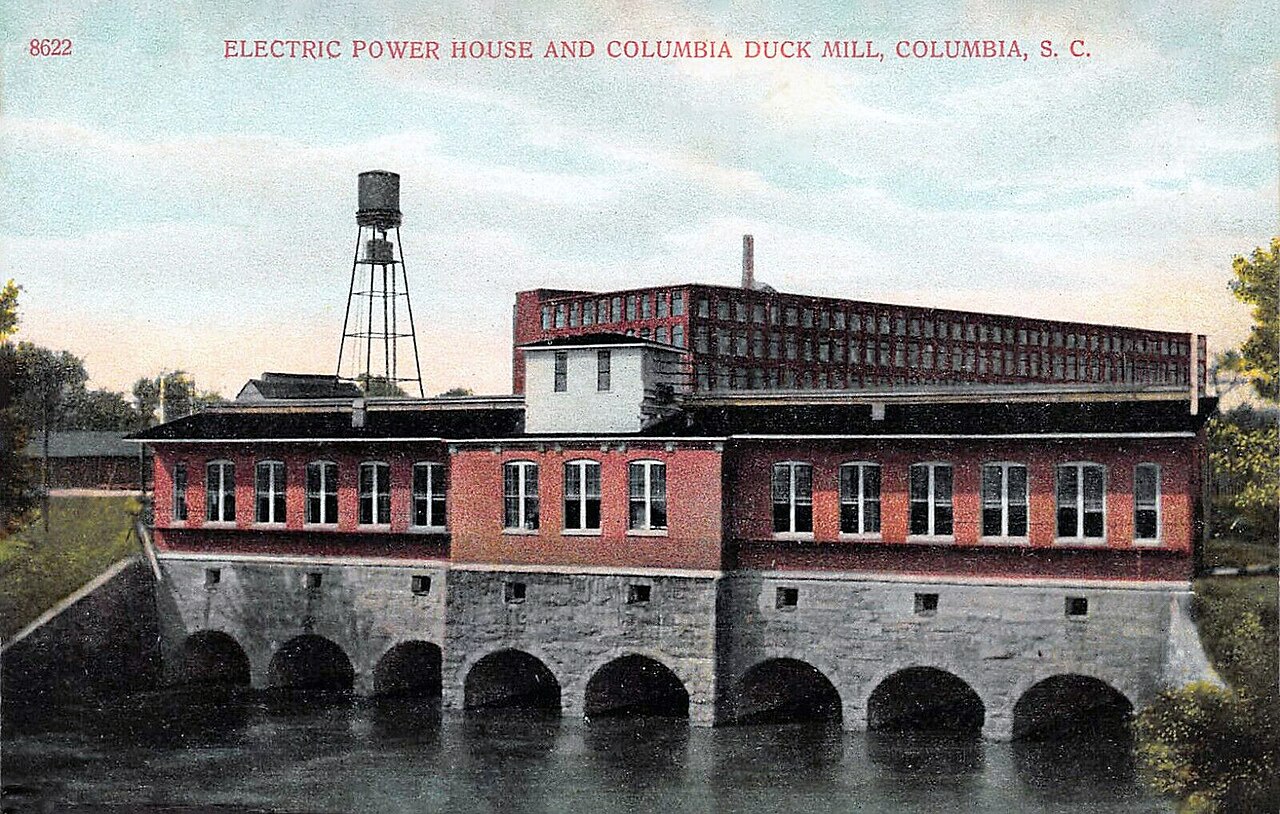
Electrification revolutionized mill architecture and geography. No longer tied to waterfalls or steam boilers, the industry could modernize—and, just as importantly, keep moving away from the unionized North.
Electric motors mounted on individual machines eliminated the line shafting and belts that had driven mills for a century and often caused accidents and shutdowns. Buildings could be brighter and more flexible, machines could be added or rearranged without re-engineering a central drive, and a mill no longer needed to sit on a river. In North Carolina, Duke Power and the Duke family financed new mills to create customers for their electricity. The technological liberation became a labor strategy: capital flowed to Piedmont towns where land was cheap, taxes were low, and unions were weak. By 1929 Southern mills had surpassed New England in active spindles and in cotton consumed. The same decade saw rayon—a regenerated cellulose fiber—become a mass-market material, the beginning of a chemical revolution that would, after nylon, transform the industry entirely.
Part 3Timeline
Students write one sentence on why each event mattered.
- 1920s
Electric Drive Spreads
Mills, especially new Southern mills, shift from steam and water power to electric motors, many driving machines individually.
- 1925
The Rayon Boom
American Viscose, DuPont, and other producers expand rayon output; 'artificial silk' becomes a mass-market fiber for hosiery and lingerie.
- 1929
The South Pulls Ahead
Southern mills now surpass New England in both active cotton spindles and cotton consumed; New England's century of cotton dominance is over.
- 1929
The Loray Strike
A strike led by the Communist-affiliated National Textile Workers Union at the Loray Mill in Gastonia, NC, ends in violence and the murder of the striker and songwriter Ella May Wiggins.
Part 4Key terms
- Stretch-out (answer C)
- Southern mill workers' name for management's practice of assigning each worker more machines without more pay.
- Scientific management (answer E)
- Using time studies and measurement to make each worker's movements faster and more efficient; the Bedaux system was one version.
- Rayon (answer B)
- A manufactured fiber made from wood pulp, first produced in large quantities in the 1920s.
- Absentee ownership (answer D)
- When a business is owned by people or companies far away who do not see local working conditions.
- National Textile Workers Union (answer A)
- A Communist-led union that organized the 1929 Loray Mill strike in Gastonia, North Carolina.
Part 5Primary source workshop
These excerpts are quoted word for word, including the spelling and language of their time.
Document A
The Mill Mother's Lament
Ella May Wiggins, 1929
We leave our homes in the morning, / We kiss our children good-bye, / While we slave for the bosses, / Our children scream and cry. ... But understand, all workers, / Our union they do fear. / Let's stand together, workers, / And have a union here.
Context: Wiggins, who was raising five surviving children and worked a night shift at a Gastonia-area mill, wrote ballads for the National Textile Workers Union during the 1929 Loray Mill strike. She was shot and killed by anti-union vigilantes in September 1929, and her songs became labor anthems.
Source: Ella May Wiggins. The Mill Mother's Lament. ANCHOR, State Library of North Carolina. 1929. https://www.ncanchor.org/anchor/mill-mothers-lament
- Historical context
- What was happening when and where this was created?
- Intended audience
- Who was meant to read, hear, or see it?
- Purpose
- Why was it created? What did its creator want to happen?
- Point of view
- Whose perspective does it show, and whose is missing?
Document B
Interview with Robert Ragan, Uprising of '34 Collection
Robert Ragan, interviewed by Judith Helfand and George Stoney, Early 1990s
they were trying to make up the difference by pushing the workers harder there to produce more, and uh ... to have fewer people tending more machines, and this may have been—it was a management efficiency technique is basically what it was, it was called the Bedaux, Bedaux system in France. But to everyone in this part of the country it was the stretch-out.
Context: Ragan, a Gastonia, North Carolina, resident whose father was interviewed by historians about the 1929 strike, recorded this for the documentary The Uprising of '34. He explains how the Loray Mill's owners, Manville-Jenckes of Pawtucket, used efficiency methods to cut labor costs.
Source: Robert Ragan Interview, Uprising of '34 Collection (L1995-13). Georgia State University Library, Southern Labor Archives. http://webapps.library.gsu.edu/ohms-viewer/viewer.php?cachefile=L1995-13_AV0758.xml
- Historical context
- What was happening when and where this was created?
- Intended audience
- Who was meant to read, hear, or see it?
- Purpose
- Why was it created? What did its creator want to happen?
- Point of view
- Whose perspective does it show, and whose is missing?
Corroborate
Compare "The Mill Mother's Lament" (Ella May Wiggins, 1929) with "Interview with Robert Ragan, Uprising of '34 Collection" (Robert Ragan, interviewed by Judith Helfand and George Stoney, Early 1990s). Where do they agree, where do they differ, and what might explain the differences?
Part 6Discuss
- According to Robert Ragan, what was the "stretch-out," and why did the Loray Mill's Rhode Island owners impose it?
- Wiggins wrote her ballad during the 1929 Gastonia strike, weeks before she was shot and killed; Ragan spoke about it more than sixty years later. How do their positions shape how each describes the same events?
- Using the chapter narrative, explain how electric power and new machinery made the stretch-out possible.
- Warehouse and call-center workers today report productivity quotas set and tracked by software. Is this a modern stretch-out? Argue with evidence from both eras.
Part 7Write: claim, evidence, reasoning
Answer the guiding question in one paragraph, using the documents and the reading.
| Claim | Answers the guiding question directly in one or two sentences. |
|---|---|
| Evidence | Cites at least two primary sources by name and at least one fact from the reading. |
| Reasoning | Explains how each piece of evidence supports the claim. |
| Sourcing | Notes at least one limitation of a source: who made it, when, and why. |
Part 8Exit ticket
- In one sentence, how would you answer the guiding question now?
- What piece of evidence would most change your mind?
Keep exploring
- Innovation
The Death of the Shaft
How the electric motor ended a century of belts and line shafts.
https://www.threadingamerica.com/topics/death-of-the-shaft
- Innovation
Rayon: The First Manufactured Fiber
Trees, chemistry, and the beginning of the artificial-fiber age.
https://www.threadingamerica.com/topics/rayon-the-first-synthetic
- Impact
The Great Piedmont Migration
How electricity and cheap labor moved an industry south.
https://www.threadingamerica.com/topics/piedmont-migration
- Biography
Ella May Wiggins: The Singer of Gastonia
A mill mother shot dead on the road to a union rally in 1929.
https://www.threadingamerica.com/topics/ella-may-wiggins
- Tragedy
The Marion Massacre
Six strikers killed at the Marion Manufacturing Company gate, less than three weeks after Ella May Wiggins.
https://www.threadingamerica.com/topics/marion-massacre
Places: Massachusetts, Rhode Island, New Hampshire, North Carolina, South Carolina, Virginia, Maine, Alabama, Tennessee