Threading America · Teacher edition · Chapter 5
The Cotton Kingdom
The Gin, the Lash, and the Loom · 1793–1850
Guiding question
How responsible were Northern mills and consumers for the expansion of slavery in the Cotton South?
Teacher notes
Objectives
Students will be able to:
- Place the chapter's key events, from 1793 to 1850, in order and explain why each mattered.
- Analyze 2 primary sources for context, audience, purpose, and point of view.
- Use the chapter's vocabulary accurately: Quota, Gin-house, Second Middle Passage, Short-staple cotton, WPA slave narratives.
- Write an evidence-based argument that answers the guiding question.
AP U.S. History
Period 3 (1754–1800), Period 4 (1800–1848), Period 5 (1844–1877)
Standards
| Framework | Code | Students |
|---|---|---|
| C3 Framework | D2.His.1.9-12 | Explain how events were shaped by their time and place and by broader historical contexts. |
| C3 Framework | D2.His.4.9-12 | Analyze the factors that shaped people's perspectives in different eras. |
| C3 Framework | D2.His.10.9-12 | Identify the limitations of different kinds of historical evidence. |
| C3 Framework | D2.His.16.9-12 | Integrate evidence from multiple sources into a reasoned argument about the past. |
| Common Core | RH.9-10.1 / RH.11-12.1 | Cite specific textual evidence from primary and secondary sources. |
| Common Core | RH.9-10.4 / RH.11-12.4 | Determine the meaning of words and phrases as used in historical texts. |
| Common Core | RH.9-10.6 / RH.11-12.6 | Compare and evaluate authors' points of view on the same events. |
| Common Core | WHST.9-10.1 / WHST.11-12.1 | Write arguments focused on discipline-specific content. |
Pacing
Day 1 (50 minutes)
- 5 minBefore you read: guiding question and predictions
- 15 minReading and timeline
- 25 minPrimary source workshop (2 sources)
- 5 minExit ticket
Day 2 (50 minutes)
- 5 minKey terms matching
- 20 minCorroboration and discussion questions
- 25 minClaim, evidence, reasoning paragraph
Teaching hard history
- Never use role-play or simulations of slavery, violence, or other atrocities. Ask students to analyze the testimony and documented choices of real people instead.
- Pair the voices of the people who did the work (enslaved people, children, strikers, immigrants) with the voices of those who profited, and ask whose records survived and why.
- Primary sources are reproduced word for word, including period language and dialect transcribed by interviewers. Before reading, discuss who recorded each source and for whom. Do not ask students to perform dialect aloud.
- Tell students before they see images of injured, captive, or dead people, and give them a way to step back.
- Distinguish what the sources show from what they cannot prove. Several stories in this exhibit correct popular myths; name the myth, then the evidence.
Guidance follows Learning for Justice, "Teaching Hard History: American Slavery" (Southern Poverty Law Center, 2018).
Answer key: key terms
Quota: A · Gin-house: C · Second Middle Passage: D · Short-staple cotton: E · WPA slave narratives: B
Part 1Before you read
- Read the guiding question. Write down what you already know, or think you know, about it.
- Predict one way your answer might change after reading the sources.
Part 2Read
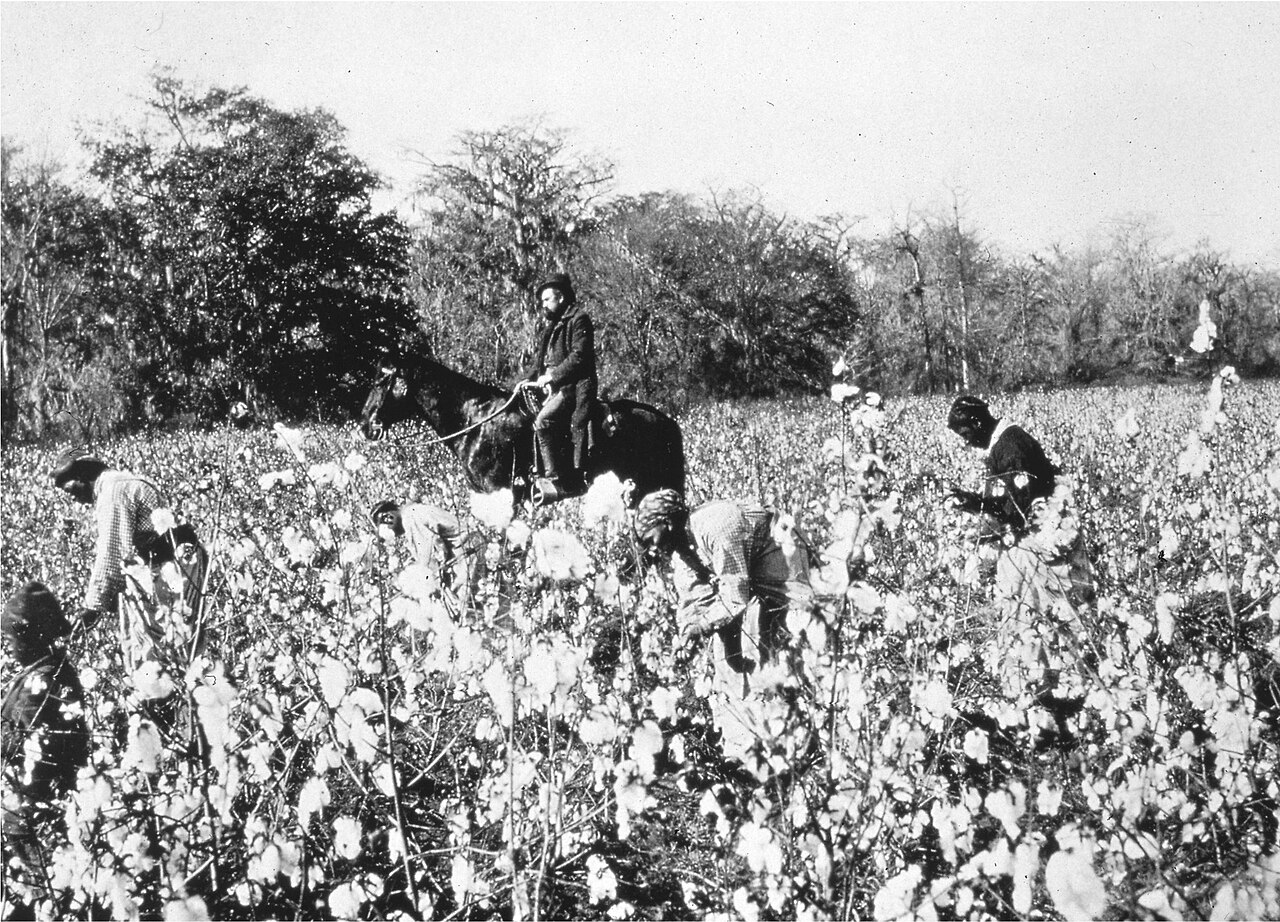
The 'efficiency' of the Northern mills was fed by the brutality of the Southern cotton field. The rise of the American textile industry was inextricable from the expansion of slavery, and the spindles of Massachusetts spun fiber picked under the lash in Mississippi.
Eli Whitney's cotton gin (1793) made short-staple upland cotton commercially viable. Within a generation it helped transform the American South into the leading supplier of the raw material of the world's first industrial economy. The 'Cotton Kingdom' expanded westward through Georgia, Alabama, Mississippi, Louisiana, and beyond, fueling the 'Second Middle Passage'—the forced removal of roughly a million enslaved people from the Upper South to the Deep South between 1790 and 1860. Cotton was the nation's leading export from about 1803, and by 1840 it accounted for more than half the value of all American exports. Northern mills did not merely buy this cotton: Northern merchants, shippers, insurers, and banks financed, carried, and insured the crop, and Northern politicians tied to the trade resisted measures that threatened it.
Part 3Timeline
Students write one sentence on why each event mattered.
- 1793
The Cotton Gin
Eli Whitney builds a gin for short-staple cotton and applies for a patent, granted in March 1794; he boasted that one man and a horse could do the work of fifty hand-cleaners.
- 1808
Transatlantic Slave Trade Ends
The federal ban on importing enslaved people takes effect, intensifying the domestic slave trade as cotton demand explodes.
- 1840
Cotton Becomes King
Cotton, the nation's leading export since about 1803, now accounts for more than half the value of all U.S. exports, feeding the mills of New England and Lancashire.
- 1850
Three Million Enslaved
The census counts more than 3.2 million enslaved people in the United States; by now most enslaved agricultural laborers in the Deep South work in cotton.
Part 4Key terms
- Quota (answer A)
- A required amount of work; on cotton plantations, the weight each enslaved person was forced to pick daily under threat of punishment.
- Gin-house (answer C)
- The plantation building where the cotton gin separated seeds from fiber and where each day's picking was weighed.
- Second Middle Passage (answer D)
- The forced movement of about one million enslaved people from the Upper South to new cotton lands in the Deep South between 1790 and 1860.
- Short-staple cotton (answer E)
- Upland cotton with short fibers that grew across the interior South once the cotton gin made it profitable to clean.
- WPA slave narratives (answer B)
- More than 2,300 interviews with formerly enslaved people recorded by the Works Progress Administration's Federal Writers' Project in 1936–1938.
Part 5Primary source workshop
These excerpts are quoted word for word, including the spelling and language of their time.
Document A
Twelve Years a Slave
Solomon Northup, 1853
When a new hand, one unaccustomed to the business, is sent for the first time into the field, he is whipped up smartly, and made for that day to pick as fast as he can possibly. At night it is weighed, so that his capability in cotton picking is known. He must bring in the same weight each night following. If it falls short, it is considered evidence that he has been laggard, and a greater or less number of lashes is the penalty. An ordinary day's work is two hundred pounds. ... a slave never approaches the gin-house with his basket of cotton but with fear.
Context: Northup, a free Black man from New York, was kidnapped in 1841 and enslaved on Louisiana cotton plantations for twelve years. His account describes the quota-and-whip system that drove the enormous rise in cotton output feeding Northern and British mills.
Source: Solomon Northup. Twelve Years a Slave: Narrative of Solomon Northup. Documenting the American South, University of North Carolina at Chapel Hill. 1853. https://docsouth.unc.edu/fpn/northup/northup.html
- Historical context
- What was happening when and where this was created?
- Intended audience
- Who was meant to read, hear, or see it?
- Purpose
- Why was it created? What did its creator want to happen?
- Point of view
- Whose perspective does it show, and whose is missing?
Document B
Interview with Sarah Ashley
Sarah Ashley, interviewed by the Federal Writers' Project, c. 1937
I used to have to pick cotton and sometime I pick 300 pound and tote it a mile to de cotton house. Some pick 300 to 800 pound cotton and have to tote de bag de whole mile to de gin. Iffen dey didn't do dey work dey git whip till dey have blister on 'em. Den iffen dey didn't do it, de man on a hoss goes down de rows and whip with a paddle make with holes in it and bus' de blisters. I never git whip, 'cause I allus git my 300 pound.
Context: Ashley, born in Mississippi and sold to a Texas planter as a child, was interviewed in her eighties by the New Deal's Federal Writers' Project. The dialect spellings were chosen by the mostly white interviewers and reflect their assumptions as well as her speech.
Source: Federal Writers' Project: Slave Narrative Project, Vol. 16, Texas, Part 1, Adams-Duhon. Library of Congress. 1936–1938. https://www.loc.gov/item/mesn161/
- Historical context
- What was happening when and where this was created?
- Intended audience
- Who was meant to read, hear, or see it?
- Purpose
- Why was it created? What did its creator want to happen?
- Point of view
- Whose perspective does it show, and whose is missing?
Corroborate
Compare "Twelve Years a Slave" (Solomon Northup, 1853) with "Interview with Sarah Ashley" (Sarah Ashley, interviewed by the Federal Writers' Project, c. 1937). Where do they agree, where do they differ, and what might explain the differences?
Part 6Discuss
- According to both narrators, how was the amount of cotton an enslaved person had to pick decided, and how was it enforced?
- Northup published his book with a white editor in 1853 to influence the national debate over slavery; Sarah Ashley was interviewed by a government writer in the 1930s. How might each setting shape what was said and how it was recorded?
- Using the chapter narrative, trace the path of a bale of cotton from a Louisiana gin-house to a New England loom. Who profited at each step?
- The United States now bans imports of cotton linked to forced labor in China's Xinjiang region. Should companies and consumers be held responsible for labor conditions far down their supply chains? Use the nineteenth-century evidence to support your argument.
Part 7Write: claim, evidence, reasoning
Answer the guiding question in one paragraph, using the documents and the reading.
| Claim | Answers the guiding question directly in one or two sentences. |
|---|---|
| Evidence | Cites at least two primary sources by name and at least one fact from the reading. |
| Reasoning | Explains how each piece of evidence supports the claim. |
| Sourcing | Notes at least one limitation of a source: who made it, when, and why. |
Part 8Exit ticket
- In one sentence, how would you answer the guiding question now?
- What piece of evidence would most change your mind?
Keep exploring
- Tragedy
The Second Middle Passage
The forced migration that built the Cotton Kingdom.
https://www.threadingamerica.com/topics/the-second-middle-passage
- Impact
Lords of the Loom, Lords of the Lash
The political alliance between Boston mill owners and Southern planters.
https://www.threadingamerica.com/topics/lords-of-loom-lash
- Biography
Eli Whitney's Patent Trap
The inventor of the gin made little from it.
https://www.threadingamerica.com/topics/whitneys-patent-trap
- Tragedy
The Hands That Picked
The enslaved people who grew the cotton, as named individuals and as the largest financial asset in the American economy.
https://www.threadingamerica.com/topics/the-hands-that-picked
Places: Georgia