Threading America · Teacher edition · Chapter 2
The Colonial Hearth
Spinning the First Threads of a Nation · 1600–1760
Guiding question
Was colonial cloth-making a private household chore or a public duty controlled by government?
Teacher notes
Objectives
Students will be able to:
- Place the chapter's key events, from 1643 to 1750, in order and explain why each mattered.
- Analyze 2 primary sources for context, audience, purpose, and point of view.
- Use the chapter's vocabulary accurately: Homespun, Mercantilism, Selectmen, Fulling, Flax.
- Write an evidence-based argument that answers the guiding question.
AP U.S. History
Period 1 (1491–1607), Period 2 (1607–1754), Period 3 (1754–1800)
Standards
| Framework | Code | Students |
|---|---|---|
| C3 Framework | D2.His.1.9-12 | Explain how events were shaped by their time and place and by broader historical contexts. |
| C3 Framework | D2.His.4.9-12 | Analyze the factors that shaped people's perspectives in different eras. |
| C3 Framework | D2.His.10.9-12 | Identify the limitations of different kinds of historical evidence. |
| C3 Framework | D2.His.16.9-12 | Integrate evidence from multiple sources into a reasoned argument about the past. |
| Common Core | RH.9-10.1 / RH.11-12.1 | Cite specific textual evidence from primary and secondary sources. |
| Common Core | RH.9-10.4 / RH.11-12.4 | Determine the meaning of words and phrases as used in historical texts. |
| Common Core | RH.9-10.6 / RH.11-12.6 | Compare and evaluate authors' points of view on the same events. |
| Common Core | WHST.9-10.1 / WHST.11-12.1 | Write arguments focused on discipline-specific content. |
Pacing
Day 1 (50 minutes)
- 5 minBefore you read: guiding question and predictions
- 15 minReading and timeline
- 25 minPrimary source workshop (2 sources)
- 5 minExit ticket
Day 2 (50 minutes)
- 5 minKey terms matching
- 20 minCorroboration and discussion questions
- 25 minClaim, evidence, reasoning paragraph
Teaching hard history
- Never use role-play or simulations of slavery, violence, or other atrocities. Ask students to analyze the testimony and documented choices of real people instead.
- Pair the voices of the people who did the work (enslaved people, children, strikers, immigrants) with the voices of those who profited, and ask whose records survived and why.
- Primary sources are reproduced word for word, including period language and dialect transcribed by interviewers. Before reading, discuss who recorded each source and for whom. Do not ask students to perform dialect aloud.
- Tell students before they see images of injured, captive, or dead people, and give them a way to step back.
- Distinguish what the sources show from what they cannot prove. Several stories in this exhibit correct popular myths; name the myth, then the evidence.
Guidance follows Learning for Justice, "Teaching Hard History: American Slavery" (Southern Poverty Law Center, 2018).
Answer key: key terms
Homespun: A · Mercantilism: C · Selectmen: D · Fulling: E · Flax: B
Part 1Before you read
- Read the guiding question. Write down what you already know, or think you know, about it.
- Predict one way your answer might change after reading the sources.
Part 2Read
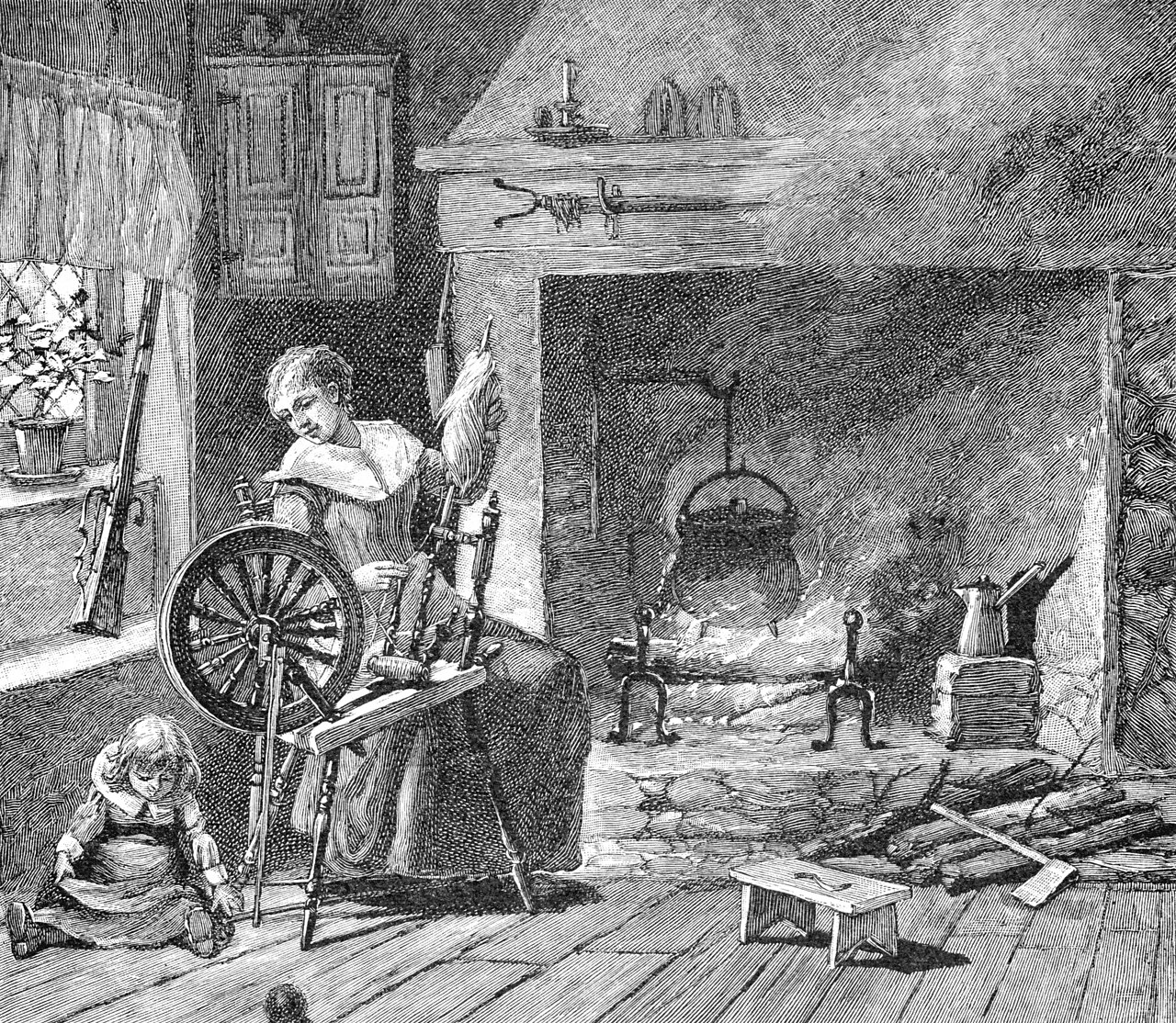
In the early colonies, textile production was a matter of survival. The hearth was the center of the industrial world, and every household a producer—turning fields of flax and flocks of sheep into the shirts, sheets, and blankets of a fragile new society.
English and Dutch settlers arrived with sheep, flax seed, and the embodied knowledge of village craft. Production was localized, manual, and deeply seasonal. Carding, spinning, and weaving were daily chores braided into cooking, dairying, and childcare. Colonial governments alternately encouraged and commanded this work: when English supplies faltered in the 1640s, the Massachusetts General Court urged towns to multiply their sheep, and in 1656 it assessed every family a quota of spinning. Britain's mercantilist policy, by contrast, sought to keep the colonies as buyers rather than makers of cloth. The Wool Act of 1699 did not forbid colonists to weave, but it barred them from shipping woolen goods out of any colony, even to a neighboring one. This tension—between domestic self-sufficiency and imperial dependence—planted political seeds that would flower in the 1760s and established the 'homespun' tradition that later became a weapon of protest.
Part 3Timeline
Students write one sentence on why each event mattered.
- 1643
The Rowley Fulling Mill
At Rowley, Massachusetts, settled in 1639 by Yorkshire cloth-workers, a fulling mill begins finishing homespun woolens-traditionally counted as the first in the English colonies.
- 1645
The Massachusetts Sheep Order
The General Court urges every town to preserve and increase its sheep and asks colonists to have more brought from England, to ease dependence on imported cloth.
- 1656
The Spinning Order
Massachusetts assesses each family for a whole, half, or quarter spinner; a whole spinner owes three pounds of yarn a week for thirty weeks a year, on pain of a fine.
- 1699
The Wool Act
Parliament forbids the export of wool and woolen manufactures from the American colonies, even to other colonies, to protect English clothiers.
- 1750
The Iron Act
Parliament bars new colonial slitting and rolling mills and steel furnaces—another sign of the imperial rule that colonies supply raw materials rather than finished goods.
Part 4Key terms
- Homespun (answer A)
- Cloth spun and woven at home rather than bought from a merchant or factory.
- Mercantilism (answer C)
- An economic system in which a nation controls trade with its colonies so that the home country gains the most wealth.
- Selectmen (answer D)
- Elected officials who ran the day-to-day business of a New England town.
- Fulling (answer E)
- Beating and washing woven wool so the fibers shrink and lock together into a thicker, stronger cloth.
- Flax (answer B)
- A plant whose stem fibers are spun into linen thread; one of the most common fibers grown on colonial farms.
Part 5Primary source workshop
These excerpts are quoted word for word, including the spelling and language of their time.
Document A
Order of the Massachusetts General Court on Spinning
Massachusetts General Court, 1655
That all hands not necessarily imployed on other occasions, as Women, Girls and Boyes, shall and hereby are enjoyned to Spin according to their skill and ability; and that the Select men in every Town do consider the condition and capacity of every family, and accordingly do assess them at one or more Spinners; ... And every one thus aforesaid, for a whole Spinner, shall for time to come, Spin every Year for thirty Weeks, three pound a Week of Linnen, Cotton or Woollen, and so proportionably for half and quarter Spinners, under the penalty of twelve pence a pound short.
Context: Facing a shortage of imported English cloth, the Massachusetts Bay colony's legislature turned household spinning into a legal obligation enforced by town officials. The order shows that the "homespun" economy was organized and policed by government, and that it depended on the labor of women and children.
Source: Labor and Trade in Colonial America (Beyond the Textbook). TeachingHistory.org, Roy Rosenzweig Center for History and New Media. 1655. https://teachinghistory.org/history-content/beyond-the-textbook/labor-and-trade-in-colonial-america/
- Historical context
- What was happening when and where this was created?
- Intended audience
- Who was meant to read, hear, or see it?
- Purpose
- Why was it created? What did its creator want to happen?
- Point of view
- Whose perspective does it show, and whose is missing?
Document B
The Wool Act
Parliament of England (10 & 11 William III, c. 10), 1699
Whereas great quantities of the like manufactures have of late been made, and are daily increasing in the kingdom of Ireland, and in the English plantations in America, and are exported from thence to foreign markets, heretofore supplied from England ... be it further enacted ... no wool, woolfells, shortlings, mortlings, woolflocks, worsted, bay, or woollen yarn, cloth, serge, bays, kerseys, says, friezes, druggets, cloth-serges, shalloons, or any other drapery stuffs, or woollen manufactures whatsoever, made or mixed with wool or woolflocks, being the product or manufacture of any of the English plantations in America, shall be loaden or laid on board in any ship or vessel, in any place or parts within any of the said English plantations, upon any pretence whatsoever.
Context: Parliament passed the Wool Act to protect England's woolen industry, its largest export, from colonial competition. The law did not ban colonists from making cloth for themselves, but it barred them from exporting it, a core example of mercantilist trade policy.
Source: Colonial Trade Laws (Legal Studies 261 open text). University of Wisconsin-Madison. 1699. https://wisc.pb.unizin.org/ls261/chapter/ch-2-2-colonial-trade-laws/
- Historical context
- What was happening when and where this was created?
- Intended audience
- Who was meant to read, hear, or see it?
- Purpose
- Why was it created? What did its creator want to happen?
- Point of view
- Whose perspective does it show, and whose is missing?
Corroborate
Compare "Order of the Massachusetts General Court on Spinning" (Massachusetts General Court, 1655) with "The Wool Act" (Parliament of England (10 & 11 William III, c. 10), 1699). Where do they agree, where do they differ, and what might explain the differences?
Part 6Discuss
- What did the 1655 Massachusetts order require a "whole Spinner" to produce each year, and who decided how many spinners each family owed?
- Who wrote each of these laws, and whose economic interests was each written to protect?
- The Massachusetts order pushed colonists to make more cloth; the 1699 Wool Act forbade them from shipping it. How might a colonial family in 1700 have experienced both laws at once?
- Governments today still use laws to encourage or restrict domestic manufacturing, such as tariffs and "Buy American" rules. Is it fair for a government to tell households or businesses what to produce or where they can sell it? Use both documents to support your argument.
Part 7Write: claim, evidence, reasoning
Answer the guiding question in one paragraph, using the documents and the reading.
| Claim | Answers the guiding question directly in one or two sentences. |
|---|---|
| Evidence | Cites at least two primary sources by name and at least one fact from the reading. |
| Reasoning | Explains how each piece of evidence supports the claim. |
| Sourcing | Notes at least one limitation of a source: who made it, when, and why. |
Part 8Exit ticket
- In one sentence, how would you answer the guiding question now?
- What piece of evidence would most change your mind?
Keep exploring
- Material Culture
The Agony of Flax
The long, many-stage process that turned a blue-flowered plant into a linen shirt.
https://www.threadingamerica.com/topics/agony-of-flax
- Innovation
Two Wheels, Two Worlds
How the great wheel and the flax wheel divided the colonial household.
https://www.threadingamerica.com/topics/great-wheel-flax-wheel
- Impact
Sheep, Statutes, and Survival
How colonial law conscripted the household into a textile economy.
https://www.threadingamerica.com/topics/homespun-economy