Threading America · Teacher edition · Chapter 1
Before the Loom
Indigenous Fiber Traditions of North America · Before 1600
Guiding question
Can we understand Indigenous textile traditions through the eyes of the outsiders who first wrote them down?
Teacher notes
Objectives
Students will be able to:
- Place the chapter's key events, from c. 5400 BCE to 1598, in order and explain why each mattered.
- Analyze 3 primary sources for context, audience, purpose, and point of view.
- Use the chapter's vocabulary accurately: Twining, Backstrap loom, Cordage, Churro sheep, Oral tradition.
- Write an evidence-based argument that answers the guiding question.
AP U.S. History
Period 1 (1491–1607)
Standards
| Framework | Code | Students |
|---|---|---|
| C3 Framework | D2.His.1.9-12 | Explain how events were shaped by their time and place and by broader historical contexts. |
| C3 Framework | D2.His.4.9-12 | Analyze the factors that shaped people's perspectives in different eras. |
| C3 Framework | D2.His.10.9-12 | Identify the limitations of different kinds of historical evidence. |
| C3 Framework | D2.His.16.9-12 | Integrate evidence from multiple sources into a reasoned argument about the past. |
| Common Core | RH.9-10.1 / RH.11-12.1 | Cite specific textual evidence from primary and secondary sources. |
| Common Core | RH.9-10.4 / RH.11-12.4 | Determine the meaning of words and phrases as used in historical texts. |
| Common Core | RH.9-10.6 / RH.11-12.6 | Compare and evaluate authors' points of view on the same events. |
| Common Core | WHST.9-10.1 / WHST.11-12.1 | Write arguments focused on discipline-specific content. |
Pacing
Day 1 (50 minutes)
- 5 minBefore you read: guiding question and predictions
- 15 minReading and timeline
- 25 minPrimary source workshop (3 sources)
- 5 minExit ticket
Day 2 (50 minutes)
- 5 minKey terms matching
- 20 minCorroboration and discussion questions
- 25 minClaim, evidence, reasoning paragraph
Teaching hard history
- Never use role-play or simulations of slavery, violence, or other atrocities. Ask students to analyze the testimony and documented choices of real people instead.
- Pair the voices of the people who did the work (enslaved people, children, strikers, immigrants) with the voices of those who profited, and ask whose records survived and why.
- Primary sources are reproduced word for word, including period language and dialect transcribed by interviewers. Before reading, discuss who recorded each source and for whom. Do not ask students to perform dialect aloud.
- Tell students before they see images of injured, captive, or dead people, and give them a way to step back.
- Distinguish what the sources show from what they cannot prove. Several stories in this exhibit correct popular myths; name the myth, then the evidence.
Guidance follows Learning for Justice, "Teaching Hard History: American Slavery" (Southern Poverty Law Center, 2018).
Answer key: key terms
Twining: D · Backstrap loom: C · Cordage: E · Churro sheep: B · Oral tradition: A
Part 1Before you read
- Read the guiding question. Write down what you already know, or think you know, about it.
- Predict one way your answer might change after reading the sources.
Part 2Read
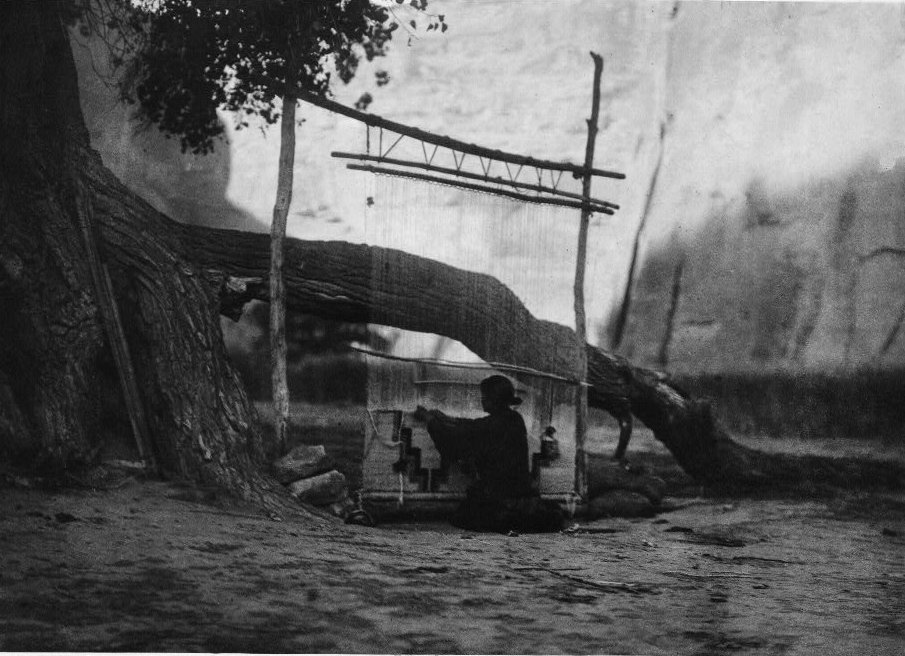
Long before the first English fulling mill, the peoples of North America were spinning, twining, and weaving cloth from cotton, bark, nettle, feathers, and shell. Their textiles clothed families, honored the dead, sealed agreements, and carried knowledge across generations, and their makers' descendants carry the work forward today.
The oldest surviving cloth in North America did not come from Europe. In a Florida peat pond near present-day Titusville, archaeologists at the Windover site recovered twined and plain-woven fabrics buried with the dead in the mid-sixth millennium BCE, roughly seven and a half thousand years ago. In the millennia that followed, textile knowledge took regionally distinct forms. In the Southwest, cotton carried north from Mesoamerica was being woven in Ancestral Pueblo communities by about 900 CE, and by the thirteenth century Pueblo farmers in present-day New Mexico grew it and wove it on upright looms. In the Eastern Woodlands, weavers processed the inner bark of basswood and the stalks of dogbane and nettle into cordage, bags, and finger-woven sashes. At Spiro, in present-day Oklahoma, Mississippian-era burials preserved feathered cloaks and lace-like openwork of extraordinary complexity. None of this was a prelude to American textile history; it is its first chapter. Colonization disrupted these traditions, sometimes with deliberate violence, but it did not end them. Hopi, Diné, Haudenosaunee, Choctaw, and many other weavers continue to practice them, and archaeologists increasingly work alongside them to read the evidence.
Part 3Timeline
Students write one sentence on why each event mattered.
- c. 5400 BCE
The Windover Textiles
Mourners at a Florida pond cemetery wrap their dead in twined and plain-woven plant-fiber cloth, the oldest textiles yet recovered in North America.
- c. 700–950 CE
Cotton Moves North
A drought-hardy cotton, Gossypium hopi, reaches the plateau country north of the Mogollon Rim; the earliest cotton textiles of the northern Southwest come from sites such as Antelope House in Canyon de Chelly.
- c. 900–1400 CE
Spiro Flourishes
Spiro, in present-day eastern Oklahoma, rises as a Mississippian civic-ceremonial center whose Craig Mound will preserve the richest prehistoric textile collection in the Southeast.
- 1150–1300 CE
The Cedar Mesa Cotton Industry
Cotton weaving burgeons across northeastern Arizona and southeastern Utah; textile patterns migrate onto painted pottery and kiva murals.
- 1598
Churro Sheep Arrive
Juan de Oñate's colonizing expedition brings churra sheep up the Camino Real de Tierra Adentro; within a century their wool enters Pueblo and Diné looms.
Part 4Key terms
- Twining (answer D)
- A way of making cloth or baskets by twisting two or more threads around a set of fixed threads, used in North America thousands of years before loom weaving.
- Backstrap loom (answer C)
- A simple loom stretched between a fixed post and a strap around the weaver's back; the weaver controls tension by leaning forward or back.
- Cordage (answer E)
- String, rope, or thread made by twisting plant or animal fibers together; the starting point for nets, bags, and woven cloth.
- Churro sheep (answer B)
- A hardy breed of sheep brought north from Mexico by Spanish colonists in 1598 whose wool became central to Pueblo and Diné weaving.
- Oral tradition (answer A)
- Knowledge, history, and teachings passed down by speaking and demonstration rather than writing.
Part 5Primary source workshop
These excerpts are quoted word for word, including the spelling and language of their time.
Document A
Relación del Suceso (Account of the Coronado Expedition)
Anonymous member of the Coronado expedition; translated by George Parker Winship, c. 1540s (translation published 1896)
The villages are somewhat larger than those of Cibola, and in other respects, in food and everything, they are of the same sort, except that these raise cotton. ... They came out to meet us peacefully, although it would have been easy to decline to do this and to have stayed on their rock, where we would not have been able to trouble them. They gave us cloaks of cotton, skins of deer and of cows, and turquoises, and fowls and other food which they had, which is the same as in Cibola.
Context: An unnamed soldier on Francisco Vázquez de Coronado's 1540–1542 expedition describes the province of Tuzan (the Hopi villages) and the mesa-top pueblo of Acuco (Acoma). It is among the earliest written evidence of Pueblo cotton farming and weaving, but it comes from an invading army that went on to demand food and cloth from Pueblo towns.
Source: George Parker Winship, ed. and trans. The Coronado Expedition, 1540–1542: Translations (Fourteenth Annual Report of the Bureau of Ethnology). Government Printing Office (via Wikisource). 1896. https://en.wikisource.org/wiki/The_Coronado_expedition,_1540-1542/Translations
- Historical context
- What was happening when and where this was created?
- Intended audience
- Who was meant to read, hear, or see it?
- Purpose
- Why was it created? What did its creator want to happen?
- Point of view
- Whose perspective does it show, and whose is missing?
Document B
A Briefe and True Report of the New Found Land of Virginia
Thomas Harriot, 1588
There is a kind of grasse in the countrey vppon the blades where of there groweth very good silke in forme of a thin glittering skin to bee stript of. It groweth two foote and a halfe high or better: the blades are about two foot in length, and half inch broad. ... Here of if it be planted and ordered as in Persia, it cannot in reason be otherwise, but that there will rise in shorte time great profite to the dealers therein ... Although notwithstanding there is great store thereof in many places of the countrey growing naturally and wilde.
Context: Harriot, a scientist on Sir Walter Raleigh's 1585 Roanoke expedition, catalogued the plants of coastal Carolina Algonquian country to attract English investors. His "silk grass," probably a native yucca, was a fiber plant Native people of the region already knew; Harriot frames it mainly as a future export commodity.
Source: Thomas Harriot. A Briefe and True Report of the New Found Land of Virginia. Documenting the American South, University of North Carolina at Chapel Hill. 1588. https://docsouth.unc.edu/nc/hariot/hariot.html
- Historical context
- What was happening when and where this was created?
- Intended audience
- Who was meant to read, hear, or see it?
- Purpose
- Why was it created? What did its creator want to happen?
- Point of view
- Whose perspective does it show, and whose is missing?
Document C
Navajo Weavers
Washington Matthews, 1884
It is by no means certain, still there are many reasons for supposing, that the Navajos learned their craft from the Pueblo Indians, and that, too, since the advent of the Spaniards; yet the pupils, if such they be, far excel their masters to-day in the beauty and quality of their work. ... Cotton, which grows well in New Mexico and Arizona, the tough fibers of yucca leaves and the fibers of other plants, the hair of different quadrupeds, and the down of birds furnished in prehistoric days the materials of textile fabrics in this country. While some of the Pueblos still weave their native cotton to a slight extent, the Navajos grow no cotton and spin nothing but the wool of the domestic sheep, which animal is, of course, of Spanish introduction, and of which the Navajos have vast herds.
Context: Matthews, an Army surgeon and ethnographer, studied Diné (Navajo) weaving for the Smithsonian's Bureau of Ethnology. His report is a late outsider's view, written long after 1600, and his theory of Pueblo origins differs from Diné oral tradition, which credits Spider Woman with teaching weaving.
Source: Washington Matthews. Navajo Weavers (Third Annual Report of the Bureau of Ethnology, 1881–82). Smithsonian Institution (via Project Gutenberg). 1884. https://www.gutenberg.org/ebooks/17742
- Historical context
- What was happening when and where this was created?
- Intended audience
- Who was meant to read, hear, or see it?
- Purpose
- Why was it created? What did its creator want to happen?
- Point of view
- Whose perspective does it show, and whose is missing?
Corroborate
Compare "Relación del Suceso (Account of the Coronado Expedition)" (Anonymous member of the Coronado expedition; translated by George Parker Winship, c. 1540s (translation published 1896)) with "A Briefe and True Report of the New Found Land of Virginia" (Thomas Harriot, 1588). Where do they agree, where do they differ, and what might explain the differences?
Part 6Discuss
- According to the Relación del Suceso, what did the people of Tuzan and Acuco grow and wear, and what did they give the Spanish when the expedition arrived?
- Thomas Harriot described silk grass as a source of "great profite to the dealers therein." What does his word choice reveal about why he was writing and who his readers were, and what does it leave out about the people who already used the plant?
- Washington Matthews wrote in 1884, nearly three centuries after Spanish sheep arrived. Which of his claims can be used as evidence about textile life before 1600, and which cannot? Explain your reasoning.
- Today Hopi, Diné, and other Native weavers and scholars work with museums to interpret ancestral textiles. Should Indigenous communities have the final word on how these traditions are presented in an exhibit like this one? Defend your position using these documents.
Part 7Write: claim, evidence, reasoning
Answer the guiding question in one paragraph, using the documents and the reading.
| Claim | Answers the guiding question directly in one or two sentences. |
|---|---|
| Evidence | Cites at least two primary sources by name and at least one fact from the reading. |
| Reasoning | Explains how each piece of evidence supports the claim. |
| Sourcing | Notes at least one limitation of a source: who made it, when, and why. |
Part 8Exit ticket
- In one sentence, how would you answer the guiding question now?
- What piece of evidence would most change your mind?
Keep exploring
- Innovation
Cotton on the Mesa
Ancestral Pueblo and Hopi weavers, and a fiber grown in the desert for centuries before Europeans arrived.
https://www.threadingamerica.com/topics/ancestral-pueblo-cotton
- Innovation
The Diné Loom
How the Diné made the Pueblo upright loom and Spanish sheep into one of the world's great weaving traditions.
https://www.threadingamerica.com/topics/dine-loom-and-churro
- Material Culture
Bark, Nettle, Feather, and Shell
Eastern Woodlands finger-weaving, the lace of Spiro, and why wampum is not cloth money.
https://www.threadingamerica.com/topics/woodlands-fiber-and-spiro
- Tragedy
The Long Walk and the Trading Post
1863 to the 1930s: how conquest, confinement, and federal policy reshaped Diné weaving.
https://www.threadingamerica.com/topics/long-walk-and-the-trading-post