Threading America · Teacher edition · Chapter 12
The Ashes of New York
Triangle Shirtwaist and the Birth of American Safety Law · 1911
Guiding question
Was the Triangle fire an accident, a crime, or the predictable result of how the garment industry worked?
Teacher notes
Objectives
Students will be able to:
- Place the chapter's key events, from 1909 to 1914, in order and explain why each mattered.
- Analyze 2 primary sources for context, audience, purpose, and point of view.
- Use the chapter's vocabulary accurately: Shirtwaist, Fire code, Factory Investigating Commission, Women's Trade Union League, Workers' compensation.
- Write an evidence-based argument that answers the guiding question.
AP U.S. History
Period 7 (1890–1945)
Standards
| Framework | Code | Students |
|---|---|---|
| C3 Framework | D2.His.1.9-12 | Explain how events were shaped by their time and place and by broader historical contexts. |
| C3 Framework | D2.His.4.9-12 | Analyze the factors that shaped people's perspectives in different eras. |
| C3 Framework | D2.His.10.9-12 | Identify the limitations of different kinds of historical evidence. |
| C3 Framework | D2.His.16.9-12 | Integrate evidence from multiple sources into a reasoned argument about the past. |
| Common Core | RH.9-10.1 / RH.11-12.1 | Cite specific textual evidence from primary and secondary sources. |
| Common Core | RH.9-10.4 / RH.11-12.4 | Determine the meaning of words and phrases as used in historical texts. |
| Common Core | RH.9-10.6 / RH.11-12.6 | Compare and evaluate authors' points of view on the same events. |
| Common Core | WHST.9-10.1 / WHST.11-12.1 | Write arguments focused on discipline-specific content. |
Pacing
Day 1 (50 minutes)
- 5 minBefore you read: guiding question and predictions
- 15 minReading and timeline
- 25 minPrimary source workshop (2 sources)
- 5 minExit ticket
Day 2 (50 minutes)
- 5 minKey terms matching
- 20 minCorroboration and discussion questions
- 25 minClaim, evidence, reasoning paragraph
Teaching hard history
- Never use role-play or simulations of slavery, violence, or other atrocities. Ask students to analyze the testimony and documented choices of real people instead.
- Pair the voices of the people who did the work (enslaved people, children, strikers, immigrants) with the voices of those who profited, and ask whose records survived and why.
- Primary sources are reproduced word for word, including period language and dialect transcribed by interviewers. Before reading, discuss who recorded each source and for whom. Do not ask students to perform dialect aloud.
- Tell students before they see images of injured, captive, or dead people, and give them a way to step back.
- Distinguish what the sources show from what they cannot prove. Several stories in this exhibit correct popular myths; name the myth, then the evidence.
Guidance follows Learning for Justice, "Teaching Hard History: American Slavery" (Southern Poverty Law Center, 2018).
Answer key: key terms
Shirtwaist: A · Fire code: C · Factory Investigating Commission: B · Women's Trade Union League: E · Workers' compensation: D
Part 1Before you read
- Read the guiding question. Write down what you already know, or think you know, about it.
- Predict one way your answer might change after reading the sources.
Part 2Read
The deadliest workplace disaster in New York City history changed the relationship between government and the workplace. One Saturday afternoon in March, 146 people died in about eighteen minutes.
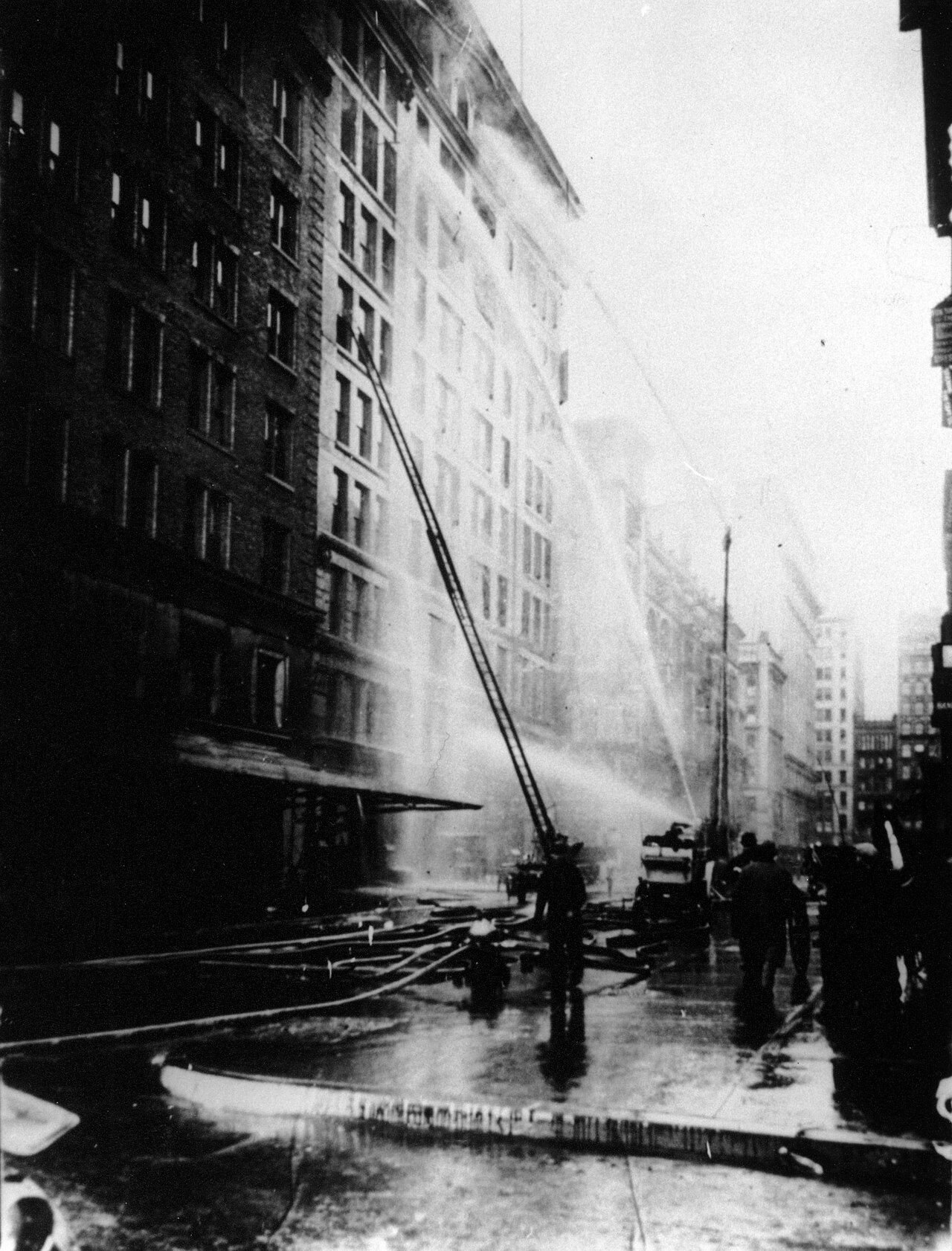
On March 25, 1911, fire broke out on the eighth floor of the Asch Building near Washington Square, where the Triangle Waist Company occupied the top three floors. Fed by cotton scraps and tissue, it spread within minutes. A door to one of the ninth-floor stairways was locked—a practice, the owners' critics charged, meant to prevent theft and to control workers' comings and goings. The single exterior fire escape twisted and collapsed under the weight of those who reached it, and fire department ladders could not reach the upper floors. Within about eighteen minutes, 146 workers—most of them young Jewish and Italian immigrant women, the youngest fourteen years old-were dead. The tragedy galvanized a generation of reformers and produced the New York State Factory Investigating Commission, chaired by state senator Robert F. Wagner with Assemblyman Alfred E. Smith as vice-chair, whose work helped lay the political foundation for the New Deal.
Part 3Timeline
Students write one sentence on why each event mattered.
- 1909
The Uprising of the 20,000
Triangle is among the shirtwaist firms that refuse to settle on the union's terms during the general strike.
- 1911
The Fire
On March 25, 146 workers die at the Triangle Waist Company; most are young immigrant women.
- 1911
The Factory Investigating Commission
In the summer of 1911, New York creates a state commission that, through 1915, conducts the most ambitious workplace-safety investigation in American history to that time.
- 1914
The Reform Wave
Building on the commission's work, the legislature enacts some thirty-six laws, mostly between 1912 and 1914, on fire safety, factory sanitation, and the labor of women and children.
Part 4Key terms
- Shirtwaist (answer A)
- A woman's tailored blouse, hugely popular in the early 1900s and mass-produced in New York factories.
- Fire code (answer C)
- Laws that set safety requirements for buildings, such as exits, sprinklers, and fire escapes.
- Factory Investigating Commission (answer B)
- A New York State commission created after the fire that inspected workplaces and led to dozens of new safety and labor laws.
- Women's Trade Union League (answer E)
- An organization of working-class and wealthy women, founded in 1903, that helped women workers form unions.
- Workers' compensation (answer D)
- Insurance, required by law, that pays workers who are injured on the job or the families of those killed.
Part 5Primary source workshop
These excerpts are quoted word for word, including the spelling and language of their time.
Document A
Eyewitness at the Triangle
William G. Shepherd, United Press, March 25, 1911 (published March 27, 1911)
The firemen raised the longest ladder. It reached only to the sixth floor. I saw the last girl jump at it and miss it. ... The floods of water from the firemen's hose that ran into the gutter were actually stained red with blood. I looked upon the heap of dead bodies and I remembered these girls were the shirtwaist makers. I remembered their great strike of last year in which these same girls had demanded more sanitary conditions and more safety precautions in the shops. These dead bodies were the answer.
Context: Shepherd, a reporter who happened to be in Washington Square, phoned in this account as the fire burned; it was telegraphed to newspapers nationwide. It was many Americans' first picture of the disaster that killed 146 garment workers.
Source: William G. Shepherd. Eyewitness at the Triangle, by William Shepherd (from Leon Stein, ed., Out of the Sweatshop, 1977). Kheel Center, Cornell University ILR School. 1911. https://trianglefire.ilr.cornell.edu/primary/testimonials/ootss_WilliamShepherd.html
- Historical context
- What was happening when and where this was created?
- Intended audience
- Who was meant to read, hear, or see it?
- Purpose
- Why was it created? What did its creator want to happen?
- Point of view
- Whose perspective does it show, and whose is missing?
Document B
Speech at the Triangle Fire Memorial Meeting
Rose Schneiderman, April 2, 1911
I would be a traitor to these poor burned bodies if I came here to talk good fellowship. We have tried you good people of the public and we have found you wanting. ... This is not the first time girls have been burned alive in the city. Every week I must learn of the untimely death of one of my sister workers. Every year thousands of us are maimed. The life of men and women is so cheap and property is so sacred. There are so many of us for one job it matters little if 146 of us are burned to death. ... I know from my experience it is up to the working people to save themselves. The only way they can save themselves is by a strong working-class movement.
Context: Schneiderman, a Women's Trade Union League organizer and former garment worker, spoke at the Metropolitan Opera House at a meeting called by civic leaders. Her speech, printed in The Survey, became one of the most quoted statements of the American labor movement.
Source: Rose Schneiderman. We Have Found You Wanting, by Rose Schneiderman (The Survey, April 8, 1911). Kheel Center, Cornell University ILR School. 1911. https://trianglefire.ilr.cornell.edu/primary/testimonials/ootss_RoseSchneiderman.html
- Historical context
- What was happening when and where this was created?
- Intended audience
- Who was meant to read, hear, or see it?
- Purpose
- Why was it created? What did its creator want to happen?
- Point of view
- Whose perspective does it show, and whose is missing?
Corroborate
Compare "Eyewitness at the Triangle" (William G. Shepherd, United Press, March 25, 1911 (published March 27, 1911)) with "Speech at the Triangle Fire Memorial Meeting" (Rose Schneiderman, April 2, 1911). Where do they agree, where do they differ, and what might explain the differences?
Part 6Discuss
- What details in Shepherd's account show that the fire department's equipment could not save the workers?
- Schneiderman spoke to a mostly wealthy audience at a memorial meeting a week after the fire. Why does she refuse to "talk good fellowship," and what does she demand instead?
- Shepherd connects the dead to the 1909 strike. How does the chapter narrative support or complicate his claim that "These dead bodies were the answer"?
- Schneiderman argued that workers must "save themselves" through a strong labor movement; New York responded mainly by passing safety laws. Which approach better protects workers today, in warehouses here or garment factories abroad? Argue your position.
Part 7Write: claim, evidence, reasoning
Answer the guiding question in one paragraph, using the documents and the reading.
| Claim | Answers the guiding question directly in one or two sentences. |
|---|---|
| Evidence | Cites at least two primary sources by name and at least one fact from the reading. |
| Reasoning | Explains how each piece of evidence supports the claim. |
| Sourcing | Notes at least one limitation of a source: who made it, when, and why. |
Part 8Exit ticket
- In one sentence, how would you answer the guiding question now?
- What piece of evidence would most change your mind?
Keep exploring
- Tragedy
The Acquittal of Blanck and Harris
The 'Shirtwaist Kings' walked free.
https://www.threadingamerica.com/topics/blanck-and-harris-trial
- Biography
Frances Perkins: The Witness Who Built the New Deal
A young reformer watched the fire and helped remake American government.
https://www.threadingamerica.com/topics/frances-perkins-witness
- Biography
Clara Lemlich, Two Years Earlier
The warning the industry refused to hear.
https://www.threadingamerica.com/topics/clara-lemlich
Places: New York